
Real estate display ads achieve a 1.08% click-through rate — the highest of any industry on the Google Display Network, more than double the cross-industry average of 0.46%. That's not a coincidence. Real estate is one of the most emotionally charged, visually driven purchase decisions a person will ever make, and display advertising is uniquely positioned to capture that attention.
Yet most real estate professionals are still running the same forgettable banner ads they were running five years ago: a stock photo of a house, a phone number, and "Call Us Today." That approach leaves serious performance on the table. This post breaks down what separates high-converting real estate display ads from the rest — including the five ad types that work, the best practices behind them, the mistakes to avoid, and how to build them at scale.
Why Display Ads Work for Real Estate
Real estate is a long-cycle, high-consideration purchase. Buyers typically browse for weeks or months before they're ready to contact an agent. That extended window is a major opportunity for display advertising — not to generate an immediate conversion, but to stay visible and relevant throughout the entire decision process.
The medium is also a natural fit for the product. Properties are inherently visual. A well-composed photo of a sun-lit kitchen or a sweeping backyard can create emotional pull that text alone never could. Display ads let you put those images in front of the right audience, in the right geography, at the right moment.
Targeting capabilities make this even more powerful. Geo-targeting by zip code or neighborhood lets agents and agencies serve hyper-local ads to buyers actively researching specific areas. Life event targeting — reaching people who just got married, accepted a new job, or recently had a child — allows you to find buyers before they've even started actively searching.
Retargeting is where real estate display really excels. Visitors who've already browsed a listing or used a home search portal are warm. According to Improvado's display ad benchmarks, retargeting warm audiences achieves 2–3x higher conversion rates than prospecting campaigns. Showing a past visitor the exact listing they viewed — or similar properties nearby — is one of the highest-ROI tactics available to real estate marketers today.
With U.S. digital ad spend projected to reach $413.24 billion by 2026, the competition for digital attention is intensifying. Real estate professionals who build a disciplined display strategy now will have a measurable advantage.
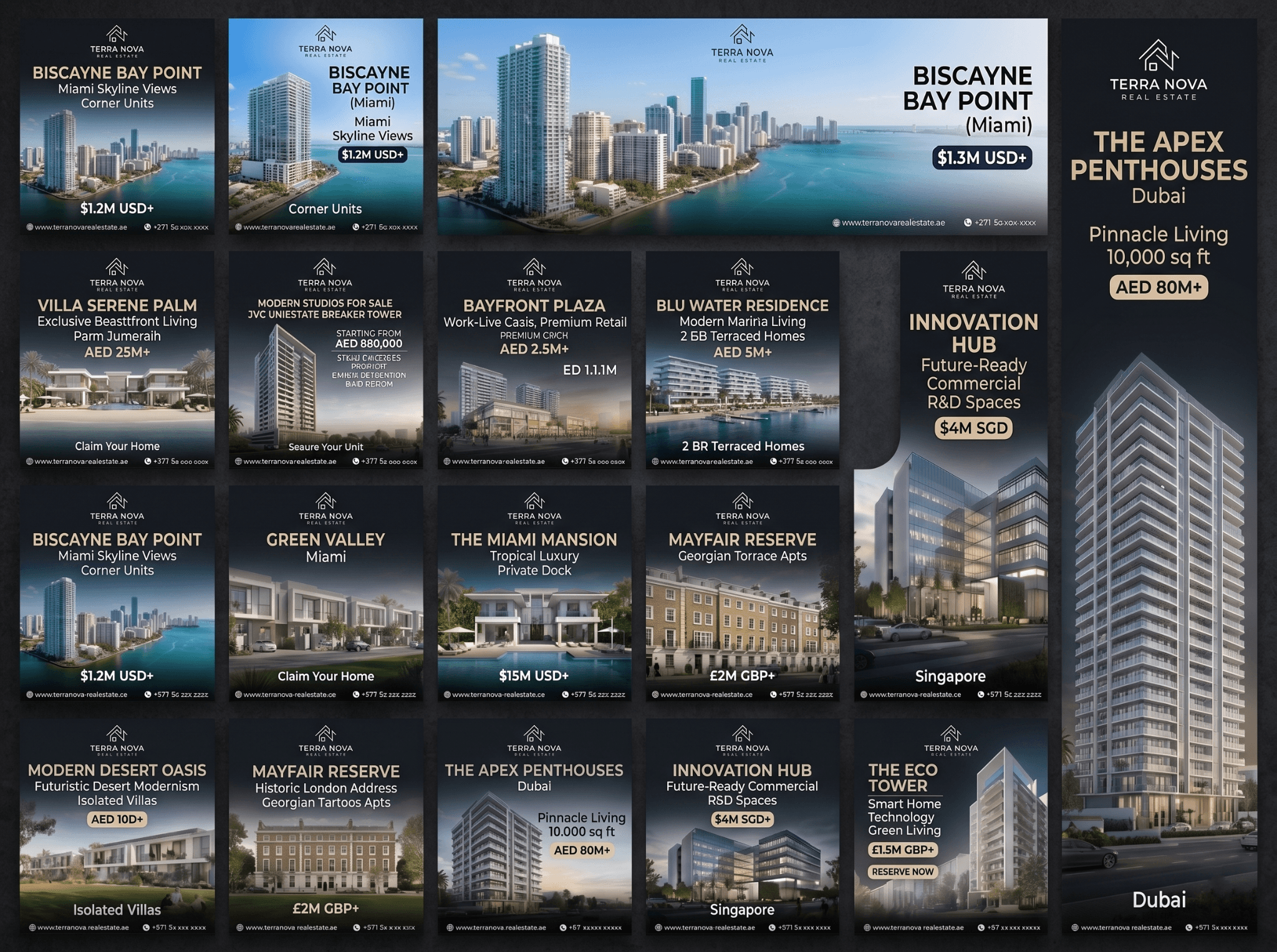
5 Types of Real Estate Display Ads That Convert
Not all real estate display ads serve the same purpose. The five types below cover the full funnel — from awareness to urgency-driven action — and each has a distinct use case.
1. Property Listing Showcase Ads
The most common format, and when done right, the most effective. A listing showcase ad leads with a full-bleed hero photo of the property — ideally the most compelling exterior or interior shot — paired with the essentials: listing price, bedroom/bathroom count, square footage, and neighborhood or address.
Real estate banner ads in the 300×250 medium rectangle and 728×90 leaderboard formats are the two most widely supported sizes on the Google Display Network and perform best for this format. Your CTA should be specific: "View This Home" or "Schedule a Tour" outperforms the generic "Learn More" in every A/B test.
High-quality photography is non-negotiable. A dark, poorly framed photo will generate impressions but kill clicks. Professional real estate photography pays for itself in ad performance alone.
2. "Just Sold" Social Proof Ads
Seller lead generation requires a different creative approach. Rather than showcasing an available listing, a "Just Sold" ad highlights a recent transaction: the property photo, the sale price, and a stat like "Sold in 9 Days" or "Sold 7% Over Asking."
These ads serve two purposes simultaneously. They demonstrate the agent's ability to close deals — building credibility with prospective sellers — and they create a retargeting touchpoint for homeowners in the same neighborhood who are considering listing. The implied message is simple: this agent gets results in your area.
Run these ads as neighborhood-targeted campaigns immediately after closing. The recency and local relevance make them disproportionately effective.
3. Open House Urgency Ads
Open house ads are inherently time-sensitive, and that urgency should show in the creative. The most effective versions include an animated countdown element — days and hours until the event — alongside the property photo, date, time, and address.
Animation is particularly valuable here. Dynamic creative ads achieve 54% higher CTR than static equivalents, and the movement of a countdown timer naturally draws the eye in a busy page environment. These ads should run with frequency capping to avoid overexposure in the days leading up to the event, and they should be pulled immediately after the open house concludes.
Use retargeting lists of past portal visitors or neighborhood homeowners for the most relevant reach.
4. Home Valuation / Market Report Lead Gen Ads
Top-of-funnel lead generation for sellers starts with value, not a pitch. A home valuation ad offers something concrete — "Find Out What Your Home Is Worth" or "Get Your Free Market Report" — in exchange for contact information.
These ads work best when paired with a dedicated landing page (not a generic homepage) that delivers on the promise immediately. The creative itself should be clean and benefit-forward: the headline carries the offer, the visual is a local neighborhood or property aesthetic, and the CTA is a single clear action.
This format is ideal for building seller pipelines months before those leads are ready to list. The offer provides genuine utility, which earns trust faster than promotional messaging ever will.
5. Neighborhood Lifestyle Ads
Sometimes the strongest real estate ad doesn't feature a property at all. Neighborhood lifestyle ads sell the area — parks, restaurants, school ratings, commute times, community character — to buyers who are still deciding where they want to live.
These are especially effective for relocation buyers or buyers expanding their geographic search. A series of ads showcasing different neighborhoods within a target market builds brand authority and positions the agent or brokerage as the local expert, not just a listing database.
This format works best in awareness campaigns targeting broad geographic audiences or in-market buyers early in their search. Pair it with retargeting campaigns featuring specific listings once the buyer has engaged.
Real Estate Display Ad Best Practices
Following the right format is only half the equation. These practices determine whether your ads generate clicks or get scrolled past.
Use professional photography on every ad. This cannot be overstated. The image is the ad. A well-lit, professionally composed property photo does more work than any headline or CTA combination. Never substitute with generic stock photography of houses — buyers recognize inauthenticity immediately.
Include specific details. Price, address or neighborhood, beds, baths, square footage. Buyers who see a 3BR/2BA at $485,000 in their target neighborhood will click. Buyers who see "Beautiful Home Available" will not.
Geo-target by zip code and neighborhood. Broad geographic targeting wastes budget. Serving a listing ad to someone 40 miles away with no interest in that area burns impressions. The tighter the geographic targeting, the higher the relevance — and the better the CTR.
Retarget portal visitors with dynamic ads. Someone who spent time on your website browsing listings is already interested. Showing them a display ad featuring the exact property they viewed — or comparable listings — is one of the highest-leverage moves in real estate digital marketing. Retargeting warm audiences achieves 2–3x higher conversion rates than cold prospecting.
Design mobile-first. More than 60% of property searches happen on mobile devices. Your 300×250 and 320×50 ad units need to read clearly on a small screen, with a tap target that's large enough to register. Text that's legible on desktop can be completely unreadable on mobile at banner scale.
A/B test lifestyle imagery versus property-focused imagery. Some audiences respond to photos of the property itself; others respond to the lifestyle it represents — the neighborhood coffee shop, the proximity to a park, the walkable street. Test both, and let data decide.
Use animated HTML5 banners to showcase multiple perspectives. A single-frame static ad can only show one angle. Using an animated banner maker or HTML5 ad builder, you can cycle through the kitchen, the master suite, the backyard, and the street view in a single ad unit — giving buyers a richer sense of the property without requiring a click.
Maintain brand consistency across all agents. For brokerages and agencies managing multiple agents, inconsistent branding undermines credibility. Standardized banner ad templates with locked logo placement, color palette, and typography ensure every ad looks like it came from the same professional organization.
Common Mistakes to Avoid
Even well-intentioned real estate advertisers make display ad design mistakes that undercut performance.
Too much text in small ad units. A 300×250 banner is not a flyer. Cramming a headline, subheadline, three bullet points, a disclaimer, and a CTA into a small format produces visual noise, not communication. Prioritize one message, one image, one action.
Generic stock photography. A photo of a smiling family in front of a white colonial is not your listing. Buyers know it. Stock imagery signals low effort and erodes trust — the exact opposite of what real estate marketing requires.
Vague or weak CTAs. "Learn More" tells the buyer nothing about what happens next. "See This Home," "Book a Tour," or "Get Your Home Value" are specific, benefit-oriented, and set clear expectations. Specificity drives clicks.
Ignoring dynamic creative for multi-listing campaigns. Agents and agencies with large listing portfolios who run a single static ad for every property are missing a major efficiency gain. Dynamic creative tools automatically generate individual ad variations for each listing from a product feed, maintaining relevance at scale without manual creative production for every new property.
Not using frequency capping. Running the same ad to the same person five times a day is not persistence — it's ad fatigue. Frequency capping limits overexposure, protects brand perception, and ensures your budget reaches more unique users rather than saturating a small audience repeatedly.
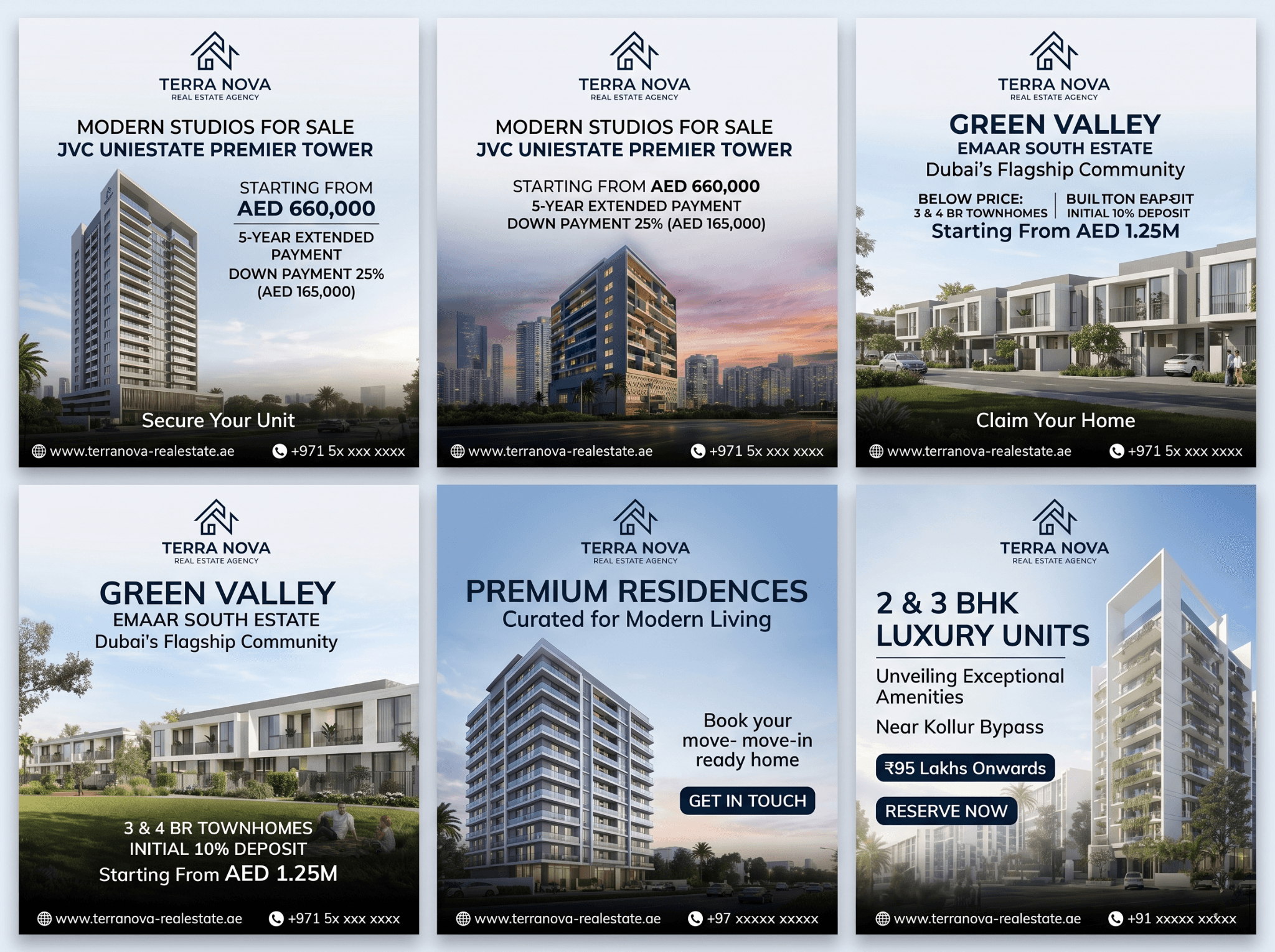
How to Build Real Estate Display Ads at Scale with Viewst
The biggest challenge for real estate marketers isn't knowing what to create — it's producing enough variations, fast enough, to keep pace with an active listing portfolio. A busy agent or brokerage may add dozens of new listings a month, each requiring ads in five or more sizes across multiple platforms.
Viewst is a display ad builder purpose-built for this kind of volume. Here's how it addresses the real estate scale problem:
• Start from professional templates. Viewst's template library includes real estate-specific layouts optimized for standard ad formats — 300×250, 728×90, 160×600, 320×50, and more — so you're not building from a blank canvas.
• Upload your listing catalog via CSV product feed. Viewst reads your listing data and automatically generates HTML5 ad variations for every property — photo, price, specs, CTA — without manual design work per listing.
• Auto-resize one master creative into all standard sizes. Design once, export everywhere. Viewst's multi-size engine adapts your master creative to every required format while preserving layout integrity.
• Maintain brand consistency across agent teams. Shared brand books lock in logos, colors, and fonts so every agent's ads look professional and on-brand, regardless of who created them.
• Generate AI content variations for A/B testing. Test different headlines, CTAs, and copy angles automatically without duplicating creative work.
• Publish directly to Google Ads and Meta Ads Manager. No file export, no manual upload loop. Go from creative to live campaign in minutes.
No code required. No design skills needed.
Conclusion
Real estate display ads outperform every other industry for a reason: the product is inherently visual, the purchase cycle is long, and buyers are passively open to influence throughout their search. Combine professional property photography, precise geographic and behavioral targeting, and smart creative automation, and you turn passive browsers into active, qualified leads.
The agents and brokerages pulling ahead in digital right now aren't spending more — they're creating better ads, faster, and running them smarter. That's the standard worth building toward.
Ready to Build Real Estate Display Ads That Convert?
Viewst makes it easy to create professional, animated HTML5 display ads — without writing a single line of code. With real estate templates, automatic multi-size resizing, CSV listing feed integration, and built-in team collaboration, you can go from concept to live campaign faster than ever.

Steven Khuong is a GTM strategist and advisor focused on helping companies scale creative production and advertising systems using AI and automation. He has led growth initiatives across high-volume digital platforms, with a focus on turning fragmented creative workflows into structured, scalable systems that drive faster campaign execution and performance.
In this article
" height="11.060000000000002px" id="wzBCZ87AK" transform="translate(6.47 2.47)" width="6.590000000000003px"/></g></svg>)