

Two Enterprise Platforms, Two Different Mandates
Both Viewst and Celtra serve enterprise marketing teams producing ads at scale. Both justify the investment. But they are solving for different problems, and choosing the wrong one is an expensive mistake.
Viewst is a creative production platform. Its mandate is to take a brief and turn it into a hundred on-brand, ad-network-ready creatives as fast as possible — with strong AI assistance, designer-grade control, and zero developer dependency. It wins on speed, brand governance, and production cost.
Celtra is a creative operations backbone for organizations with sophisticated programmatic requirements: Dynamic Product Ads with rule-based logic, rich media interactive formats, direct DSP integrations, and campaign-level QA. It wins on the delivery and optimization side of the house.
Most teams do not need Celtra's infrastructure. For those that do, it is worth every dollar. The question is whether your team is one of them.
Quick Comparison
Capability
Viewst
Celtra
Brand Library / Brand Books
Yes — Brand Kits with locked assets
No native brand library
Ad Account Integration
Plug-and-play (Meta, Google) — no dev required
Requires custom development or API setup
Native AI Tools
Copy, image generation, banner generation, translation — built into editor
Limited native AI; data-driven optimization focused
Animation Timeline
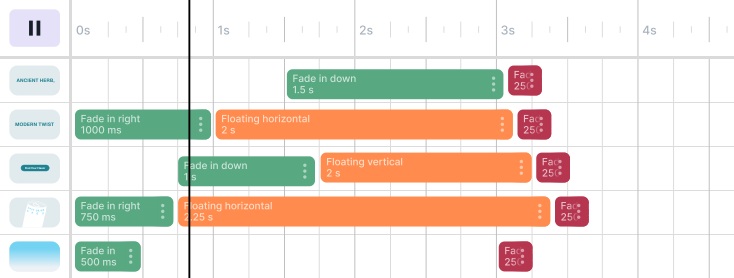
Full keyframe editor per layer
Drag-and-drop editor; animation available
Rich Media / Interactive Ads
Standard HTML5 display; custom HTML/CSS/JS embeddable
Purpose-built for rich media, Creative JS API
Dynamic Creative Optimization
Feed-based bulk variant generation via CSV/URL
Full DCO platform with in-platform feed editing and rule logic
DSP / Ad-Server Delivery
Meta push, webhooks, network-ready exports
DV360, The Trade Desk, tag macros, third-party pixels
Analytics
Creative-level with ad-account sync (Premium)
Load, render, error rates; campaign-level QA
Pricing Model
Seat-based, predictable — unlimited exports
Seats plus creative export volume — can escalate at scale
SSO
Okta / SAML
OAuth2 / OIDC
Where Viewst Is the Stronger Choice
Brand governance without a brand library is not brand governance
Celtra does not offer a native brand book or centralized content library. Viewst's Brand Kits store logos, colors, typography, and components in a single source of truth that every template inherits. Combined with per-layer template permissions — locking specific elements while leaving others editable — Viewst gives Creative Directors more control over distributed teams than Celtra's template-based guardrails provide.
No developer required
Setting up Celtra integrations with DSPs and ad servers typically requires custom development. For teams without dedicated ad-ops engineers, this is a real barrier. Viewst's ad account integrations with Meta and Google are plug-and-play. Teams push finished creative directly to their campaigns without writing a line of code or waiting on a technical resource.
First-party AI across the full production workflow
Viewst integrates AI copy generation, image creation, full banner generation from text prompts, and multi-language translation directly into the editor. Celtra's automation is largely data-driven and template-based rather than generative. For teams that use AI to accelerate the ideation and production phases — not just the trafficking phase — Viewst's AI suite has no equivalent in Celtra.
Pricing that does not punish scale
Viewst charges per seat with unlimited exports. A team producing 2,000 creatives a month pays the same as a team producing 200. Celtra's pricing combines seat costs with creative export volume, which can escalate significantly for high-output production operations. For teams running this analysis at scale, the total cost of ownership difference can be substantial.
Where Celtra Is the Stronger Choice
Complex Dynamic Product Ads with rule-based logic
Celtra's DCO engine is best-in-class for DPA campaigns. Enriched templates support per-SKU rules: conditional badges, promotional frames, video overlays, and copy logic that changes based on product attributes. In-platform feed editing means teams can update pricing, copy, and imagery without re-uploading. If your strategy centers on sophisticated product catalog advertising, Celtra is built for it in a way Viewst is not yet.
Rich media and interactive ad formats
Viewst produces standard HTML5 display creative with custom HTML, CSS, and JavaScript embeddable for advanced executions. Celtra's Creative JS API supports fully bespoke interactive ad behaviors — expandable panels, interactive product viewers, video integration within banners. For campaigns where rich media formats are a core creative requirement, Celtra's infrastructure handles complexity that Viewst was not built to manage.
Direct DSP connections and campaign-level QA
Celtra connects directly to DV360, The Trade Desk, and Google Ad Manager with auto-populated tag macros and third-party tracking pixels. Teams can validate creative behavior, load times, and rendering before launch through Celtra's campaign-level QA tools. For large programmatic operations where trafficking accuracy matters, this integration depth is a meaningful advantage.
The Decision Framework
The clearest way to choose: where does your production break down today?
If the answer is 'we cannot produce enough on-brand creative fast enough, and our designers are stuck manually resizing and tweaking,' Viewst solves that problem directly and immediately.
If the answer is 'our programmatic campaigns require dynamic product-level personalization, rich media formats, and direct DSP integration that our current tools cannot handle,' Celtra is the right infrastructure.
If the answer involves both — and it sometimes does — many enterprises run Viewst for rapid display production and a separate DCO/serving platform for programmatic creative. The tools operate cleanly in parallel.