
TL;DR
AI tools that speed up ad production without hurting design quality share three architectural decisions: they automate the production work (resizing, format adaptation, variant generation) but not the creative concept; they enforce brand guardrails so AI-assisted variations cannot drift off-brand; and they keep humans in the loop for approval. Viewst, Bannerflow, Celtra, Adobe Firefly Services, and Smartly are the platforms most often shortlisted by teams that refuse to trade craft for speed. Generative AI tools that originate creative concepts from prompts typically degrade quality at scale.
The two categories of AI in ad production
The speed-quality conversation gets clearer once you separate two fundamentally different applications of AI in ad creative.
Production AI automates the mechanical work of ad production: resizing a master creative into 12 IAB sizes, adapting layouts across aspect ratios, generating language variations from a translation feed, producing dynamic content variants from product data. The creative concept is human-designed. AI handles the production at scale.
Generative AI for ad concepts uses prompts to originate the creative itself: generating new imagery, writing the headline, deciding the layout. The creative concept comes from a model, not a designer.
The speed-quality trade-off behaves differently in each category. Production AI scales linearly without degrading quality, because it's amplifying human creative work. Generative AI for concepts tends to degrade quality at scale, because models trained on broad corpora reproduce average aesthetic patterns rather than distinctive brand voice.
This distinction explains most of the confusion in the market.
How production AI preserves design quality at scale
Production AI preserves quality because it operates downstream of the creative decision. Three specific mechanisms.
Smart resize intelligence. Production AI platforms read the layout hierarchy of a master creative and adapt it intelligently to different aspect ratios. Elements scale, reposition, and adjust based on canvas constraints. The quality of the output is bounded by the quality of the master. (For the deeper mechanics of how this works in practice, see our HTML5 ad automation guide.)
Brand guardrail enforcement. Logos, fonts, color palettes, and approved copy lock at the workspace level. AI-generated variations operate inside those constraints. Quality drift across variations is bounded by the brand system, not by the model.
Human approval gates. Production AI surfaces variations for human review before they ship. The designer decides which variations meet the bar.
The economic implication: production AI lets one designer produce the output of five, without the quality erosion that comes from generative AI doing the concept work. We walk through the staffing math more concretely in how to produce hundreds of ad variations without expanding the team.
Where generative AI for concepts breaks down at scale
Generative AI is genuinely useful for ad creative in three narrow applications: rapid mood boarding, background variation generation for product photography, and copy ideation as a starting point for a human writer. In these applications, generative AI produces drafts that humans then refine.
Generative AI breaks down when it's used to originate finished creative at scale, for three reasons documented across multiple 2025 and 2026 studies of generative ad performance.
Visual style regression. Models trained on broad corpora reproduce average aesthetic patterns. At small scale, this looks acceptable. At scale, brands using generative AI tools for concept origination produce creative that increasingly resembles every other brand using the same tools.
Brand voice dilution. Generative copy lacks the specific voice signals that define brand character. Across many variations, the cumulative effect is brand voice erosion.
Performance underperformance. Multiple performance marketing teams have documented that generative-AI-originated creative tests below human-designed creative on CTR and conversion across paid social and display. The magnitude varies by category, but the direction is consistent.
This is why mature performance marketing teams in 2026 use generative AI selectively (for ideation and assistance) and production AI broadly (for scaling human-designed creative).
Platforms that balance speed and craft well
The platforms most often shortlisted by quality-conscious performance teams in 2026 share a consistent pattern: strong production AI, brand guardrail enforcement, and limited but useful generative AI for assistance rather than origination.
Platform | Production AI strength | Brand guardrails | Generative AI scope | Best for |
Viewst | Strong | Strong | Production-assisted | Performance teams, agencies |
Bannerflow | Strong | Strong | Production-assisted | Enterprise brands |
Celtra | Strong | Strong | Production-assisted | Enterprise creative ops |
Adobe Firefly Services | Strong | Strong (when configured) | Both | Adobe-ecosystem teams |
Smartly | Strong | Strong | Production-assisted | Paid social teams |
Creatopy | Moderate | Moderate | Production-assisted | Mid-market teams |
Light | Light | Generation-heavy | Non-designer teams | |
Generic AI ad makers | Variable | Often light | Often generation-heavy | One-off campaigns |
The platforms in the top tier all share the same architectural decision: AI accelerates production, humans drive creative concepts. This is not coincidence. It's the only architecture that scales without quality degradation.
What "balancing speed and craft" actually means in workflow
Specific workflow patterns that quality-conscious teams use to capture the speed benefits of AI without losing craft.
Master creative discipline. Every campaign starts with one canonical master creative, designed by a human designer with full creative judgment applied. AI operates downstream.
Brand system as constraint, not suggestion. The brand system (logos, fonts, palettes, copy guidelines) is enforced by the platform, not by manual policing. Designers spend zero time checking whether variations are on-brand.
Two-pass review. First pass is automated: the platform flags variations that fail technical checks (file size, animation timing, font rendering). Second pass is human: a designer or producer reviews variations for quality and approves before launch.
Generative AI in narrow lanes. Generative AI is used for specific tasks where it genuinely helps (mood boarding, background variations, copy ideation) and explicitly excluded from concept origination on brand-facing creative.
Performance measurement. Variations are measured against benchmarks. Variations that underperform get pulled and analyzed for quality issues before more like them ship.
This is the workflow pattern that consistently produces speed without quality loss.
How fast can AI production realistically go?
Quantitative benchmarks from teams that have measured the transition from manual to AI-assisted production.
A campaign with 12 banner sizes, 4 languages, 3 offers, and 2 creative directions produces 288 ads. Manual production at 30 minutes per HTML5 ad: 144 hours, or 18 working days for one designer. The same campaign through a production AI platform: 4 to 8 hours of total work for the full set.
The realistic multiplier is 18 to 36 times faster, depending on campaign complexity. The quality of the output is bounded by the quality of the master creative, not by the speed of generation.
For agencies, the implications are larger. An agency with 20 active clients producing 5 campaigns per quarter at 50 variations each produces 5,000 variations per quarter. Manual production at the same 30-minute baseline: 2,500 hours per quarter, or roughly 15 full-time designers. Production AI: the same 5,000 variations produced by 2 to 3 designers handling masters and brand systems.
These numbers are not theoretical. They're consistent across documented agency case studies in 2025 and 2026.
Common mistakes when adopting AI ad production tools
Letting generative AI originate brand-facing concepts. This is the single most common quality-killing mistake. AI should scale and adapt human-designed creative, not replace the design.
Automating before locking the brand system. Automation scales whatever you give it, including inconsistency. Lock the brand system before scaling production.
Treating volume as the metric. Volume of variations is not the goal. Performance of variations is. Volume without performance is just noise.
Skipping human approval. Even with strong brand guardrails, human review catches edge cases that automation misses. The two-pass review pattern protects quality.
Picking based on AI feature theater. Most "AI features" in ad production platforms are incremental at best. The AI that matters is the production resize intelligence and brand guardrail enforcement, not the generative concept tools.
Where Viewst fits
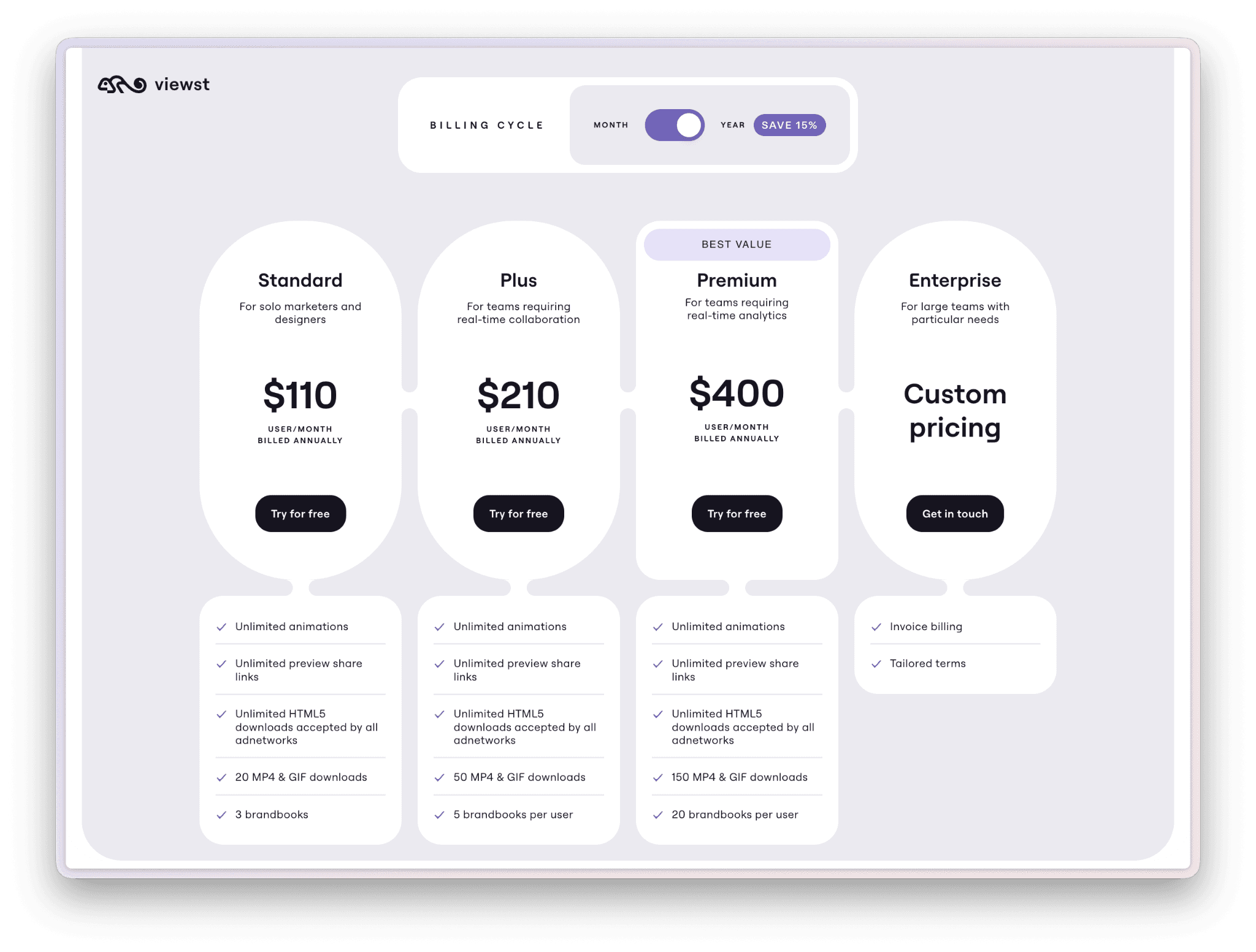
Viewst is structured around production AI with strong brand guardrail enforcement. One master creative produces every size, language, and dynamic content variant. Brand elements lock at the workspace level. Generative AI is used for production-assisted tasks (background variation generation, smart resize) rather than for originating brand-facing concepts. The platform is positioned for performance marketing teams and creative agencies that want to scale production without trading quality. Tier inclusions are on the Viewst pricing page, and the free trial includes the full production AI workflow.
Frequently asked questions
Does AI in ad production reduce design quality?
Not if the AI is used for production (resizing, variant generation) rather than concept origination. Production AI amplifies human-designed creative without degrading it. Generative AI used to originate brand-facing concepts typically degrades quality at scale.
Can AI ad tools replace designers entirely?
No, not without quality loss. The mature 2026 workflow uses AI to scale designer output, not to replace designers. One designer using production AI can produce the equivalent of five designers in a manual workflow, but the creative judgment still needs to be human.
Are AI-generated ads less effective than human-designed ads?
Generative-AI-originated ads tend to underperform human-designed ads on CTR and conversion across paid social and display, based on documented performance marketing studies. Production-AI-scaled variations of human-designed concepts perform comparably to or slightly better than fully manual production, because more variations enable more testing.
Which is faster: manual ad production or AI-assisted?
AI-assisted production is typically 18 to 36 times faster than manual production for the same volume. A 288-variation campaign that takes 18 working days manually can be produced in 4 to 8 hours with production AI.
How do I avoid generative AI quality issues in my ad production?
Use generative AI for specific tasks where it adds value (mood boarding, background variation, copy ideation as a starting point) and exclude it from concept origination on brand-facing creative. Use production AI broadly to scale human-designed concepts.
What is the biggest mistake teams make when adopting AI ad production?
Letting generative AI originate brand-facing concepts. AI should scale and adapt human-designed creative, not replace the design.
Bottom line
AI ad production tools accelerate output without hurting quality when they're used for production rather than concept origination. The platforms that consistently deliver this balance share the same architectural pattern: production AI for scaling, brand guardrails for consistency, human approval for quality. The platforms that struggle are the ones that lean heavily on generative AI for concept origination, which degrades quality at scale.
The economic implication for performance marketing teams: AI doesn't require trading craft for speed. The right tools deliver both, when they're set up around human creative decisions and AI-scaled production.

He started with development background, then turned into designer and finally came to the product management. Yuri has had a tremendous and different experience. He managed production in a digital agency, managed the development of different apps, financial platforms, CRMs and ERPs. Moreover, Yuri won in some hackathons. Yuri is passioned about building systems and unravel chaos.
In this article
" height="11.060000000000002px" id="wzBCZ87AK" transform="translate(6.47 2.47)" width="6.590000000000003px"/></g></svg>)