Choosing between creative management platforms can feel like comparing two different philosophies. The Viewst vs Celtra debate captures one of the most common tensions in modern ad production: enterprise-grade scale versus mid-market agility. Both platforms promise to accelerate creative output, reduce manual work, and keep brands consistent across channels — but they approach those goals from very different starting points.
Celtra has established itself as a creative automation powerhouse for global enterprises, powering campaigns for brands like Spotify, Adidas, and Unilever. Viewst, by contrast, is purpose-built for display ad production with transparent pricing, fast onboarding, and a self-serve model that makes it accessible to teams of almost any size.
In this guide, we compare the two platforms across six critical dimensions — creative production, animation, scaling, brand governance, ad network integration, and pricing — so you can decide which creative automation platform fits your workflow, budget, and growth trajectory.
Creative Production and Automation
At their core, both Viewst and Celtra are creative automation software tools designed to eliminate repetitive design tasks. But the scope and complexity of their production engines differ significantly.
Viewst
Viewst takes an HTML-first approach to display ad design. Every creative is built as real HTML and CSS in real time — not rendered as a static image and exported later. This means production-ready HTML5 output from the moment you start designing. The platform offers one-click auto-resizing across all IAB standard ad sizes, CSV and feed-based bulk generation for banner sets, and dynamic templates with synced edits across every variation.
For teams focused on ad production automation, Viewst delivers a streamlined workflow: import a design from Figma or Photoshop, adapt it to multiple sizes in seconds, generate hundreds of localized variations from a data feed, and export directly to ad platforms. The result is a 20–30x acceleration in time-to-market, according to Viewst's internal benchmarks, without requiring dedicated developers or a lengthy setup process.
Celtra
Celtra positions itself as a full-lifecycle creative automation platform for enterprise brands. Its Scaling Studio automates the production of digital campaigns and creative variations at massive scale. Dynamic Product Ads connect product feeds to custom creative templates for commerce advertising, while Dynamic Creative enables self-serve activation of hyper-personalized ads.
The platform's modular template system lets designers build a master creative once and generate thousands of permutations across formats, markets, and channels. Case study results are striking: Siemens reportedly reduced ad creation time to two minutes per asset with an 8.2x productivity increase, and Wolt achieved a 20x productivity boost while producing more than 300,000 creatives through Celtra's automation engine. These numbers reflect what Celtra does best — powering volume at truly global scale.
Animation and Design Capabilities
Rich media and animated ads consistently outperform static banners. How each platform handles animation shapes both the creative possibilities and the skill level required to use them.
Viewst
Viewst provides a timeline-based animation editor with over 82 customizable presets. Because the platform writes CSS and JavaScript keyframe animations natively, every animated banner is production-ready HTML5 — lightweight, performant, and compatible with all major ad networks. Designers can control timing, easing, delays, and sequencing for individual elements or groups, all within a visual interface that doesn't require coding knowledge.
This approach means that the same person who designs the ad can also animate it, reducing handoffs between design and development. All plans include unlimited HTML5 downloads, so there is no per-export cost for animated creatives.
Celtra
Celtra's Ad Suite has long been an industry standard for premium rich media ad experiences. The platform supports advanced animation, interactivity, and in-banner video across display, social, programmatic, video, and even digital out-of-home (DOOH) channels. Its design environment gives creative teams fine-grained control over layout, animation, and storytelling.
That said, Celtra was historically slower to adopt certain format standards — for instance, it was noted as being late to support some social platform specifications and specific ad formats like VPAID. For teams that operate primarily in display advertising, Celtra's broad channel coverage may introduce complexity that isn't strictly necessary.
Viewst vs Celtra: Scaling and Localization
The ability to scale a single master creative into hundreds or thousands of localized variations is where creative management platforms earn their keep. Both platforms offer scaling, but the mechanics and accessibility differ.
Viewst
Viewst's scaling workflow revolves around its bulk generation engine. Teams upload a CSV or connect a data feed, map fields to template elements (headlines, images, CTAs, pricing), and generate an entire set of localized banners in a single batch. Every variation inherits synced edits from the master template, so a last-minute copy change propagates across all sizes and languages instantly.
AI-powered auto-localization further accelerates the process by generating translated copy variations. For mid-market teams running campaigns across a handful of markets, this approach is fast, intuitive, and requires no custom development.
Celtra
Celtra's multi-market versioning and localization capabilities are built for global scale. Spotify, for example, produced more than 14,000 on-brand creatives across 111 markets using Celtra's toolkit-based approach. The platform's modular templates with design guardrails ensure that local teams can customize messaging and imagery without breaking brand rules.
Celtra also offers real-time feed editing for dynamic product ads, so creatives can update automatically as pricing, inventory, or promotional data changes. For enterprises managing dozens of markets with complex product catalogs, this level of automation is genuinely transformative — provided the organization has the resources to set up and maintain the integration.
Brand Governance and Collaboration
Maintaining brand consistency while empowering distributed teams to move quickly is a defining challenge for any creative automation platform.
Viewst
Viewst includes native Brandbooks — centralized content libraries where teams store logos, color palettes, typography rules, components, and locked templates. This serves as a single source of truth for brand identity. Any team member, whether a seasoned designer or a marketing coordinator, can create on-brand assets without hunting for files or guessing at specifications.
Collaboration features include in-context commenting, role-based permissions, guest preview links, approval workflows, and status and deadline tracking. The platform is built so that review and iteration happen inside the same environment where creatives are produced, eliminating the email-and-attachment cycle that slows down many teams.
Celtra
Celtra enforces brand governance through design guardrails embedded in its modular templates. Approval flows ensure that creatives pass through the right stakeholders before going live. The platform also provides real-time collaboration and shared workflows, allowing creative, media, and marketing teams to work from a single system.
However, Celtra does not offer the same kind of native, centralized brand book functionality that Viewst provides. While templates and reusable components serve a similar purpose, there is no dedicated library system that acts as a persistent brand identity hub. For organizations with many sub-brands or client accounts, this can mean additional effort to maintain consistency.
Ad Network Integration and Performance
Getting creatives from production to live campaigns without friction is critical for programmatic creative workflows and dynamic creative optimization.
Viewst
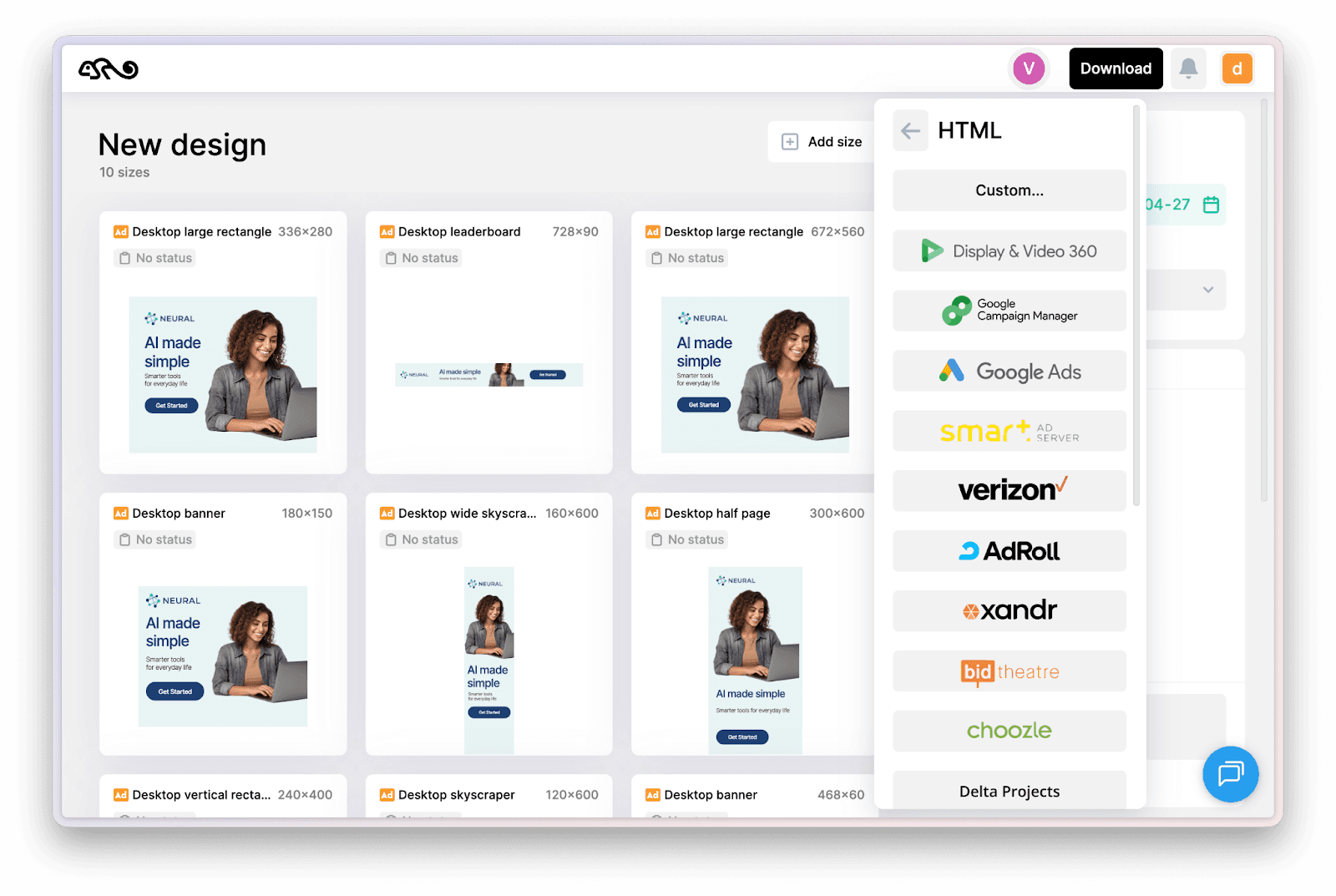
Viewst offers direct, plug-and-play integrations with major ad platforms including Google DV360, Campaign Manager, and Meta Ads Manager. Exporting is straightforward: select your creatives, choose a destination, and publish. There is no custom development or API work required. The platform also provides real-time creative analytics and A/B testing, giving designers direct visibility into performance data so they can iterate on what works.
Celtra
Celtra integrates with major DSPs, ad servers, and media platforms — the company lists over 100 media platform connections. Its activation capabilities span social, programmatic, display, video, and DOOH, making it one of the most broadly connected platforms in the market. Celtra also offers performance intelligence features, including predictive creative scoring (Celtra Score) that evaluates assets before launch.
The trade-off is that Celtra's integrations often require custom development or API work to connect to specific ad accounts. For teams without dedicated technical resources, this can slow down initial deployment and limit the self-serve experience that smaller or mid-sized organizations expect.
Pricing and Onboarding
Perhaps the most decisive factor in the Viewst vs Celtra decision is how each platform handles pricing and the time it takes to get up and running.
Viewst
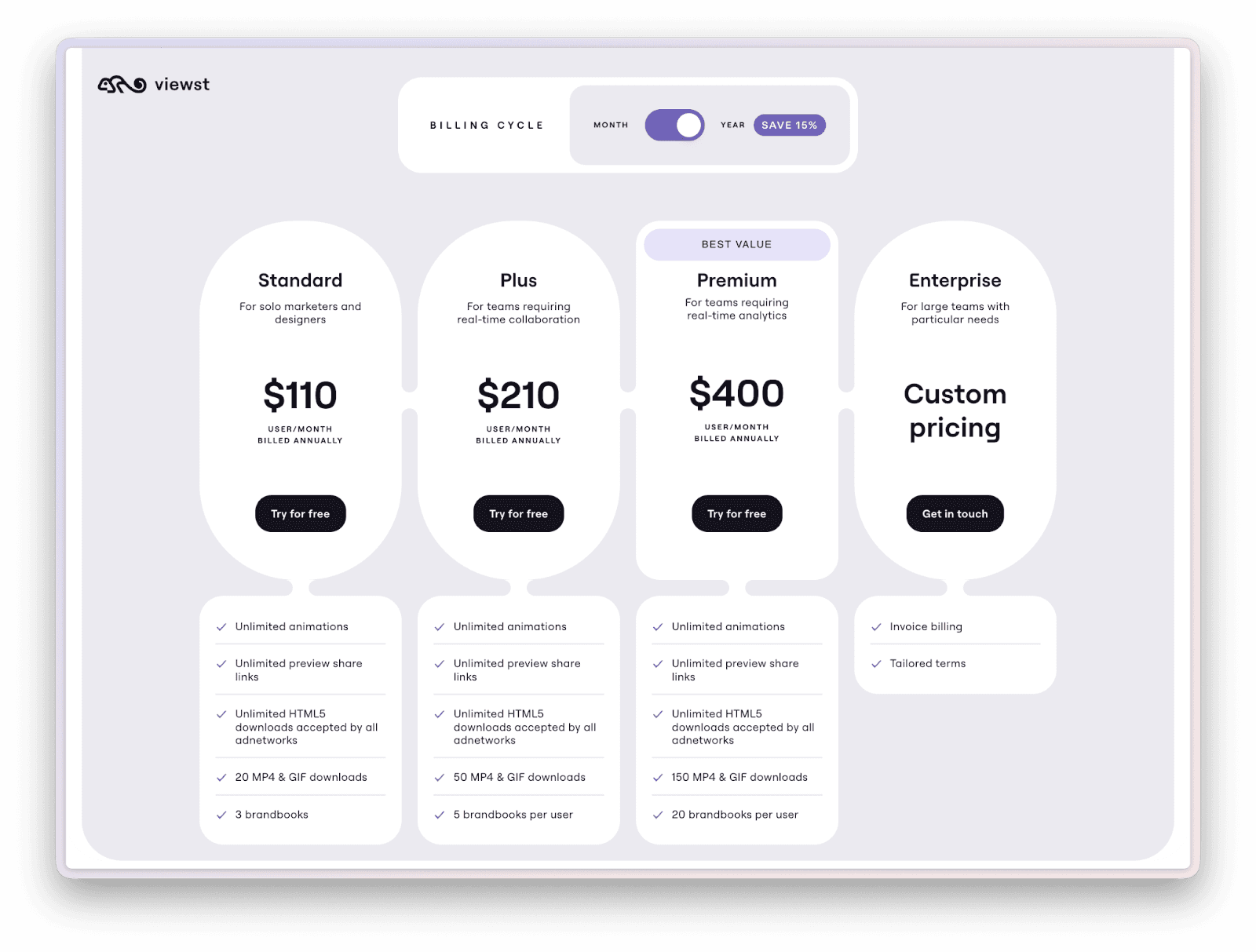
Viewst uses a straightforward seat-based pricing model with four tiers: Standard for solo users, Plus for teams and collaboration, Premium for analytics, and Enterprise for custom needs. All plans include unlimited designs, unlimited auto-resizing, and unlimited HTML5 downloads — there is no per-export fee. Annual billing offers a 15% discount. Pricing is published on the website, so teams can evaluate costs before ever speaking to a sales representative.
Onboarding takes one day. The platform is designed as a self-serve tool, so most teams are productive within hours. For organizations that have experienced long, resource-intensive platform rollouts, this speed can be a significant advantage.
Celtra
Celtra does not publish its pricing. The platform operates on a custom enterprise pricing model that typically includes both seat-based fees and charges tied to creative exports or usage volume. Entry-level costs are significantly higher than mid-market alternatives, reflecting Celtra's positioning as an enterprise solution.
Onboarding is extensive. Celtra offers dedicated success managers, consulting and training services, custom API integration support, and creative services — a full white-glove experience. While users praise the quality of onboarding ("among the best onboarding we've seen from a vendor," according to one Celtra customer testimonial), the process requires meaningful time and organizational commitment. For teams that need to move quickly or operate with lean budgets, this can be a barrier to entry.
Comparison Summary
Feature | Viewst | Celtra |
Primary Focus | Display ad production | Enterprise creative automation |
Animation | 82+ presets, timeline editor, HTML5 native | Advanced rich media, video, DOOH |
Scaling / Localization | CSV/feed bulk generation, AI localization | Multi-market versioning, 111+ markets |
Brand Governance | Native Brandbooks, locked templates | Design guardrails in modular templates |
Ad Network Integration | Direct export to DV360, CM, Meta | 100+ platforms, often requires API setup |
Collaboration | Comments, approvals, guest links, deadlines | Shared workflows, approval flows |
Pricing Model | Transparent, seat-based, published | Custom enterprise, not published |
Onboarding | One day, self-serve | Extensive, white-glove |
Unlimited HTML5 Exports | Yes, all plans | Usage-based |
Best For | Mid-market teams, display-focused | Global enterprises, omnichannel |
Which Platform Is Right for You?
The Viewst vs Celtra decision ultimately comes down to organizational scale, channel breadth, and how much complexity your team is prepared to manage.
Celtra is an outstanding choice for global enterprises that need omnichannel creative automation across dozens of markets, with advanced AI-powered personalization, predictive performance intelligence, and deep integrations into complex media ecosystems. Its case studies with brands like Spotify, Siemens, and Wolt demonstrate what the platform can achieve when fully deployed. If your organization has the budget, technical resources, and patience for an extensive onboarding process, Celtra delivers at a scale that few platforms can match.
Viewst is the better fit for teams that need fast, reliable display ad production without enterprise-level complexity. Its transparent pricing, one-day onboarding, unlimited HTML5 exports, and self-serve model make it accessible to mid-market marketing teams, agencies, and in-house creative departments that want to move quickly. If your primary workflow is producing, scaling, and deploying display and banner ads — and you want to be productive within hours, not weeks — Viewst is built for exactly that purpose.
The evolution of display advertising has made creative automation essential for every team, not just enterprise ones. Whether you are producing 50 banners a month or 50,000, the right platform is the one that matches your pace, your budget, and your ambition.
Ready to see how Viewst works for your team? Start your free trial at viewst.com and launch your first campaign today.

Victoria is the CEO at Viewst. She is a serial entrepreneur and startup founder. She worked in Investment Banking for 9 years as international funds sales, trader, and portfolio manager. Then she decided to switch to her own startup. In 2017 Victoria founded Profit Button (a new kind of rich media banners), the project has grown to 8 countries on 3 continents in 2 years. In 2021 she founded Viewst startup. The company now has clients from 43 countries, including the USA, Canada, England, France, Brazil, Kenya, Indonesia, etc.
In this article
" height="11.060000000000002px" id="wzBCZ87AK" transform="translate(6.47 2.47)" width="6.590000000000003px"/></g></svg>)