If you're evaluating an HTML5 ad builder for your team, two names keep surfacing: Viewst and Bannerflow. Both platforms let you create rich media display ads without writing code, auto-resize creatives across IAB sizes, and collaborate with stakeholders inside a single workspace. Yet the way each tool approaches pricing, onboarding, and day-to-day workflows differs significantly. In this Viewst vs Bannerflow comparison, we break down six critical areas so you can decide which creative management platform fits your goals, budget, and team structure.
Display advertising remains one of the highest-volume creative channels, and the gap between brands that can scale production efficiently and those that cannot is growing. Both Viewst and Bannerflow were built to close that gap—but they serve different segments of the market. Whether you're a lean in-house team or a global enterprise operation, the details below will help you make a confident choice.
HTML5 Ad Building Capabilities
The core promise of both platforms is the same: produce production-ready HTML5 ads without writing a line of code. But the underlying technology and user experience diverge once you start building.
Viewst
Viewst takes an HTML-first approach. Every element you place on the canvas is rendered as real HTML and CSS in real time—not rasterized pixels. This means your exported banners are lightweight, responsive, and compliant with every major ad network's specifications right out of the editor. The drag-and-drop builder ships with IAB-standard templates, Figma and Photoshop import, and a growing AI toolkit that includes background removal, copy generation, and auto-localization. With over 17,000 brands already using the platform, Viewst has been refined around fast, self-serve workflows that let teams go from a blank canvas to a live campaign in a single day.
For a deeper look at what modern display ads can do, see Viewst's guide on display ad formats and best practices.
Bannerflow
Bannerflow positions itself as a premium creative management platform (CMP). Its Creative Studio lets teams build HTML5 rich media banners with drag-and-drop widgets, interactive elements like forms and galleries, and in-banner video. A "master creative" concept allows designers to build one responsive ad and auto-generate all required sizes and language variants from that single source. Bannerflow integrates with over 100 advertising platforms—including Google Ads, Adform, Salesforce, and major DSPs—and offers in-platform hosting so that live ads can be updated in real time without re-trafficking.
Animation and Rich Media
Animation is what separates a static banner from a rich media ad that captures attention. Both platforms provide timeline-based animation tools, but depth and accessibility vary.
Viewst
Viewst's timeline-based animation editor includes 82+ customizable presets that cover entrance, emphasis, and exit sequences. Because animations compile to CSS and JavaScript keyframes, the exported files are production-ready HTML5—no post-processing needed. Teams can animate individual elements, set easing curves, and preview the full sequence without leaving the editor. This approach keeps file sizes small and load times fast, which matters when ad networks impose strict weight limits.
If you're still weighing whether animated ads are worth the extra effort, Viewst's article on static vs. animated display ads lays out the performance data.
Bannerflow
Bannerflow also offers a visual animation timeline with drag-and-drop widgets. Advanced animation tools let designers add parallax effects, countdowns, and interactive hotspots. In-banner video is a standout feature—Bannerflow's own data suggests that video within display ads increases click-through rates by 18.4%. However, some reviewers note that the animation tooling has gaps: stroke effects on text, superscript characters, eyedropper color picking, and animation on grouped elements are either limited or missing. These gaps can slow down production when designs call for precision.
Creative Scaling and Automation
Ad production automation is the main reason teams invest in a dedicated display ad builder instead of using general-purpose design tools. Here's how each platform handles scale.
Viewst
Viewst's one-click auto-resizing instantly adapts a design to every IAB standard ad size, and every plan—including the entry-level Standard tier—includes unlimited resizing and unlimited HTML5 downloads. For high-volume production, the CSV/feed-based bulk generation feature lets teams upload a spreadsheet of copy, images, and CTAs to produce hundreds of banner variants in minutes. Dynamic templates keep edits synchronized: change a headline in the master, and the update ripples across every size and variation. Viewst reports that these workflows accelerate time-to-market by 20–30x compared to manual design.
Bannerflow
Bannerflow's scaling model centers on the master creative. Build one ad, and the platform auto-generates all sizes, formats, and market-specific versions. The company claims a 95% reduction in banner production time, which aligns with the enterprise-scale campaigns it targets. Campaign scheduling, auto-rotation, and multi-market localization features round out the workflow. However, because Bannerflow's scaling capabilities are tied to higher-tier "On Demand" packages—Export, Seamless, Dynamic, and Optimisation—teams may need to commit to a larger contract before accessing the full automation suite.
Viewst vs Bannerflow: Dynamic Creative Optimization
Dynamic creative optimization (DCO) personalizes ad content in real time using data signals—product feeds, weather, geolocation, or audience segments. It's one of the fastest-growing areas in display advertising.
Viewst
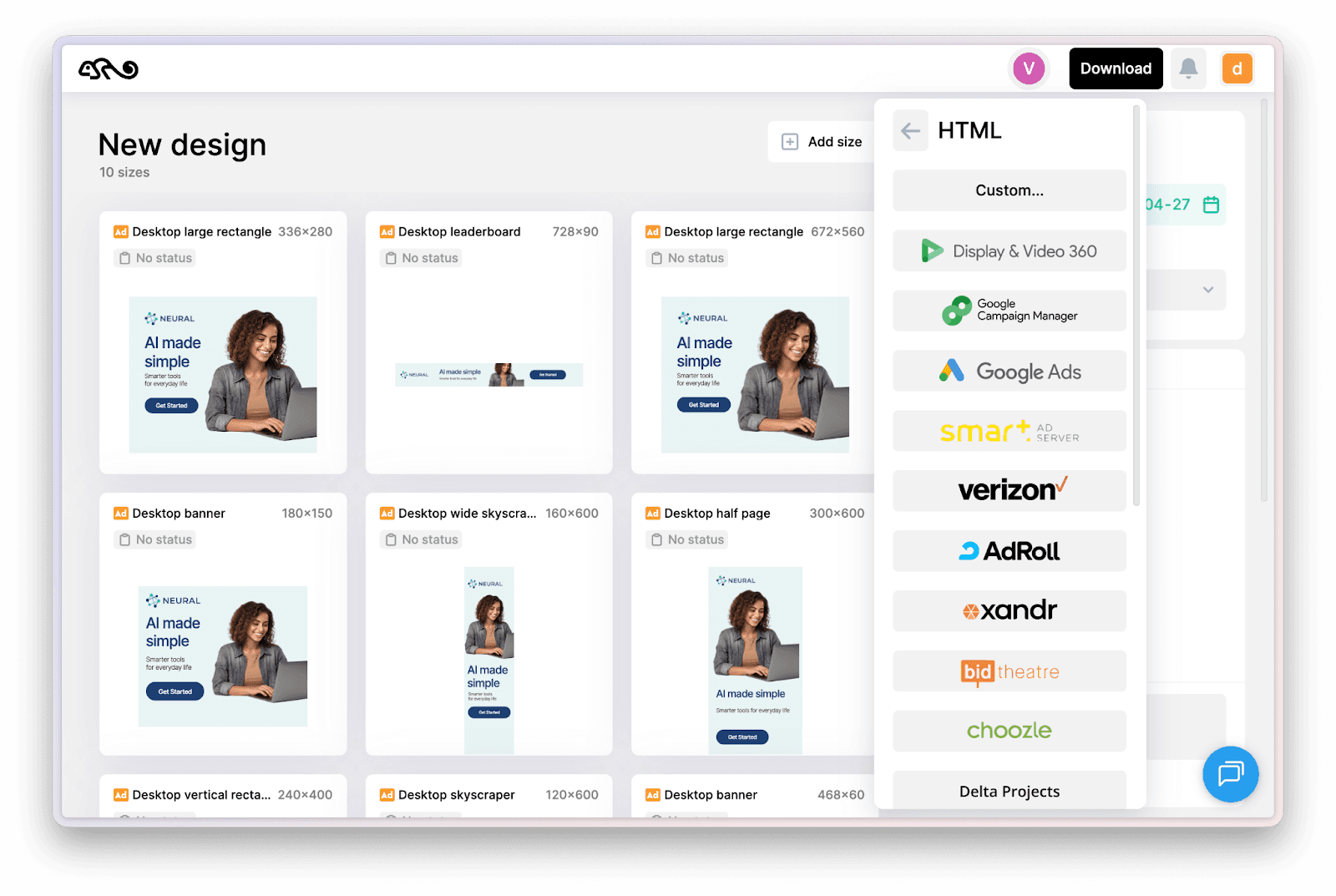
Viewst supports dynamic templates that pull in variable content—headlines, product images, pricing—from external feeds. Combined with CSV bulk generation, teams can produce data-driven creative sets at scale. Real-time creative analytics and A/B testing are available on all plans (Premium and above for full analytics dashboards), allowing teams to measure which creative variants perform best and iterate quickly. Direct export integrations with Google DV360, Campaign Manager, and Meta Ads Manager make it easy to push dynamic creatives into programmatic buying platforms.
Bannerflow
DCO is one of Bannerflow's headline features. The platform connects live product feeds, galleries, and interactive data layers directly to ad templates, enabling hyper-personalized creative at scale. Because Bannerflow also serves as an ad server with real-time update functionality, changes to a DCO campaign propagate instantly—no need to re-traffic tags. Heatmaps and A/B testing help optimize layouts, and creative-level performance metrics (CTR, engagement, conversions) feed back into optimization loops. For enterprise teams running always-on, multi-market DCO campaigns, this integrated ecosystem is a genuine advantage.
Collaboration and Workflow
Production speed depends not just on design tools but on how quickly feedback cycles close. Both platforms include in-platform collaboration, though the scope differs.
Viewst
Viewst offers in-context commenting, role-based permissions, guest preview links, and structured approval workflows with status and deadline tracking. Brandbooks let brand managers lock down templates, fonts, and color palettes so that distributed teams stay on-brand without bottlenecks. A centralized asset library with version control ensures everyone works from the latest approved assets. These features are accessible across all plan tiers, making collaboration available from day one—even for smaller teams.
Bannerflow
Bannerflow provides real-time, in-platform commenting and approval workflows designed for multi-market teams. Because the platform doubles as an ad server, approved creatives can be published directly without leaving the interface. Multi-market localization flows allow regional teams to adapt approved master creatives for local markets. While powerful, reviewers note that the volume of features can create a steep learning curve, and some UI interactions feel unintuitive—particularly for team members who are not daily users of the platform.
Pricing and Accessibility
Pricing transparency can be just as important as feature depth. The ability to evaluate cost before a sales call removes friction from the buying process and signals confidence in the product's value.
Viewst
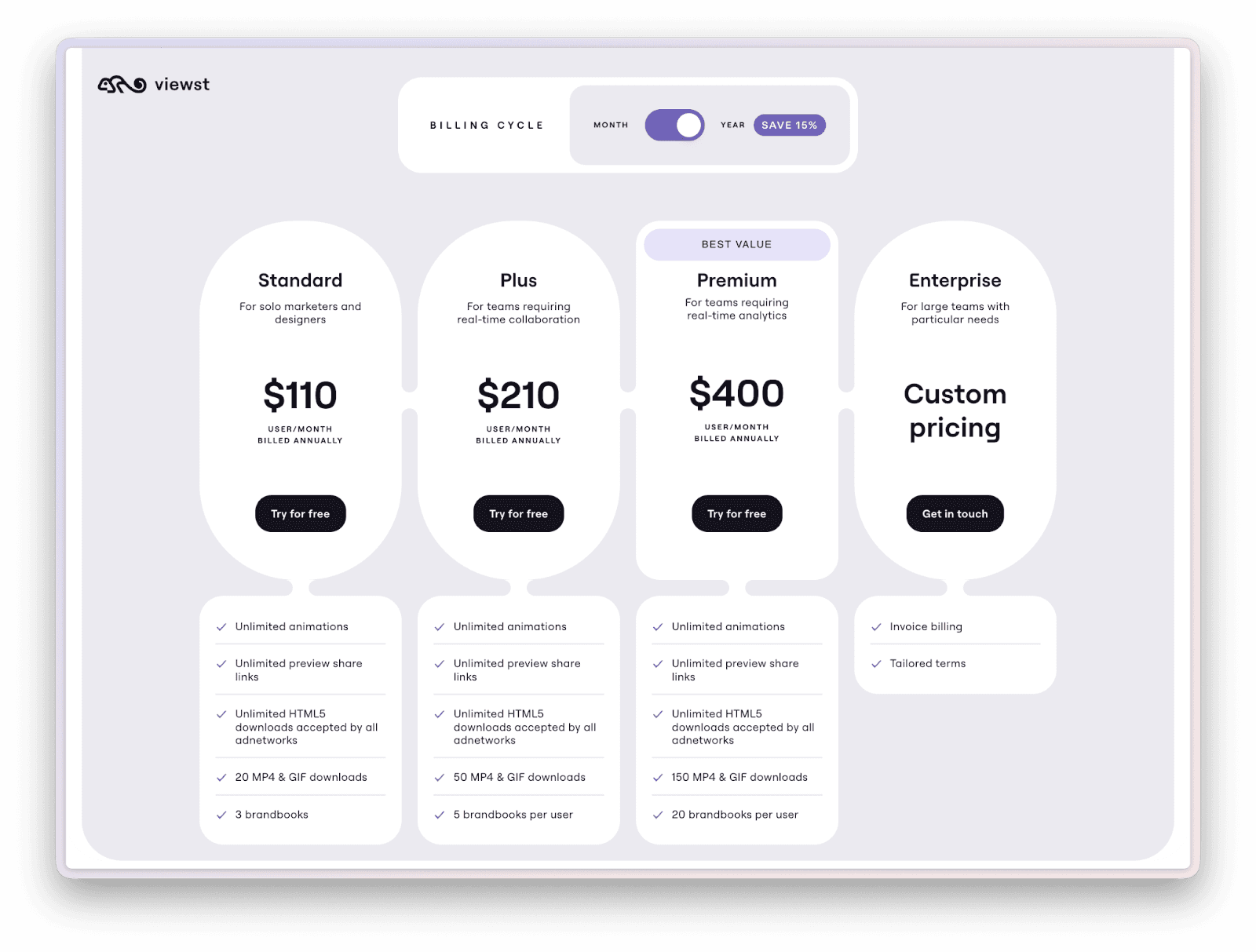
Viewst publishes its pricing openly. Plans range from Standard (for solo creators) through Plus (teams and collaboration), Premium (advanced analytics), and Enterprise (custom). Every plan includes unlimited designs, unlimited auto-resizing, and unlimited HTML5 downloads—there are no per-export charges. A 15% annual billing discount is available, and onboarding typically takes a single day. This self-serve model makes Viewst accessible to freelancers, agencies, and mid-market teams who need to move fast without lengthy procurement cycles.
Bannerflow
Bannerflow does not publish pricing publicly. Prospective customers must request a demo and go through a consultative sales process to receive a quote. The platform offers "On Demand" packages (Export, Seamless, Dynamic, Optimisation), but specific costs are not disclosed. This approach is common among enterprise-oriented CMPs and is not inherently negative—custom pricing can mean tailored value—but it adds friction for teams that want to evaluate quickly. Onboarding typically requires more setup time given the platform's breadth of features, and smaller teams may find the enterprise-focused go-to-market model less approachable.
Comparison Summary Table
Feature | Viewst | Bannerflow |
HTML5 Ad Builder | HTML/CSS real-time rendering; Figma & PSD import | Master creative with widget-based builder; 100+ integrations |
Animation | 82+ presets; CSS/JS keyframes; timeline editor | Timeline editor; in-banner video; interactive widgets |
Auto-Resizing | One-click to all IAB sizes; unlimited on all plans | Master creative auto-generates sizes; tied to package tier |
Bulk Generation | CSV/feed-based bulk creation | Product feeds & data layers via DCO packages |
DCO | Dynamic templates + CSV feeds; A/B testing on all plans | Full DCO with live feeds, heatmaps, real-time ad serving |
Collaboration | Comments, roles, guest links, approval workflows, Brandbooks | In-platform commenting, approvals, multi-market localization |
Ad Network Export | Google DV360, Campaign Manager, Meta Ads Manager | 100+ platforms; in-platform hosting & real-time updates |
Analytics | Real-time creative analytics on all plans | Heatmaps, A/B testing, creative-level metrics |
Pricing | Transparent; published tiers; unlimited exports | Custom only; not publicly listed |
Onboarding | Self-serve; one-day setup | Consultative; longer ramp-up period |
Conclusion: Which HTML5 Ad Builder Is Right for You?
Both Viewst and Bannerflow are serious HTML5 banner creators purpose-built for display ad production at scale. Bannerflow excels in enterprise DCO, integrated ad serving, and multi-channel deployment—making it a strong fit for large organizations that need a unified platform from creation through real-time campaign management. If your team already operates at enterprise scale and values in-platform hosting with live-update capabilities, Bannerflow's breadth is hard to match.
Viewst, on the other hand, delivers comparable creative power with transparent pricing, faster onboarding, and a self-serve model that removes procurement barriers. Unlimited exports on every plan, CSV-based bulk generation, and real-time analytics on all tiers mean that even lean teams get full production capability from day one. For agencies, mid-market brands, and growing in-house teams that need to scale without waiting for a custom contract, Viewst offers a more accessible path to ad production automation.
Ready to see how Viewst can accelerate your display ad production? Start building at viewst.com and experience the difference a transparent, self-serve creative management platform can make.

Dasha is a content and product contributor at Viewst, focused on AI-driven creative production and modern advertising workflows. Her work explores how teams can streamline asset creation, scaling, and deployment using new technologies.
In this article
" height="11.060000000000002px" id="wzBCZ87AK" transform="translate(6.47 2.47)" width="6.590000000000003px"/></g></svg>)