Trust in software is earned slowly and lost quickly. In ad design tools, it comes down to three things: does the output work every time, does the brand stay intact, and does the team hit the deadline? Here is which platforms are delivering.
The word 'trusted' gets applied to software loosely. In the context of online ad design tools, it has a specific meaning: the platform ships output that runs on ad networks without errors, maintains brand consistency without constant oversight, and performs reliably when a campaign is going live and there is no time to troubleshoot.
As how the evolution of banner ad production has changed industry standards shows, the shift from Flash to HTML5 raised the technical bar for ad production tools significantly. The tools that have earned trust are the ones that absorbed that complexity - click-tag compliance, file-size validation, network-specific packaging - so their users do not have to manage it manually.
What trust means in practice. What makes an online ad design tool trustworthy
1. The output actually runs on ad networks
An HTML5 ad builder that exports files which fail network validation is not reliable, it is a source of last-minute emergencies. Trusted tools build compliance into the export: click-tag support, file-size limits, animation duration rules, and network-specific packaging for Google Ads, DV360, Meta, and Campaign Manager. Viewst validates against these specs automatically. The file that comes out is the file that goes live.
2. Brand consistency is enforced, not assumed
The most trusted tools for enterprise teams and agencies are not the most flexible, they are the ones where flexibility is appropriately constrained. Per-layer template permissions that lock brand elements, brand kits that serve as a single source of truth for logos and typography, and role-based access that prevents accidental overrides. Viewst's brand governance model operates at the element level, not the template level. That distinction matters at scale.
3. Transparent, predictable pricing
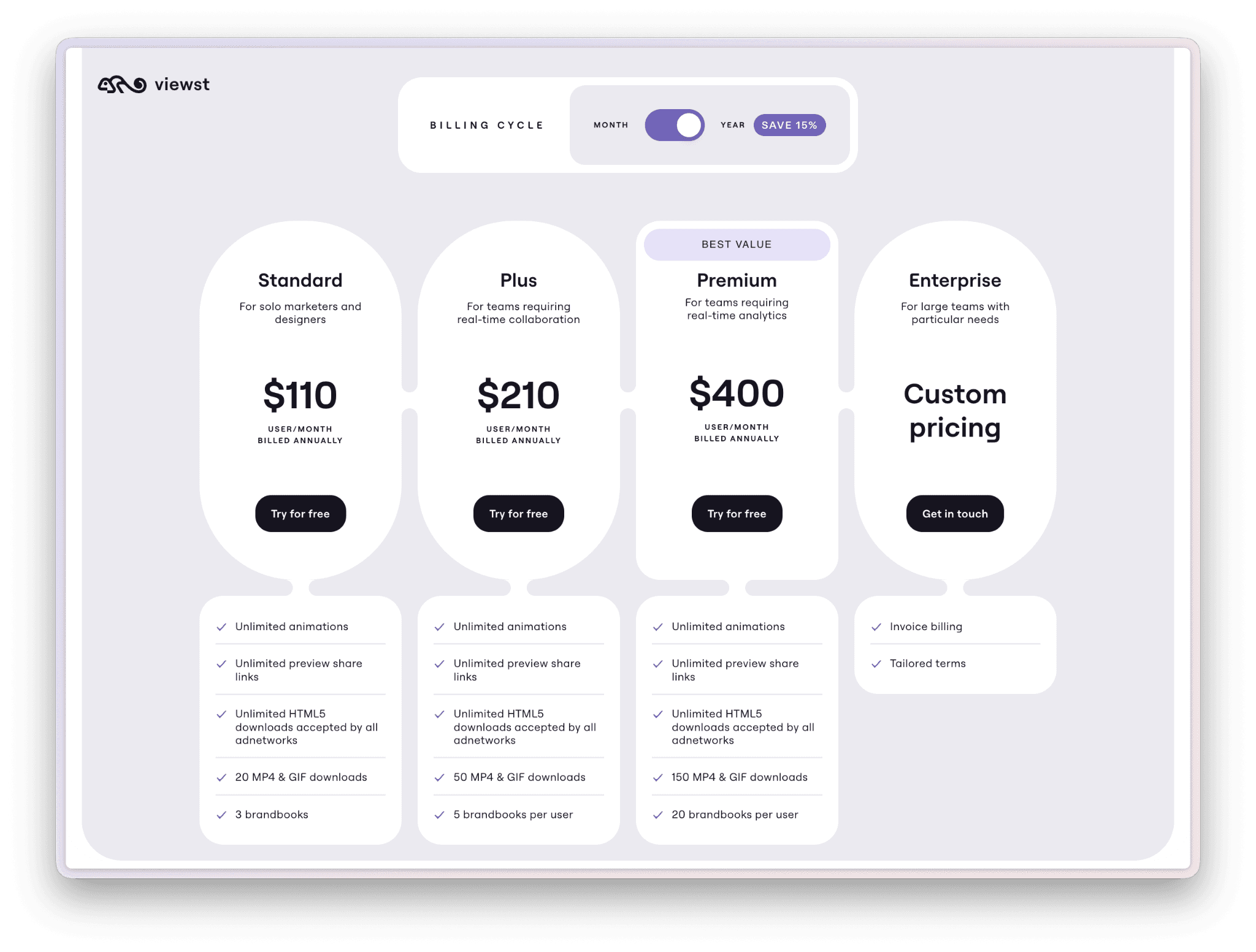
Tools that charge per export, per creative, or per impression create billing surprises that erode trust at the finance level. Viewst charges per seat with unlimited HTML5 exports on every plan. The cost of producing 100 creatives and 10,000 creatives is the same. For teams planning campaign budgets, that predictability is a form of trust.
4. A track record you can verify
Trust requires evidence. Named customer case studies with specific, documented results carry more weight than testimonial carousels with first names and job titles. Viewst's public case studies, including Wister and Digicust, both documenting approximately 90% reductions in production timelines, give prospective users something concrete to evaluate. The full record is available at how HTML5 display ad production works in practice.
5. Self-serve access for honest evaluation
Tools that require a demo and a sales conversation before you can touch the product are asking for trust before they have earned it. Viewst offers self-serve sign-up, transparent pricing, and a 14-day free trial. Evaluation on your own terms, with your own creative, against your own campaign requirements that is how trust is built.
Platform assessments. The most trusted platforms in 2026. Honest assessment
Viewst
Purpose-built for HTML5 display ad production. Used by 17,000+ brands and agency teams. Transparent pricing from $110 per month per seat with unlimited exports. Self-serve with one-day onboarding. Per-layer brand governance, Figma import, CSV feed automation, direct push to Meta and Google. The platform most teams evaluate first when their current tool stops scaling.
Creatopy (now BriefAI)
Strong mid-market option with built-in A/B testing and Shopify integration. Solid animation capability, accessible pricing from $49 per month per editor. Less granular brand governance than Viewst, and native ad serving is its primary differentiator over production-focused platforms.
Bannerflow
Well-established in the European market with a strong programmatic ad-ops workflow. Wide network publishing, scheduling, and live optimization. Demo-based sales process with pricing that is not publicly available. Better suited to teams whose primary challenge is trafficking and delivery than creative production speed.
Celtra
Enterprise-grade DCO infrastructure trusted by Spotify, Adidas, and Unilever at global scale. Not self-serve requires custom implementation and dedicated ad-ops engineering. The right platform for organizations with the budget, technical resources, and scale to justify it. Not competitive for most mid-market teams.
Canva
Trusted for social content and general marketing design. Cannot export HTML5 banners. Does not produce ad-network-compliant programmatic creative. Widely used and well-regarded for what it was built to do, but not an ad design tool in the programmatic display sense.
The most trusted tool is not always the most well-known. It is the one your team can hand a brief to on Monday and hand a trafficked campaign from on Friday without an incident in between.
For teams evaluating how different production approaches compare in practice, display ad production automation breaks down the mechanics of automated vs manual workflows across the metrics that actually matter: time per campaign, output consistency, and cost per variant.
Evaluate Viewst on your own terms
Full platform access, 14-day trial, no sales call required. See the output quality for yourself.

Dasha is a content and product contributor at Viewst, focused on AI-driven creative production and modern advertising workflows. Her work explores how teams can streamline asset creation, scaling, and deployment using new technologies.
In this article
" height="11.060000000000002px" id="wzBCZ87AK" transform="translate(6.47 2.47)" width="6.590000000000003px"/></g></svg>)