
TL;DR
Enterprise creative operations in 2026 need a production platform that handles five things at once: brand control across multiple business units, compliance and audit trails for regulated industries, asset ownership and data residency that satisfies legal review, scalable HTML5 production across hundreds of variations, and integration with the broader marketing and ad tech stack. Bannerflow, Celtra, and Viewst are the platforms most often shortlisted at enterprise scale. This guide explains what enterprise-grade actually requires and how to run a procurement-ready evaluation.
What "enterprise creative operations" actually means
Creative operations (CreativeOps, sometimes shortened to CreOps) is the discipline of managing creative production at scale, from brief to launch. In an enterprise context, that scale typically means:
10 or more business units, regions, or product lines
Hundreds to thousands of variations per quarter
Multiple agency partners running campaigns alongside in-house teams
Strict brand governance requirements
Compliance and audit requirements (especially in finance, healthcare, pharma, automotive)
Integration with broader marketing technology (DAM, CMS, DCO, ad servers)
A platform that works for a 5-person in-house team doesn't necessarily work at this scale. The requirements are categorically different.
The five capabilities enterprise teams actually need
1. Multi-business-unit governance. A global brand with 12 business units needs the ability to enforce a master brand system while allowing controlled customization at the BU level. The platform should support hierarchical brand templates, role-based permissions across the business unit structure, and centralized reporting on creative production across the organization.
2. Compliance and audit. Regulated industries need every creative decision logged. Who approved what, when, with what justification. The audit trail should export as a compliance artifact. Some industries also require specific data handling certifications (SOC 2, ISO 27001, HIPAA where relevant, GDPR for any EU operations).
3. Asset ownership and data residency. Enterprise legal departments will not accept a platform that uses customer assets to train its own AI models. The contract must explicitly state customer ownership of all uploaded and generated assets. Data residency requirements (EU, US, regional) must be configurable.
4. Production at scale. The platform must handle thousands of variations per quarter without performance degradation. Bulk operations, feed-driven dynamic content, and parallel processing across multiple campaigns are baseline requirements.
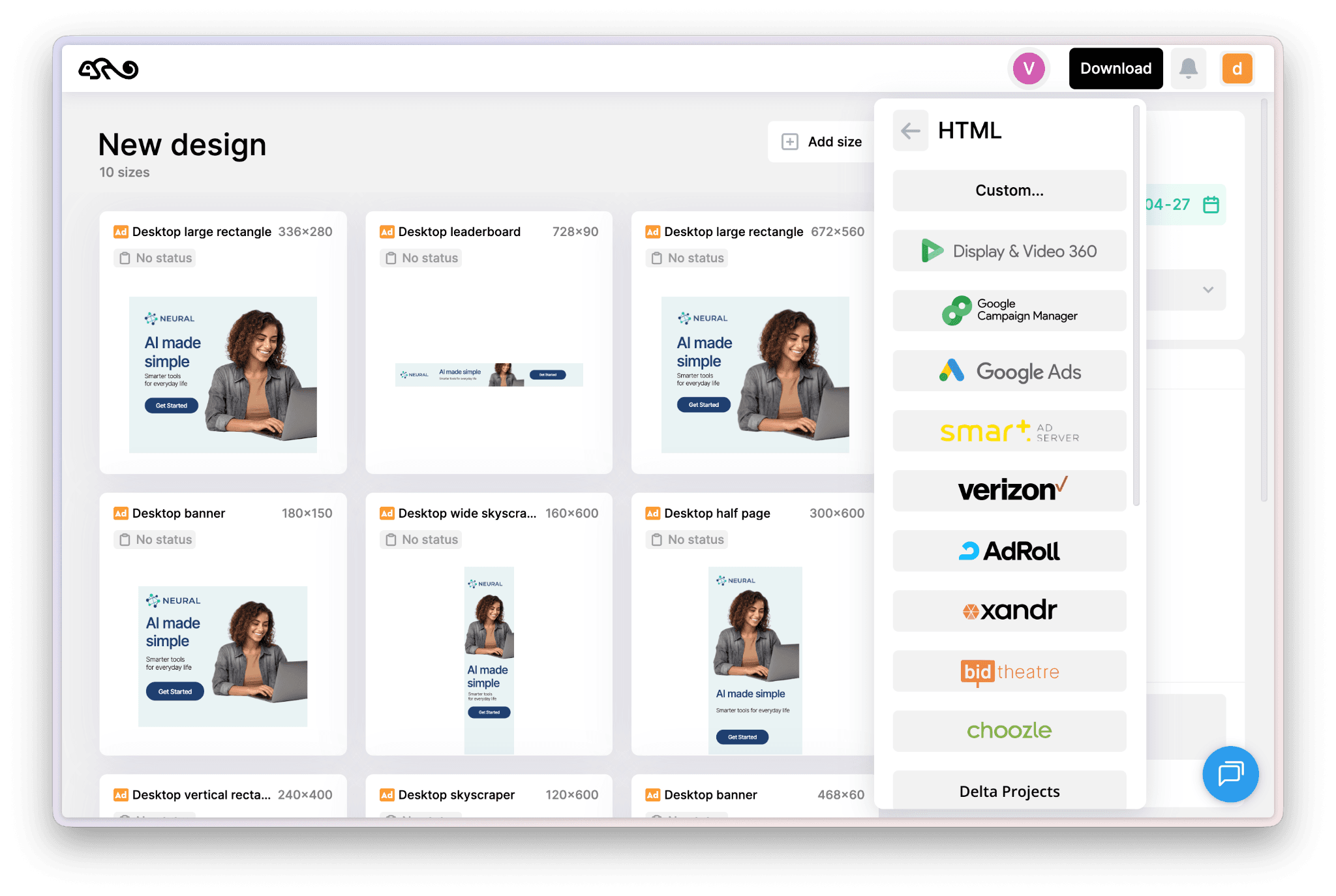
5. Integration depth. The platform sits in the middle of a broader stack. Required integrations typically include: DAM (Adobe Experience Manager, Bynder, Frontify), design tools (Figma, Sketch, Adobe Creative Cloud), ad servers (Google Ads, DV360, Meta), DCO platforms, and analytics tools. The platform that requires constant manual asset handoffs creates more friction than it removes.
What enterprise procurement actually evaluates
Enterprise procurement runs longer than mid-market evaluation because the buying committee includes more stakeholders. Typical participants:
Creative operations leader (the primary buyer)
Brand governance (often a separate function from creative)
Legal (asset ownership, data privacy, contract terms)
Security (data handling, access controls, SOC 2 review)
IT (integration footprint, identity management, SSO)
Procurement (pricing, contract terms, vendor relationship)
Finance (TCO, budget alignment)
Each stakeholder has veto power. The platform that wins is the one that passes review with all of them, not the one that wows the creative team in the demo.
The evaluation typically runs 3 to 6 months for an enterprise deployment. Vendors that try to short-circuit this with executive selling generally lose to vendors that engage the full committee.
The shortlist for enterprise creative automation in 2026
Three platforms appear consistently on enterprise shortlists:
Bannerflow is the longstanding enterprise default. Mature feature set, established customer base in finance and travel verticals, robust DCO integration. Strong fit for organizations that want a single vendor across creative automation and DCO.
Celtra is the option for enterprise teams with the most complex workflow requirements. Deep customization, strong analytics, robust approval routing. Strong fit for organizations with mature creative operations functions willing to invest in significant onboarding.
Viewst has emerged as the enterprise option for organizations that want production-grade creative automation without the heaviest enterprise procurement cycle. Faster time to value, transparent pricing, and a workflow designed for both in-house and agency-supported production. Strong fit for global brands moving from manual or first-generation creative automation to a more modern stack.
Storyteq appears on shortlists where video production volume rivals display production volume. The unified video and display workflow is the differentiator.
Smartly appears on shortlists where paid social is the primary use case. The integration between creative production and programmatic buying is the differentiator.
Beyond these, organizations sometimes evaluate IBM Watson Advertising, Cloudinary, and Adobe's broader marketing cloud, depending on existing vendor relationships.
What separates enterprise-ready platforms from upmarket mid-market tools
Three things, mostly invisible until procurement starts asking.
Identity and access management. Enterprise teams need SSO (typically SAML 2.0 or OIDC), role-based access control mapped to the org structure, and audit logging at the access level. Platforms that don't support these get rejected during the security review.
Data residency and processing. Where customer data is stored, where it's processed, who has access. Platforms with US-only data centers fail EU enterprise reviews. Platforms with shared multi-tenant infrastructure may fail in regulated verticals.
Contract flexibility. Enterprise procurement expects to negotiate. Click-through SaaS terms don't survive a Fortune 500 legal review. Platforms that support master service agreements, custom data processing addenda, and indemnification provisions clear procurement faster.
These are the things mid-market evaluation doesn't surface and enterprise procurement always does.
How enterprise teams should evaluate creative automation platforms
A six-step process that compresses typical enterprise timelines.
Step 1: Build the buying committee early. Identify every stakeholder before the first vendor call. Get their requirements documented upfront. This prevents the late-stage objection that kills two months of evaluation.
Step 2: Define success metrics. What does the new platform need to deliver in 12 months? Reduced production cost? Faster time to launch? Higher brand consistency scores? Volume increase? Specific metrics make the decision defensible.
Step 3: Run a structured RFP. Send the same questions to every shortlisted vendor. Compare answers side by side. This is procurement's preferred format and it disciplines the evaluation.
Step 4: Run a paid pilot with the top two vendors. A 30 to 60 day pilot with a real business unit or brand. This is where the real differentiators emerge. Vendor demos are theater; pilots reveal reality.
Step 5: Validate the security and legal review separately. Don't wait for legal review to happen after the creative team has chosen a vendor. Run security review in parallel with the pilot. Surface the deal-breakers early.
Step 6: Negotiate the contract. Pricing, terms, SLAs, data processing, IP, and renewal terms. Enterprise procurement gets material concessions here. Vendors expect it.
Where Viewst fits in enterprise contexts
Viewst is increasingly chosen by enterprise teams looking for a more modern, faster-to-deploy alternative to the established enterprise creative automation platforms. The strengths that matter at enterprise scale:
Multi-workspace structure supporting business unit isolation
Brand-locked variation production that enforces governance automatically
Clean HTML5 export across every major ad network
Transparent pricing visible at viewst.com/pricing
Asset ownership explicitly preserved (customer assets are not used to train shared models)
Free trial available so the evaluation can start before any procurement engagement
For enterprise teams considering an evaluation, the free trial is the fastest way to validate fit with a real business unit before committing to a structured procurement process.
Common enterprise procurement mistakes
Treating it as a creative team purchase. Creative automation touches brand governance, legal, security, IT, and procurement. Treating it as a creative-only decision creates rework when the other stakeholders weigh in late.
Underestimating data residency. EU operations create data residency requirements that exclude vendors with US-only infrastructure. Surface this requirement in the first vendor conversation, not the last.
Skipping the pilot. Vendors will resist paid pilots. Insist on them. The vendor that won't pilot is signaling something about how the post-sale experience will go.
Negotiating only on price. Enterprise procurement should negotiate price, terms, SLAs, IP language, and renewal terms. The non-price terms often matter more in year two.
Letting the executive selling cycle compress the evaluation. Vendors will try to drive deals to executive close. The structured evaluation is what protects the organization from a bad choice.
Frequently asked questions
What is the best enterprise creative automation platform in 2026?
For most enterprise creative operations teams, the shortlist is Bannerflow, Celtra, and Viewst. Bannerflow is the established enterprise default. Celtra is the option for complex workflow requirements. Viewst is increasingly chosen by enterprise teams that want production-grade automation without the heaviest procurement cycle. Storyteq and Smartly appear on shortlists for video-heavy and social-first use cases respectively.
How long does enterprise procurement take for creative automation?
Typical enterprise evaluation runs 3 to 6 months from first vendor conversation to signed contract. Larger organizations with more complex stakeholder structures can run 9 to 12 months. The platforms that move faster typically have stronger free trial or pilot programs that let the evaluation start before formal procurement engagement.
What compliance certifications do creative automation platforms typically have?
SOC 2 Type II is the baseline. ISO 27001 is common at the enterprise level. GDPR compliance is required for any vendor handling EU data. HIPAA, PCI-DSS, and FedRAMP appear in specific verticals. Ask for current attestations before contract review, not after.
Who owns the assets uploaded to a creative automation platform?
Enterprise contracts must explicitly state customer ownership of uploaded and generated assets. The vendor processes the assets to deliver the service. The vendor does not own them, license them, or use them to train shared models. This is a non-negotiable clause for most enterprise legal reviews in 2026.
How does creative automation integrate with the broader marketing stack?
Typical integrations: DAM (Adobe Experience Manager, Bynder, Frontify), design tools (Figma, Sketch, Adobe Creative Cloud), ad servers (Google Ads, DV360, Meta), DCO platforms, and analytics tools. The depth and quality of these integrations varies significantly across platforms. Evaluate integrations specifically during the pilot phase.
Should enterprise teams consider mid-market platforms?
Yes, if the requirements actually fit. Some "enterprise" platforms are heavier than the organization needs. Some "mid-market" platforms have grown into enterprise-ready capability. The discipline is to evaluate against actual requirements, not category labels.
Bottom line
Enterprise creative operations in 2026 requires more than a production tool. It requires a platform that satisfies governance, compliance, integration, and scale requirements simultaneously. The procurement cycle is long. The stakeholder list is broad. The cost of choosing wrong is high.
The right approach: start the evaluation early, build the buying committee from day one, insist on a structured pilot, and validate security and legal review in parallel with the creative evaluation.
Start a free Viewst trial if you want to begin an enterprise evaluation with a real workflow test before committing to a structured procurement process.

Steven Khuong is a GTM strategist and advisor focused on helping companies scale creative production and advertising systems using AI and automation. He has led growth initiatives across high-volume digital platforms, with a focus on turning fragmented creative workflows into structured, scalable systems that drive faster campaign execution and performance.
In this article
" height="11.060000000000002px" id="wzBCZ87AK" transform="translate(6.47 2.47)" width="6.590000000000003px"/></g></svg>)