If you manage display campaigns at any meaningful scale, you know the pain: a single master creative needs to live in dozens of sizes — leaderboards, medium rectangles, skyscrapers, interstitials, mobile banners — and each resize is a manual slog through Photoshop or Figma. Multiply that by language variants, seasonal messaging swaps, and A/B test iterations, and your production queue balloons into hundreds of individual files. That is the bottleneck display ad production automation was built to solve. By replacing repetitive, error-prone handwork with intelligent tooling, automation platforms let creative teams shift their energy from pixel-pushing to strategy. In this guide, we will break down what production automation looks like in practice, compare the leading platforms, and show why Viewst has become the go-to creative automation platform for over 17,000 brands worldwide.
Why Display Ad Production Automation Matters
Traditional display ad workflows are linear and labor-intensive. A designer creates one size, then manually adapts it to every other format the media plan requires. Even a modest campaign covering Google Display Network and Meta can demand 15–20 distinct sizes. Factor in localization for three or four markets and you are staring at 60–80 individual files — each requiring pixel-perfect layout adjustments, text reflow, and QA.
Display ad production automation collapses that effort. Instead of exporting file after file, you build one master creative and let the platform handle resizing, text reflow, and asset adaptation. The result is dramatic: teams using Viewst report cutting production time by up to 20x, freeing designers to focus on concept development rather than repetitive execution. For agencies juggling multiple client accounts and media teams running always-on programmatic campaigns, the time savings translate directly into margin and speed-to-market.
Beyond speed, automation enforces consistency. Manual resizing introduces drift — a logo shifts two pixels, a CTA button lands on a different baseline, a headline wraps awkwardly. Automation tools apply layout rules uniformly across every size, ensuring brand guidelines survive the scaling process intact.
Ad Format Support — From Static Banners to Rich Media
A useful display ad builder must cover the full spectrum of modern ad formats. Static JPG and PNG banners remain the workhorses of programmatic display, but increasingly, marketers need HTML5 creatives for interactivity, animated GIFs for social placements, and MP4 videos for video-capable inventory.
Viewst delivers native HTML5 output that is fully editable and accepted by every major ad network — Google Ads, DV360, Meta, and beyond. You can also export MP4 and GIF formats directly from the same project, eliminating the need for separate video production tools. The platform supports all standard IAB sizes out of the box and lets you create custom dimensions for non-standard placements.
Creatopy and Bannerflow both offer HTML5 export, though Bannerflow is more tightly focused on programmatic display and includes built-in ad serving. Celtra targets enterprise clients with rich media capabilities but often requires developer involvement for custom integrations. For teams that want a broad format range without complexity, Viewst's approach — one workspace, every format — is the most accessible.
Animation Capabilities — No-Code Motion That Converts
Animation is no longer optional in display advertising. Animated creatives consistently outperform static banners in click-through rate and viewability metrics. The challenge is that animation traditionally requires either coding skills (GSAP, CSS keyframes) or specialized motion-design software (After Effects), both of which slow production and raise costs.
Viewst solves this with 82 built-in, no-code animations that cover 97% of daily production needs. Fade-ins, slide-ups, parallax scrolls, hover effects — all applied through a visual timeline, no JavaScript required. This makes Viewst a powerful animated banner maker that any designer can use on day one. Because animations are defined at the template level, every resized version inherits the same motion behavior automatically, ensuring consistency across all ad sizes.
Creatopy provides a similar drag-and-drop animation interface and performs well for simpler motion sequences. Bannerflow offers timeline-based animation geared toward programmatic specialists. Celtra supports advanced rich-media interactions but typically requires a steeper learning curve and, in some cases, custom code. Viewst strikes the best balance between animation depth and ease of use, making it the fastest path from static design to polished, animated output.
Creative Scaling — One Master, Unlimited Variations
Creative scaling is the core promise of any ad production automation platform, and it is where the real ROI lives. Viewst's one-click auto-resize takes a single master creative and generates every size you need in seconds. Unlike basic "smart resize" features that simply crop or letterbox, Viewst intelligently reflows text, repositions elements, and preserves visual hierarchy across aspect ratios.
On top of resizing, Viewst's AI content variations let you connect your brand assets, specify a campaign goal, and generate unlimited visual variations automatically — ideal for A/B testing at scale. Feed-based generation takes this further: upload a CSV from your PIM system and the platform produces multiple HTML5 variations per row, a game-changer for e-commerce, real estate, and automotive advertisers who manage thousands of SKUs. Learn more about display ads production automation on the Viewst resource hub.
Creatopy offers smart resize and dynamic feeds but lacks Viewst's AI-powered variation engine. Bannerflow's scaling strengths center on dynamic creative optimization (DCO) for programmatic, which is powerful but narrower in scope. Celtra provides enterprise-grade localization and feed editing but wraps it in a complex, expensive package. For most teams, Viewst delivers the widest scaling toolkit at the lowest barrier to entry.
Collaboration — Streamlined Review and Approval Workflows
Creative production does not end when the designer clicks "done." Stakeholders need to review, comment, request changes, and formally approve before anything goes live. Disconnected workflows — where feedback lives in email threads, Slack messages, and spreadsheet trackers — add days to the production cycle and introduce errors.
Viewst embeds the entire review-and-approval loop directly in the platform. Designers share a preview link; reviewers leave comments, request changes, or approve — all with status and deadline tracking built in. This eliminates the back-and-forth of exporting screenshots, annotating PDFs, and reconciling conflicting feedback. As Kevin Taliman, Graphic Designer at Cavender Auto Group, notes: "Viewst has been a time-saving tool and has helped our marketing team become more organized with its built-in approval process."
Creatopy and Bannerflow both include collaboration features, though they tend to be lighter-weight — share links and basic comment threads without the structured approval workflows Viewst offers. Celtra's enterprise tier includes robust approval chains, but access requires a significantly higher price point and longer implementation timelines. For mid-market teams and agencies that need structured collaboration without enterprise complexity, Viewst hits the sweet spot.
Pricing — Predictable Costs Without Per-Export Fees
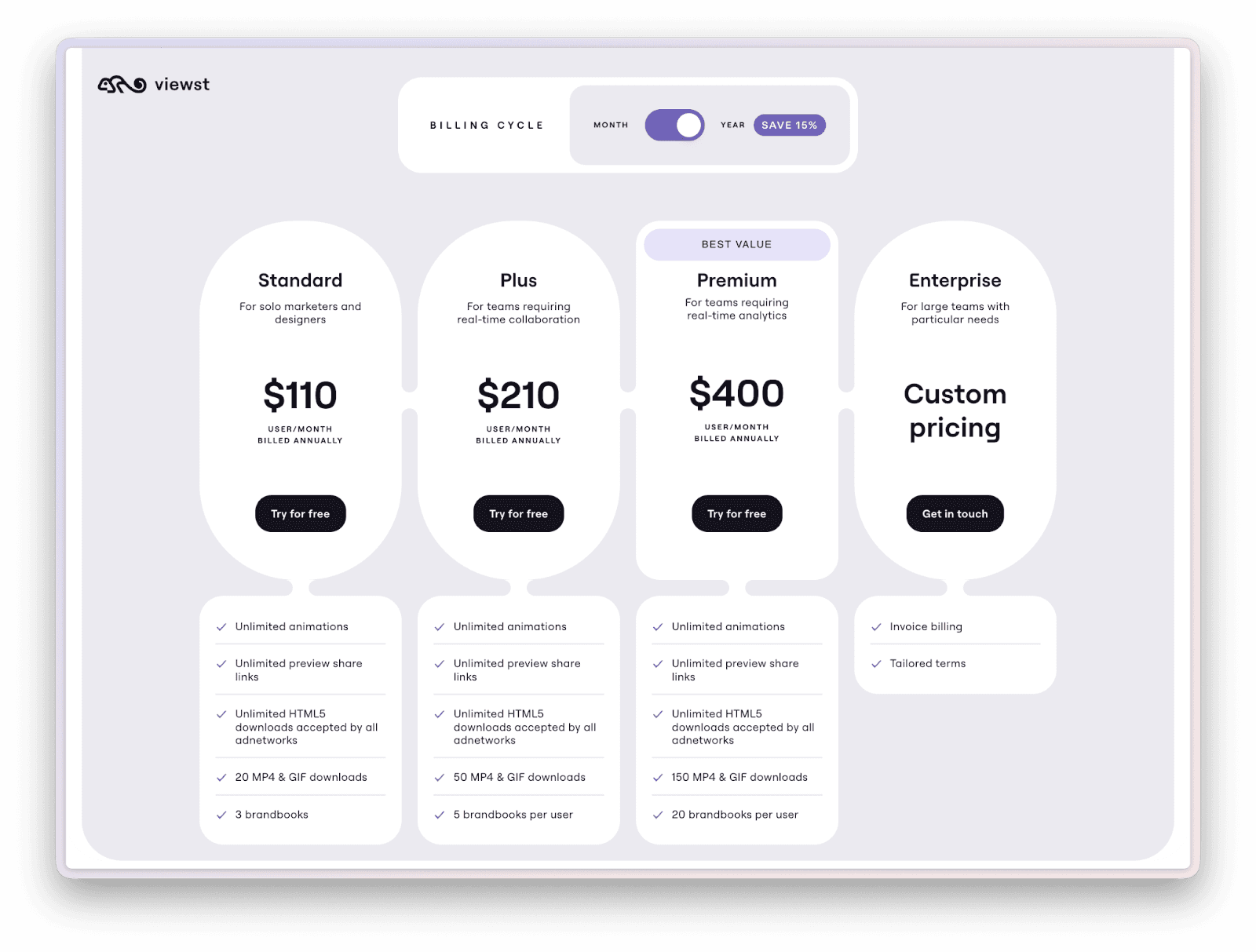
Pricing can make or break the business case for a creative management platform. Viewst uses a straightforward seat-based model: you pay per user, with unlimited resizes, animations, preview share links, and HTML5 downloads included in every plan. There are no per-export surcharges, so scaling your output does not scale your bill. A free tier is available for individuals getting started, and Pro plans offer additional MP4/GIF downloads and brandbook capacity. Check Viewst pricing for current plan details.
Creatopy follows a similar seat-based approach and also offers a free trial, making it accessible for small teams. Bannerflow, however, targets mid-to-enterprise buyers with custom pricing that is not publicly listed — expect annual contracts and higher minimums. Celtra's pricing is the most complex: it combines seat licenses with per-export or per-impression fees, which can create unpredictable costs as campaigns scale. For teams that value budget predictability alongside production power, Viewst's transparent pricing is a significant advantage.
Comparison Summary
The table below summarizes how Viewst, Creatopy, Bannerflow, and Celtra compare across the key dimensions of display ad production automation.
Feature | Viewst | Creatopy | Bannerflow | Celtra |
Ad Format Support | HTML5, JPG, PNG, GIF, MP4 — all IAB sizes | HTML5, JPG, PNG, GIF, MP4 | HTML5, JPG, PNG — display focused | HTML5, rich media — enterprise scope |
Animation | 82 no-code animations, visual timeline | Drag-and-drop animation builder | Timeline-based, programmatic focus | Advanced rich media, may need code |
Creative Scaling | One-click resize, AI variations, feed-based generation | Smart resize, dynamic feeds | DCO, programmatic scaling | Enterprise localization, feed editing |
Collaboration | Built-in review, approval, status & deadline tracking | Share links, basic comments | Share links, comment threads | Enterprise approval chains (higher tier) |
Pricing Model | Seat-based, no per-export fees, free tier | Seat-based, free trial | Custom pricing, annual contracts | Seats + per-export/impression fees |
Best For | Teams needing speed, simplicity, and scale | Small-to-mid teams, template-first | Programmatic display specialists | Large enterprises with dev resources |
Conclusion — Automate Your Ad Production Today
Display ad production does not have to be a bottleneck. The platforms reviewed here all bring meaningful automation to the table, but they differ sharply in accessibility, pricing, and breadth. Bannerflow excels in programmatic display but carries opaque pricing. Celtra offers enterprise-grade power but demands developer resources and complex contracts. Creatopy is a solid mid-market option with good templates and a gentle learning curve.
Viewst combines the best of all worlds: comprehensive format support, 82 no-code animations, AI-powered creative scaling, built-in collaboration workflows, and transparent seat-based pricing — all in a platform that over 17,000 brands already trust. Whether you are an in-house marketing team producing banners for a single brand or an agency managing dozens of accounts, Viewst gives you the tools to go from concept to live campaign faster than any alternative.
Ready to eliminate manual resizing and versioning for good? Start your free Viewst account today and experience display ad production automation that actually delivers.

Steven Khuong is a GTM strategist and advisor focused on helping companies scale creative production and advertising systems using AI and automation. He has led growth initiatives across high-volume digital platforms, with a focus on turning fragmented creative workflows into structured, scalable systems that drive faster campaign execution and performance.
In this article
" height="11.060000000000002px" id="wzBCZ87AK" transform="translate(6.47 2.47)" width="6.590000000000003px"/></g></svg>)