
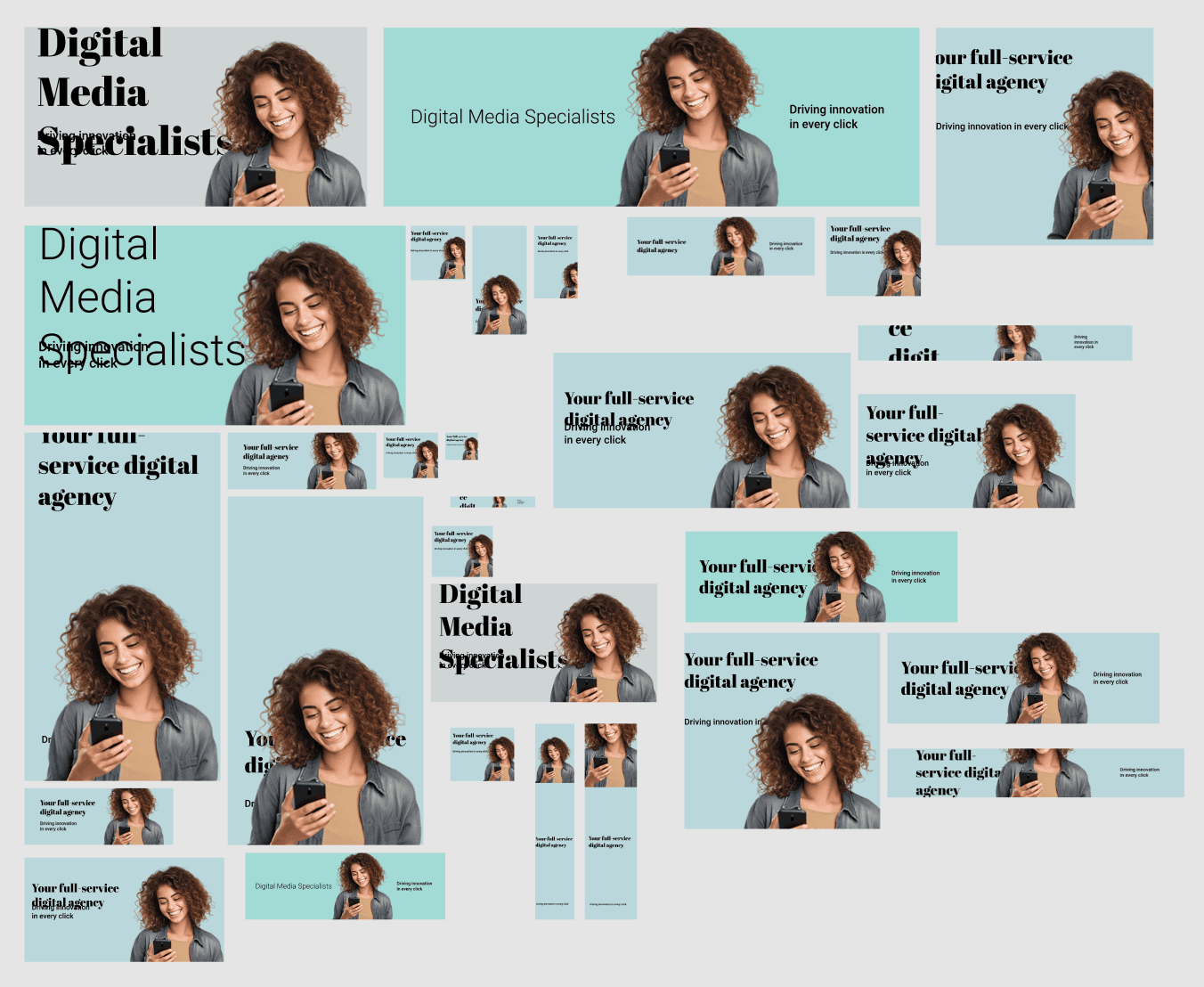
Every creative director has had some version of this conversation. A senior designer, hired for concept work and craft, admits they spent most of the week resizing banners and swapping copy for three markets. Not because it's hard. Because there's no one else to do it.
That's the creative treadmill. It's the reason your team is always behind, your best people are quietly updating their LinkedIn profiles, and your paid social feed looks like your competitor's from six months ago.
It's also the reason modern marketing has a structural problem that more headcount won't solve.
The bottleneck is structural, not human
A single campaign in 2015 needed maybe a dozen ad variants. Today, the same campaign needs hundreds. Different channels. Different placements. Different markets. Different audience segments. Different test variants the performance team wants to try by Thursday.
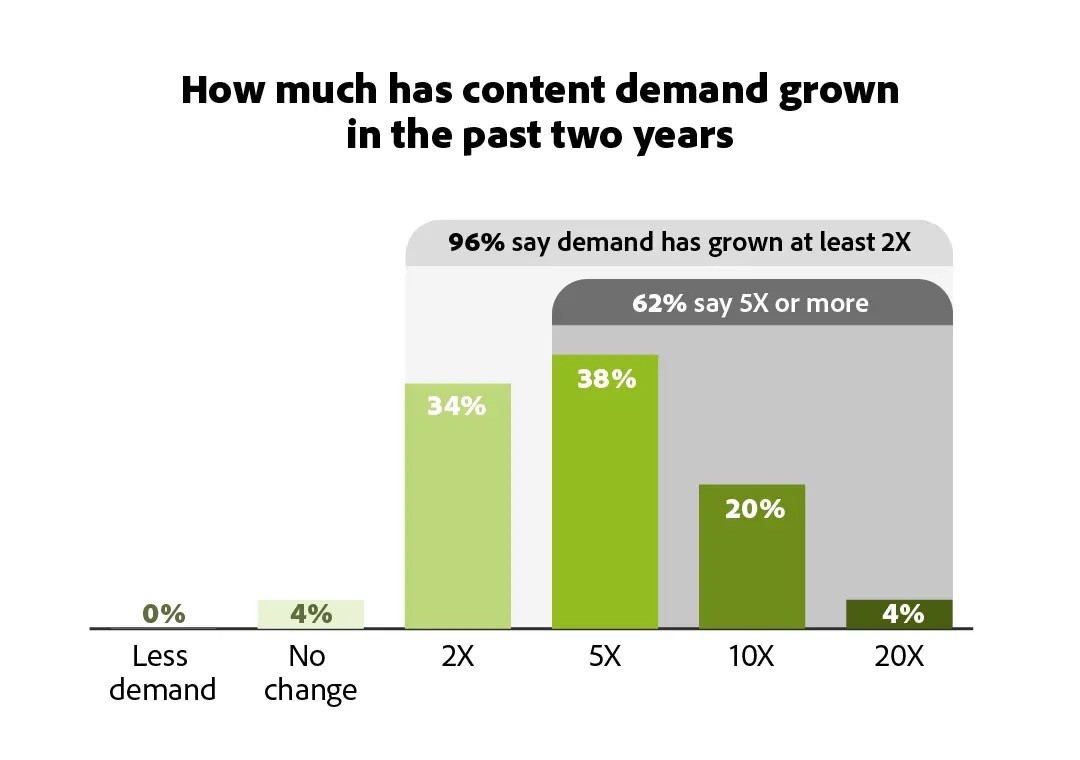
Adobe research
The tools most creative teams use were built for the 2015 volume. A designer opens Figma or Photoshop, builds the hero asset, then spends the rest of the week duplicating files and nudging logos into place.
That workflow doesn't scale. Not because designers are slow, but because the process asks one person and one tool to do every job at once: concepting, layout, brand compliance, resizing, localization, export, QA. The designer is generating and policing their own work simultaneously.
In any other production-heavy discipline, that would be a red flag. In film, editors don't color-grade their own cuts. In software, engineers don't approve their own code. The separation exists because different decisions require different kinds of judgment.
Creative production is the one place where we've let that separation collapse. And the output shows it.
What you actually lose when production breaks
Three things, in order of how fast they bleed.
First, speed. When designers are the bottleneck, campaigns ship late. Late campaigns miss seasonal windows, launch moments, and trend cycles. A Black Friday creative that ships on November 28 is not a Black Friday creative.
Second, volume. When you can only produce 10 variants per week, you can't run meaningful A/B tests. Performance marketers end up making decisions on sample sizes too small to be real. Budget gets spent on the wrong hook for six weeks because no one had time to test a better one.
Third, and most expensive, brand consistency. When production is rushed, small compromises accumulate. The font is almost right. The logo is almost in the safe zone. The CTA color is almost on-brand. Across hundreds of assets over a year, "almost right" becomes the brand. And consumers notice, even when they can't name what's off.
The trade-off most teams accept (and shouldn't)
Faced with the treadmill, marketing leaders usually pick one of three bad options.
Go fast and watch brand consistency crumble. Stay on-brand and move too slow to compete. Or try to do both and burn out the team, which leads to the same two outcomes plus attrition.
The assumption underneath all three choices is that speed, scale, and brand integrity are a zero-sum triangle. Pick two.
That assumption was true when the only tools available were manual canvases. It isn't anymore.
What actually changes when you fix the bottleneck
The teams that have broken out of the trade-off did it by treating creative production the way serious manufacturing treats assembly lines. Not as a creative act, but as a system with defined stages, clear handoffs, and enforced quality gates.
In practice, that means four layers, and every one has a job the others can't do.
The master template sets the creative ceiling. One approved concept, built once, becomes the source of truth for every variant that follows. If the concept is strong, every variant inherits that strength. If the concept is weak, no amount of downstream production fixes it.
The brand guardrails lock in what can't change. Logos, typography, color, spacing, safe zones. These aren't suggestions in the system. They're enforced constraints. A variant that violates a guardrail doesn't get produced.
The automation layer handles everything repetitive. Resizing for every channel spec, swapping copy for localization, generating test variants, exporting in the right format for each ad platform. This is the work designers currently do manually, badly, and resentfully.
The review gate catches whatever slipped through. Not every problem can be prevented structurally. A human check at the end, scoped tightly enough that it doesn't become another bottleneck, is what keeps the standard from drifting over time.
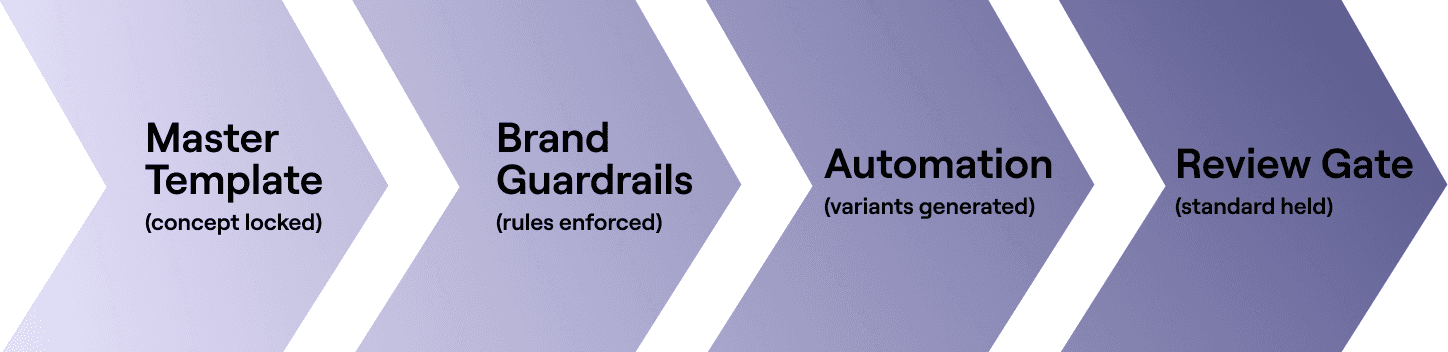
Strip any layer out and the system degrades. No template means no ceiling. No guardrails means brand drift. No automation means designers are back in the mines. No review means the whole thing slowly fills up with small compromises until it looks like every other brand.
Variance control, not peak performance, is the whole game
The version of this argument that usually gets made is "produce 10x more variants, find the one that performs 10x better." That framing is wrong. Or at least, it's incomplete.
In paid media, the brands that win aren't the ones producing the single best asset. They're the ones who rarely produce a bad one. When distribution algorithms make small differences in creative compound across millions of impressions, the floor matters more than the ceiling.
Viewst customers tend to describe the shift the same way. Wister and Digicust have both publicly documented roughly 90% reductions in production timeline on our site. But the lift they describe in conversation isn't about peak output. It's about never shipping a late or off-brand asset anymore. The variance tightened. The floor rose. Performance became predictable instead of heroic.
That's what a real production system gives you. Not a faster canvas. A tighter floor.
What to do on Monday
If you lead a creative or marketing team and the description above sounds painfully familiar, there's a cheap diagnostic worth running before you change any tooling.
Ask your designers, in writing, how they spent the last two weeks. Hours on new concept work. Hours on resizing and variant production. Hours on revisions and stakeholder back-and-forth. Then look at the ratio.
If concept time is under 30% of total hours, you don't have a design problem. You have a production problem. No amount of new hires or new canvases will fix it. The structure is the thing that has to change.
That's the work Viewst was built for. If you want to see what the production-line approach looks like in practice, the free trial at viewst.com is the fastest way. Or read the Wister and Digicust case studies on our site to see what the before-and-after looks like for teams that have already done this.
The creative treadmill isn't inevitable. It's a choice, and most teams are making it by default.

Dasha is a content and product contributor at Viewst, focused on AI-driven creative production and modern advertising workflows. Her work explores how teams can streamline asset creation, scaling, and deployment using new technologies.
In this article
" height="11.060000000000002px" id="wzBCZ87AK" transform="translate(6.47 2.47)" width="6.590000000000003px"/></g></svg>)