
Why Ad Production Should Be a Product, Not Just a Service
Display ad production is no longer a one-off, manual deliverable.
For agencies under pressure to ship hundreds of HTML5 banners across formats and markets, ad production can and should become a repeatable, margin-positive product.
Google and BCG’s 2026 agency research shows leading agencies plan to spend nearly half their time on data/tech services, with data/tech fees expected to reach 32% of revenue. Turning ad production into a standardized, AI-powered offering is directly aligned with that shift.
This guide breaks down how to:
Package display ad production as a productized service
Price it profitably (and defensibly) with AI in the mix
Design workflows that scale across clients and markets
Maintain quality and brand safety at high velocity
We’ll use Viewst — an HTML5-native ad production platform — as a reference model for what modern creative automation looks like in practice.
The Case for Productized Ad Production in the AI Era
AI adoption is already mainstream in agencies, but monetization lags.
Forrester reports 9 in 10 US marketing agencies use genAI and half use agentic AI, yet 61% still treat AI as a “cost of business” and only 31% plan to monetize agentic AI within 24 months.
At the same time:
U.S. digital ad revenue hit $294.6B in 2025, up 13.9% YoY.
Display alone represents $81.6B and programmatic $162.4B of that spend (IAB).
Adobe says 71% of marketers expect digital content needs to increase 5x by 2027.
There is clear demand for:
More creative volume
Faster turnaround
Lower per-unit production cost
Agencies that productize ad production with AI can:
Capture recurring, tech-based fees instead of purely time-based billing
Offer performance-linked packages (e.g., creative refreshes per month tied to spend)
Defend margins by decoupling production value from hours spent
Google/BCG explicitly recommends agencies pilot SaaS tools and turn one-time services into recurring subscription revenue. Ad production is a prime candidate.
Step 1: Define Your Productized Ad Production Offering
Start by treating ad production as infrastructure, not bespoke design.
Your value is not just “making banners.” It’s providing a repeatable, governed system that can support high-volume campaigns at speed.
Core Components of a Productized Offering
At minimum, a modern display production product should include:
Master creative setup
Taking a single master HTML5 or design file (Figma, Adobe) as source of truth
Structuring it in an AI-compatible, modular way (headline, image, CTA, logo blocks)
Smart resize and format coverage
Generating all required sizes from one master using AI Smart Resize
Covering standard IAB formats plus platform-specific sizes (GAM, DV360, retail media)
Versioning and personalization
Content variants by audience, offer, or market
Dynamic text and asset swaps governed by brandbooks
Motion and interaction
One-click animation across layers via AI Instant Animator
True WYSIWYG previews that match ad-server output
Quality control and export
HTML5-native, validated ZIPs within platform limits (e.g., 600 KB on Google Ads)
Ready-to-use GIF/MP4 for environments that don’t support HTML5
Viewst wraps all of these in one production studio, sitting between design tools and media platforms. That is the model you want to emulate: one integrated, governed environment where production happens.
Package Levels That Make Sense for Agencies
To productize, transform this into clear tiers:
Production Core (for stable campaigns)
Master creative setup + AI Smart Resize to a defined format list
Up to X localized variants per market
Standard QA and export to the client’s preferred ad server
Performance Iteration (for growth accounts)
Everything in Core
Ongoing A/B testing variants per month
Rapid creative refreshes with pre-agreed SLAs (e.g., 48-hour turnaround)
Reporting on creative volume and production time saved
Personalization at Scale (for enterprise)
Dynamic content libraries (copy blocks, images, CTAs)
Rule-based localization and audience-specific variants
Human-in-the-loop review tiers aligned with IAB’s personalization playbook
Governance and brandbook enforcement across all markets
Each package should be:
Clearly scoped (formats, volume, SLAs)
Repeatable across clients
Backed by AI-enabled workflows rather than manual labor
Step 2: Pricing Productized Ad Production Without Undercutting Yourself
The biggest risk with AI in production is pricing to the hour.
If your internal workflows get 6X faster, but your fees drop by 6X, you’ve eroded your upside.
Move From Time-Based to Value-Based and Tech-Enabled Pricing
Use these principles:
Value-based anchors
Tie packages to campaign scale and media spend, not just banner count
Position production as a risk reducer (brand safety, speed, QA) and performance enabler
Tech fee component
Add a recurring “production infrastructure” fee per brand or per market
Justify it as access to your AI-powered production stack (e.g., Viewst) and governance system
Unit economics that reward scale
Offer declining per-unit rates at higher volumes, but protect minimums
Make clear that automation enables that scale — it’s the product, not a discount gimmick
Example Pricing Structures
Here are simple, defensible ways to price:
Per-set pricing
One master concept + up to X formats = one set
Base fee per set (covering setup, resizing, animation, QA)
Add-ons for localization, dynamic personalization, or extra formats
Monthly production retainers
Fixed monthly fee covering a defined quota (e.g., 10 sets, 50 variants)
Overflow pricing per additional set or variant
Optional SLAs (rush fees, weekend support) priced separately
Performance-linked fees
Creative refresh packages tied to thresholds (e.g., new set every $50K spend or every X weeks)
Bonus component linked to uplift in CTR or conversion where you control creative testing
Google/BCG notes that performance-based fees are the clearest way to monetize AI value while shifting away from pure time billing. Your production product is a natural candidate for these hybrid models.
Step 3: Design an AI-Ready Production Workflow Agencies Can Trust
Workflow is where productization either succeeds or collapses.
Your goal: one repeatable loop from master creative to exported assets, with AI handling the mechanical work and humans making creative decisions.
A Practical End-to-End Workflow (Using Viewst as Reference)
Intake and master creative
Client provides brand guidelines, key visuals, and core messaging
You import Figma or Adobe files directly into Viewst (or similar)
You structure layers (headline, body, CTA, logo, imagery) for reuse
AI-assisted master build
Use AI Designer to convert prompts + brand assets into structured HTML5 banners
Or deflaten flat images into editable designs via AI Image Deflatening
Apply brandbooks to lock typography, colors, and logo treatment
Smart resizing and animation
Generate all required sizes via AI Smart Resize from the single master
Use AI Instant Animator to apply consistent motion across all sizes
Ensure True WYSIWYG previews match final HTML5 behavior
Localization and personalization
Duplicate master sets per market or audience
Swap copy and imagery using dynamic content libraries
Keep brand rules enforced via locked brandbooks
Review and approvals inside the production environment
Share live previews with stakeholders
Collect comments directly in Viewst rather than via screenshots and email
Use structured approval statuses for sign-off
Export and activation
Validate HTML5 files to meet platform constraints (e.g., Google’s eligibility and size limits)
Export ready-to-upload HTML5, GIF, and MP4 assets
Hand off to media teams or connect to ad servers where supported
By running every client through the same workflow, you gain:
Predictable timelines
Lower QA risk
Data on production performance (turnaround, volumes per month)
Step 4: Maintain Quality and Brand Safety Across Clients and Markets
Scale is being rewarded, but quality and trust are now the bottleneck.
IAB reports that 83% of ad executives have deployed AI in the creative process and 58% plan to increase AI for creative generation. Yet only about one-third of brands, agencies, and publishers have formal governance tools.
Without governance, AI-created banners quickly become a liability.
Governance Principles for AI-Powered Ad Production
Use these foundations:
Master creative as single source of truth
All sizes and variants must stem from a master asset
Structural changes happen at the master level and propagate downstream
Brandbooks and locked styling
Enforce type scales, color systems, logo rules at the platform level
Prevent off-template edits from breaking consistency
Human-in-the-loop QA
Apply risk-tiered review: high-risk campaigns get more eyes, lower-risk get streamlined checks
Check language nuance and local regulatory constraints for each market
Modular content libraries
Create approved blocks of copy, imagery, and CTAs
Let AI assemble variants from these modules rather than from scratch
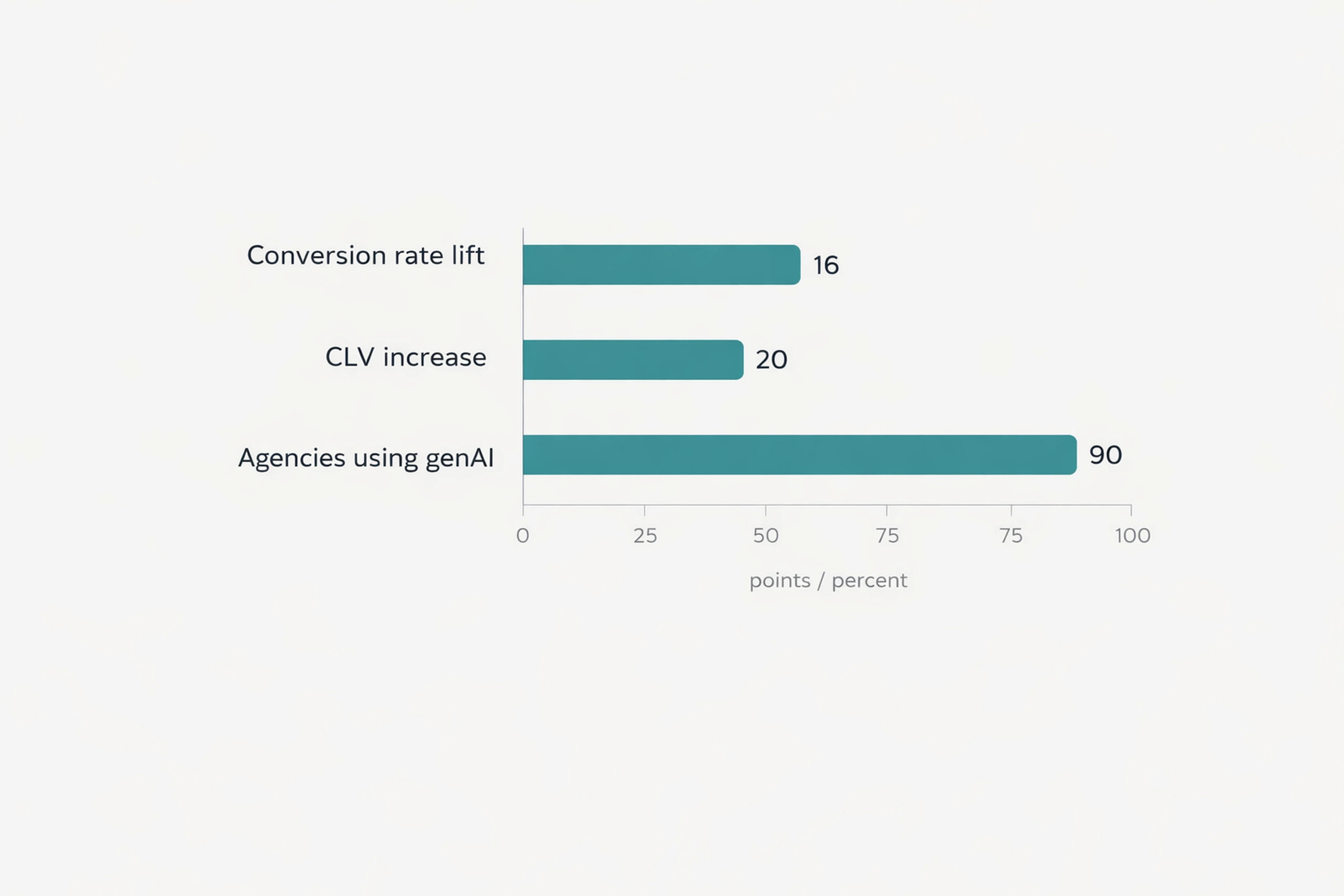
IAB’s personalization playbook shows strong personalization can drive a 16-point lift in conversion rates and up to a 20-point increase in CLV — but only when quality and relevance are maintained.
Addressing Consumer Trust and AI in Ads
Consumer skepticism about AI-generated ads is real.
IAB found:
82% of ad execs believe Gen Z/Millennial consumers are positive about AI-generated ads
Only 45% of consumers actually feel positive
However, 73% said knowing an ad was AI-created would increase or not change purchase likelihood, and disclosure ranked as the third-highest driver of attention after visuals and humor.
Practical implications for your production product:
Document when and how AI is used in creative workflows
Standardize disclosure practices where appropriate (especially in regulated sectors)
Use AI primarily to remove mechanical work — not replace creative judgment
Viewst’s ethos aligns with this: AI eliminates repetitive tasks like resizing and basic animation, while designers keep control of craft and narrative.
Step 5: Operationalizing Productized Production Inside Your Agency
To make this stick, you need operational rigor.
You’re not just adding another tool; you’re building a production system.
Roles and Responsibilities
Clarify ownership:
Production lead / ops manager
Owns the platform (Viewst or equivalent), brandbooks, and workflow design
Ensures every client is onboarded into the standardized process
Designers
Own master creative craft, motion design decisions, and visual QA
Use AI tools to execute production work faster, not bypass it
Media and performance teams
Provide campaign structures, audience definitions, and optimization feedback
Request creative refreshes against clear SLAs and volume limits
Metrics and Stories That Help You Sell the Product
You need proof of impact.
Public case studies already show the upside:
Garnier India saved 87% of creative development and trafficking time with Google’s creative tools
Men in Green cut production time in half with Ads Creative Studio
Dentsu saw Copilot in Microsoft Advertising accelerate workflows up to 6X
Rocketium cites agencies producing 200,000+ versions per year and 41x higher personalized volume
Track similar metrics for your production product:
Average turnaround time per set (before vs. after AI)
Number of variants shipped per campaign / per month
Production cost per unit vs. legacy workflows
Turn these into:
Sales collateral (“We cut your banner production time by 70%+ without adding headcount.”)
QBR talking points with existing clients
Internal benchmarks to refine pricing and capacity planning
Why Viewst Fits As Your Production Infrastructure Layer
You can build productized production on many tools, but not all are built for HTML5 display at scale.
Viewst is purpose-built for:
HTML5-native output with editable layers, not flat images
AI Smart Resize from one master to all required sizes
AI Image Deflatening to turn flat assets into editable designs
AI Designer to convert prompts and brand assets into structured banners
AI Instant Animator for one-click motion across layers
Brandbooks and governance to lock styling at the platform level
Integrated review and approval directly inside the banner sets
Viewst sits between design (Figma, Adobe) and media (ad servers, DSPs), owning the high-friction production layer you’re trying to productize.
For agencies, this means:
A single source of truth for banner sets
Less time lost in email, Slack, and offline decks
A defensible "production infrastructure" fee you can charge clients
FAQ: Productizing Ad Production with AI Creative Platforms
1. How do we avoid commoditizing our creative by using AI?
Treat AI as a production accelerator, not a concept generator.
You still sell creative strategy, master concepts, and brand storytelling as bespoke, high-value work. The productized layer is the repeatable system that turns those ideas into hundreds of high-quality, on-brand assets fast.
2. What’s the best way to structure retainers around ad production?
Anchor retainers to:
A monthly quota of banner sets and variants
Clear SLAs for turnaround and revisions
A recurring infrastructure fee for access to your AI-powered production stack
Add overflow pricing for extra volume and optional rush fees.
3. How do we maintain quality when producing for many markets at once?
Use master creatives, locked brandbooks, and modular content libraries.
Local teams can adapt copy and imagery within these constraints, while human-in-the-loop QA checks cultural nuance and regulatory issues. A platform like Viewst helps enforce these rules at scale.
4. How do we justify AI-enabled production fees to clients who think AI should make things cheaper?
Highlight outcomes, not hours:
Faster time to market (more tests per quarter)
Reduced brand risk via governance and QA
Greater personalization volume, which IAB links to double-digit conversion and CLV gains
Position your platform costs as part of the infrastructure that delivers these outcomes.
5. What types of agencies benefit most from productized ad production?
Agencies with:
High display and programmatic volume
Multi-market or multi-client campaign structures
Pressure to deliver frequent creative refreshes and A/B tests
Digital, performance, and media agencies working with SaaS, fintech, e-commerce, and app-first brands are particularly well-suited.
By turning ad production into a governed, AI-powered product — and using platforms like Viewst to run that system — agencies can protect creative quality, scale output, and unlock new recurring revenue streams without burning out their teams.

Victoria is the CEO at Viewst. She is a serial entrepreneur and startup founder. She worked in Investment Banking for 9 years as international funds sales, trader, and portfolio manager. Then she decided to switch to her own startup. In 2017 Victoria founded Profit Button (a new kind of rich media banners), the project has grown to 8 countries on 3 continents in 2 years. In 2021 she founded Viewst startup. The company now has clients from 43 countries, including the USA, Canada, England, France, Brazil, Kenya, Indonesia, etc.
In this article
" height="11.060000000000002px" id="wzBCZ87AK" transform="translate(6.47 2.47)" width="6.590000000000003px"/></g></svg>)