
Sports marketing teams don’t lack ideas. They struggle with production.
Rights are fragmented, fixtures change weekly, and localized creative consistently outperforms generic messaging:
Locality found 71% of Americans prefer localized ads, rising to 81% among 18–34-year-olds.
53% of local ad viewers say they’re more likely to purchase, versus 13% for national-only ads.
Attentive reports 81% of people ignore irrelevant messages and 1 in 4 are less likely to buy after a generic message.
At the same time, IAB’s 2026 Outlook expects +9.5% ad spend growth and almost $9B in incremental spend tied to the Winter Olympics, FIFA World Cup, and U.S. midterms. More sports spend, more fragmentation, more pressure on production.
This guide ranks five repeatable sports marketing campaign workflows that help brands and sponsors scale localized, rights-compliant ad creative across leagues, fixtures, and regions.
How these workflows were ranked
This ranking is built for:
Heads of Creative and Creative Operations
Design and Production Directors
Performance marketing leaders running sports-heavy programs
Agencies handling multi-league sponsorships and retail media
Each workflow is ranked by:
Scalability – how easily you can push into dozens or hundreds of variants.
Localization strength – how well it supports markets, languages, and fan segments.
Rights complexity handling – how safely it deals with league/team/territory constraints.
Fit for live sports – how well it supports frequent fixtures and live moments.
Automation potential – where tools like Viewst can remove repetitive production work.
You’ll see, for each workflow:
What it is and where it fits in a sports context
Its strengths and limitations
How creative automation platforms (including Viewst) can streamline the production steps
For a deeper primer on structuring end-to-end campaigns, you can pair this piece with our in‑depth guide: sports marketing campaigns: structuring creative workflows for seasonal, fast-moving ads.
Overview: the 5 core sports campaign workflows
Here’s the high-level comparison before we dive into each pattern.
Rank | Workflow | Best for | Rights complexity | Live moment fit | Key risk |
|---|---|---|---|---|---|
1 | Master creative → multi-size expansion | Evergreen sponsorships, seasonal pushes | Low–medium | Medium | Over-reliance on one concept |
2 | Feed-driven localization | Multi-market fixtures, retail & ticketing | Medium | High | Data or feed quality issues |
3 | Rights-tiered branching (league/team/market) | Complex sponsorship portfolios | High | Medium | Governance overhead |
4 | Live moment-triggered DCO | Big tournaments, finals, playoffs | Medium–high | Very high | Operational complexity, QA |
5 | Centralized review & launch ops | Any org with multiple teams/agencies | Varies | Medium | Slower to implement if culture resists |
1. Master creative → multi-size expansion
Best for:
Sponsorship branding that runs all season (e.g., “Proud partner of Club X”)
Awareness-focused campaigns around major events (Olympics, World Cups)
Organizations starting from static or existing creative
What this workflow is
You create one strong master concept—usually in a hero format like a 300x600 or 1080x1080—and then systematically adapt it into the full set of placements:
Standard display: 300x250, 728x90, 160x600, 300x600, 320x50
Rich media / HTML5 variants with animation
Social and in-app placements
The master remains the creative “single source of truth,” while all other sizes inherit layout rules, animation logic, and brand elements.
Why it ranks #1
This is the most reliable and repeatable workflow in sports marketing. It balances creative control with scalability.
Keeps one distinctive idea, avoiding the “watered down” effect of fragmented concepts.
Aligns with research from Publicis London and Effie: multi-market campaigns perform better when they keep bold, emotionally charged creative rather than defaulting to generic messages.
Works well across rights tiers because you can create multiple masters (e.g., league, team, generic) and still expand efficiently.
Strengths
Scales fast: Perfect for high-volume display campaigns.
Protects the idea: Designers focus on one strong direction and evolve it.
Consistent branding: Brandbooks and master templates keep everything on-model.
Production-proof: Very suitable for automation and HTML5 output.
Limitations
Limited hyper-local nuance unless paired with a localization layer.
Creative fatigue risk if the master runs too long without iteration.
Rights differences (e.g., no crest in some markets) mean you need separate masters.
How to automate this workflow
A production-ready platform should support:
Template-based ad production for sports sponsorships: One master design turns into dozens of HTML5 variants.
Automated resizing of display ads: Smart layouts that keep hierarchy as formats change.
Instant animation: Apply entrance and exit motion, timing, and transitions across all sizes.
Editable HTML5 output: Designers can tweak the layout later without re-building.
In Viewst, teams typically:
Build a master creative using AI Designer or upload an existing PSD.
Use Smart Resize to generate all required formats.
Apply Instant Animator for consistent motion across placements.
Export native HTML5 with click tags and network-specific settings.
2. Feed-driven localization
Best for:
Multi-market campaigns across regions and languages
Ticketing, offers, and retail (e.g., “Game-day offers in your city”)
Large fan segments: women’s leagues, Hispanic audiences, or regional fan clubs
What this workflow is
You connect a data feed—fixtures, teams, locations, languages, pricing—to a creative template. The system generates localized variants automatically:
Different cities: “Watch the derby in Chicago this Sunday”
Different leagues: “WNBA Playoffs streaming live”
Different languages: Spanish creative tailored to Hispanic fans
This pattern is essential where localized creative dramatically outperforms generic messaging.
Locality’s study: 71% of Americans prefer localized ads; 53% of local ad viewers are more likely to purchase vs. 13% for national-only.
Attentive: 96% of consumers say they’re likely to buy from brands that personalize messaging.
Why it ranks #2
It’s the best way to scale truly localized sports creative—especially for segments like women’s sports and Hispanic fans:
Nielsen projects women’s football reaching 800M+ fans by 2030, with 60% female.
The 2023 FIFA Women’s World Cup reached a 2B media engagement audience.
The U.S. Hispanic community is 65M strong with $3.4T in purchasing power; 53% of viewers for the 2024 Copa América final were Hispanic.
Feed-driven workflows help you talk to these fans in relevant, trusted ways.
Strengths
High personalization: Messages align with league, team, language, and geography.
Massive scale: Hundreds or thousands of variants off one template.
Performance lift: Localization boosts trust and purchase likelihood.
Flexible: Easy to adjust offers and fixtures centrally.
Limitations
Dependency on data quality: Broken or stale feeds ruin campaigns.
Template constraints: Overly rigid templates can feel generic.
Governance complexity: You must enforce brand and rights rules across all variants.
How to automate this workflow
For a robust feed-driven localization workflow, look for:
Data-binding to templates: Fields like team name, date, price, CTA copy.
Language-aware layouts: Character-length handling (e.g., German or Spanish copy).
Version control: Track which feed versions fed which creative.
Bulk export and tagging for ad servers and retail media platforms.
In an AI ad production platform, the pattern often looks like:
Configure a localization-ready master template.
Connect a CSV, Google Sheet, or internal fixture feed.
Map fields to text and imagery (e.g., league logo, home vs away, stadium).
Generate variants and batch export HTML5 or static files for trafficking.
3. Rights-tiered branching by league, team, and market
Best for:
Brands with multiple sponsorships (e.g., league plus team, men’s plus women’s teams).
Complex rights agreements varying by market or channel.
Agencies managing portfolios of teams and competitions.
What this workflow is
You design a rights-aware campaign tree. Each branch reflects what you’re allowed to show in a given context:
League-level assets only (no team logos) for some territories.
Team logos and player imagery where rights allow.
Neutral, non-branded visuals where rights are restricted.
Think of it as a structured decision tree:
Start with a generic master (no restricted marks).
Branch down into league- or competition-specific variants.
Branch further into team-specific or market-specific versions.
Each node in the tree inherits as much design as possible from the parent to minimize manual work.
Why it ranks #3
Rights-tiered branching is essential in modern sports marketing—especially as rights splinter across broadcasters, streamers, and apps—but it’s more complex to manage than the first two workflows.
WARC notes that brands are maintaining sponsorship spend and that women’s sport, in particular, is a fresh opportunity where fans expect brands to show duty of care. That duty includes respecting rights and using appropriate imagery per property.
Strengths
Rights safety: Clear rules for where each asset can be used.
Reusability: Once set, the tree can be reused each season.
Portfolio-friendly: Great for large brands spanning multiple leagues.
Governance: Makes review and approvals more predictable.
Limitations
Set-up effort: Requires careful modeling of rights tiers upfront.
Operational overhead: Needs strong governance to keep branches aligned.
Risk of inconsistency if branches drift creatively.
How to automate this workflow
Look for capabilities like:
Brandbooks and permissions: Define which templates and assets are available per market.
Role-based access control: Limit who can edit league- vs team-level templates.
Reusable components: Shared layouts across branches while swapping logos, imagery, and copy.
Audit trails: Track which branch produced which final ad.
In Viewst, a typical rights-tiered setup might:
Use brand systems to define fonts, colors, and permissible assets per tier.
Duplicate a base template into league, team, and neutral versions.
Use AI Designer for quick layout variations that respect those constraints.
Centralize review and approvals so legal and rights teams sign off at each branch.
4. Live moment-triggered dynamic creative optimization (DCO)
Best for:
Tournaments, playoffs, and finals where live results drive messaging.
In-game or post-game campaigns (“Celebrate the win”, “Last chance to buy merch”).
Broadcasters, streaming platforms, and apps with time-sensitive offers.
What this workflow is
You combine moment triggers (scores, time remaining, outcomes) with dynamic creative optimization:
If Team A leads at halftime, show a specific offer.
If a star player hits a milestone, push a highlight-themed creative.
If the local team reaches the final, switch from generic tournament ads to team-specific victory messaging.
The creative templates are pre-approved and linked to rules. Once the moment happens, the system automatically selects and serves the right variant.
Why it ranks #4
This workflow can be incredibly effective but carries more operational risk. It’s ranked below the first three because it depends on strong upstream workflows:
You still need a master creative and multi-size expansion.
You still benefit from feed-driven localization.
You still must respect rights-tiered branching.
DCO is the orchestration layer that sits on top.
Strengths
Relevance at peak attention: Messages match fan emotion in real time.
Performance lift: DCO case studies often show double-digit increases in engagement.
Media efficiency: You show more specific, higher-intent ads when it matters.
Limitations
Operational complexity: Requires reliable triggers and QA.
Testing burden: Each rule combination should be tested before going live.
Risk of misfires: Wrong creative for the wrong moment damages trust.
How to automate this workflow
Automation needs to cover two fronts:
Creative production: Quickly generate all the variants your DCO engine may need.
Integration: Deliver structured HTML5 creatives to DCO and ad-serving platforms.
Important capabilities include:
Structured output: Clearly labeled elements and variants for dynamic swaps.
Batch animation tools: Apply consistent motion across state-based creatives.
Network-aware export: Handle file weight, click tags, fallback imagery.
Teams often use creative automation tools to pre-build the full creative matrix, then plug it into DCO setups with ad servers or programmatic platforms.
5. Centralized review and launch operations
Best for:
Organizations with multiple internal teams or agencies.
Global brands running sports campaigns across regions.
Any team struggling with version confusion and slow approvals.
What this workflow is
Instead of each team building and approving creative in isolation, you establish a centralized review and launch workflow:
One shared system for creative versions, comments, approvals, and statuses.
Clear stages: “In design → In review → Legal → Approved → Live”.
Integrated exports for trafficking to major ad networks.
This is the operations backbone that keeps the other workflows on track.
Why it ranks #5
Centralized ops doesn’t produce creative by itself, but it:
Cuts friction between creative, media, and legal.
Reduces launch delays from email-based approvals.
Protects against off-brand or rights-violating variants being shipped.
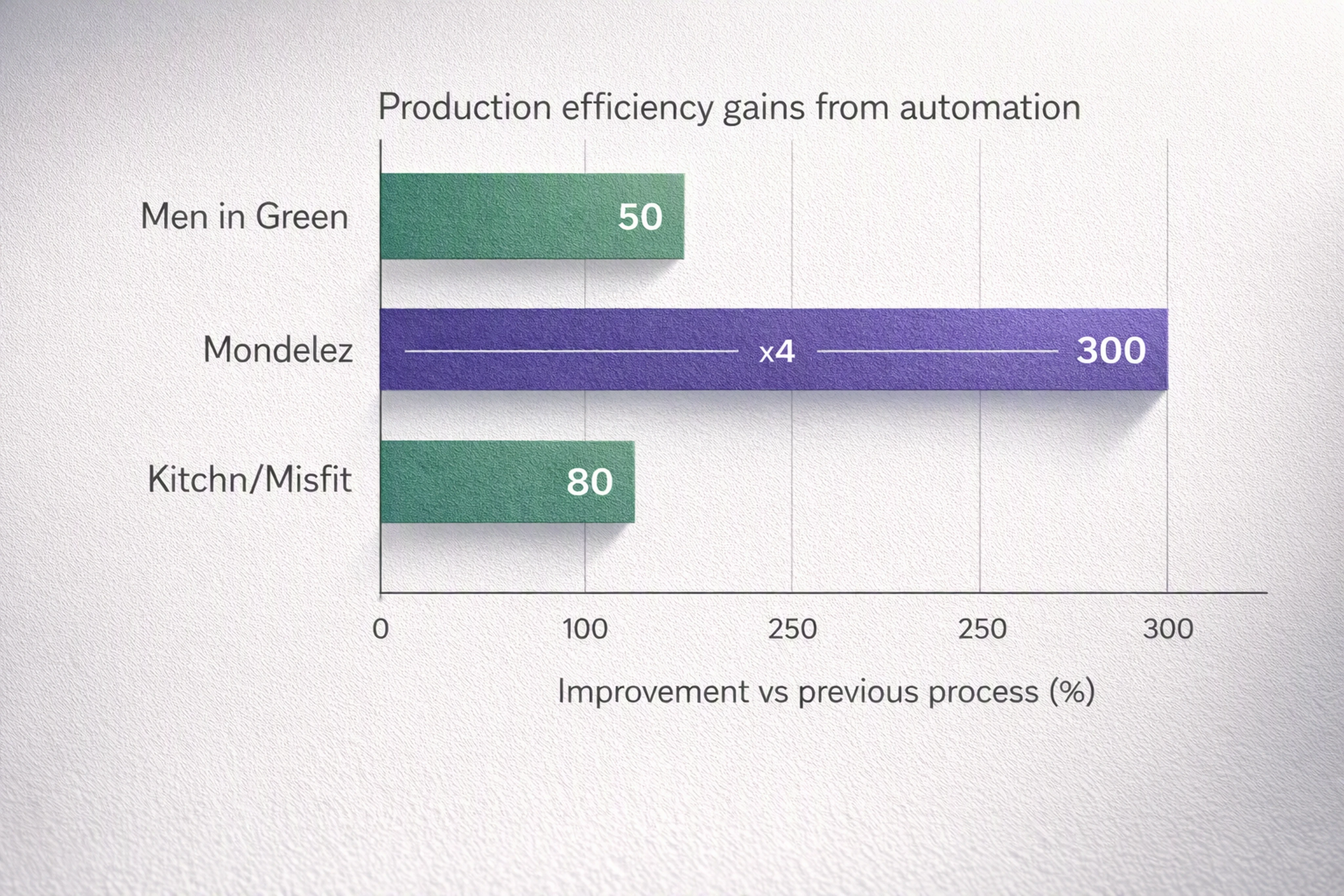
Google, Amazon, and Kitchn’s automation case studies all point to the same thing: production operations, not ideation, are the main bottleneck. For example:
Men in Green cut creative production time in half.
Mondelēz deployed 254 dynamic ad variations in 4x less time.
Kitchn/Misfit scaled from 250 to 1,200+ monthly ads while reducing time per ad by 80%.
Strengths
Single source of truth: Everyone sees the same creative and status.
Compliance-friendly: Easy to prove that only approved creatives went live.
Scales teams, not just files: New markets plug into the same workflow.
Limitations
Change management: Requires process and behavior shifts.
Implementation time: Needs alignment and training.
Tool sprawl risk if not integrated with design and export systems.
How to automate this workflow
Look for systems that combine production with collaboration:
Canvas + comments: Designers and reviewers working in the same environment.
Status tracking: Per-campaign progress and approvals.
Version history: Clear diff between v3 and v4, including who changed what.
Export presets: One-click exports per publisher or network.
This is where an AI ad production platform can act as a central hub: one place where design, resize, localization, animation, review, and export all connect.
Choosing the right workflow for your sports campaigns
There’s no single “best” workflow. The right choice depends on rights complexity and campaign urgency.
If rights complexity is low and urgency is medium
You’re running straightforward brand or awareness campaigns around sports.
Primary workflow: Master creative → multi-size expansion.
Optional add-on: Feed-driven localization for a handful of priority markets.
Use this when you:
Have broad rights or generic sports messaging.
Need consistent branding more than hyper-local nuance.
If rights complexity is medium and urgency is high
You’re running multi-market campaigns linked to fixtures, offers, or app installs.
Primary workflow: Feed-driven localization.
Secondary: Master creative expansion to build the initial templates.
Operations: Centralized review to avoid last-minute mistakes.
Use this when you:
Need to adjust offers weekly based on upcoming games.
Want to personalize around women’s sports or Hispanic audiences.
If rights complexity is high and urgency varies
You’re managing multiple leagues, teams, and territories with different rights.
Primary workflow: Rights-tiered branching.
Secondary: Master creative expansion to maintain consistent structure.
Operations: Strong governance with centralized review.
Use this when you:
Hold a mix of league-level, team-level, and event-level sponsorships.
Need to avoid rights violations while still scaling.
If urgency is extreme (live moments and in-game)
You’re activating around live games, milestones, and finals.
Primary workflow: Live moment-triggered DCO.
Prerequisites: Solid master templates, localization, and rights-tiering.
Use this when you:
Need creatives that match the moment within minutes.
Have the infrastructure and QA to support real-time messaging.
If your main pain is operational, not creative
You have plenty of ideas but struggle to get them shipped.
Primary workflow: Centralized review and launch operations.
Supporting: Any or all of the other four for production.
Use this when you:
Have duplicate work across agencies and regions.
See delays between creative sign-off and campaign launch.
Where Viewst fits in these workflows
All five workflows share a theme: production complexity is the constraint. AI and automation are becoming core infrastructure for campaigns—96% of buyers are aware of agentic AI ad buying, and two-thirds prioritize it for campaign execution.
Viewst is built to be that production infrastructure for digital advertising.
Teams at agencies and brands use it to:
Turn a master idea or existing design into a full suite of HTML5 ads.
Automate resizing, localization, and animation.
Enforce brand systems while keeping designers in control.
Run integrated review and approvals from one canvas.
If you’re building a repeatable sports marketing workflow and need a platform to design, resize, localize, animate, and export ads at scale, you can explore how teams use Viewst across leagues, fixtures, and regions.
FAQ: Sports marketing workflows and creative automation
1. What’s the most important workflow to set up first?
Start with master creative → multi-size expansion. It gives you a reusable base for any sports campaign and makes every other workflow faster. Once that’s stable, layer in feed-driven localization and rights-tiered branching.
2. How do I avoid generic creative when running multi-market sports campaigns?
Use a combination of one strong global idea and local customization:
Keep the same core visual and emotional hook.
Localize copy, language, and references (teams, cities, leagues).
Use feeds or structured data so localization doesn’t become a manual chore.
Research shows localized ads deliver more commercial outcomes than purely global work, especially when they preserve creative distinctiveness.
3. How can I safely use AI tools for sports advertising without losing control?
Use AI for production tasks, not brand decisions:
Layout, resizing, animation, and variant generation.
Structured templates with human-approved copy and design.
Editable outputs (like HTML5 with layers) so designers can refine the result.
The goal is to remove non-creative work from creative work, not replace professional judgment.
4. What’s the best workflow for women’s sports and Hispanic sports fans?
Combine feed-driven localization with rights-tiered branching:
Create dedicated templates for women’s leagues, with respectful, tailored storytelling.
Use language-specific variants and culturally relevant cues for Hispanic audiences.
Ensure rights rules for each property are encoded into your template and branching logic.
Nielsen’s data shows both segments are growing fast and respond positively to brands that show genuine, context-aware support.
5. How do I measure if these workflows are working?
Track both operational and performance metrics:
Operational: time to produce a campaign, number of variants shipped, error/rollback rate.
Performance: lift in CTR, view-through rate, ad recall, and conversion for localized vs generic creatives.
Benchmarks from Google and others show 2x faster production and 4x more variants when automation is in place; those are realistic targets for sports advertising teams adopting these workflows.

Victoria is the CEO at Viewst. She is a serial entrepreneur and startup founder. She worked in Investment Banking for 9 years as international funds sales, trader, and portfolio manager. Then she decided to switch to her own startup. In 2017 Victoria founded Profit Button (a new kind of rich media banners), the project has grown to 8 countries on 3 continents in 2 years. In 2021 she founded Viewst startup. The company now has clients from 43 countries, including the USA, Canada, England, France, Brazil, Kenya, Indonesia, etc.
In this article
" height="11.060000000000002px" id="wzBCZ87AK" transform="translate(6.47 2.47)" width="6.590000000000003px"/></g></svg>)