If you produce display advertising at any kind of volume, you have probably narrowed your shortlist down to two names: Viewst vs BriefAI (former Creatopy). Both platforms promise to collapse timelines, eliminate repetitive design tasks, and deliver production-ready HTML5 creatives, but they take markedly different paths to get there. Choosing the wrong tool can mean months of workarounds, missed deadlines, and ballooning costs.
This comparison breaks down every capability that matters to a modern display ad team: from animation control and creative scaling to ad-network integrations and pricing. By the end, you will know exactly which creative automation platform fits your workflow, your budget, and your growth trajectory.
Creative Automation Features
Creative automation software lives or dies by how much manual work it eliminates without sacrificing design quality. Both Viewst and BriefAI offer drag-and-drop editors, template libraries, and AI-powered assistants, but the underlying architecture determines how far automation can actually take you.
Viewst
Viewst was purpose-built for display ad production. Its editor constructs real HTML and CSS in real time, every element you place on the canvas is a DOM node, not a rasterized pixel. This HTML-first architecture means the output is inherently production-ready: what you see in the editor is exactly what the ad server renders. There is no lossy export step that degrades animations or inflates file size.
The platform ships with AI-powered background removal, an intelligent copy generator, auto localization across languages, and an image generator, tools that address the most repetitive sub-tasks inside a typical banner production sprint. Combined with dynamic templates that sync edits across every size variation simultaneously, Viewst lets teams move from brief to live campaign in a fraction of the time traditional tools require. The company reports a 20–30× acceleration in time-to-market across its 17,000+ brand clients.
Creatopy
Creatopy, formerly Bannersnack, now rebranded as "The Brief", positions itself as a broader ad creative automation platform. Its editor is pixel-based, and it offers a solid template library, smart resize capabilities, and a Feed Ad Builder for data-driven bulk generation.
Where Creatopy stands out is in the breadth of its AI suite. Beyond the standard background removal and copy generation features shared with Viewst, Creatopy adds AI-powered product photography, AI video generation, and a Competitive Intelligence module that lets you monitor competitor ad activity. If your team needs generative AI for use cases beyond banners, such as creating product lifestyle shots or short-form video, Creatopy's toolset extends further in those directions.
Animation and HTML5 Capabilities
Animation is the dividing line between static banners and high-performing display ads. An animated banner maker needs to balance creative flexibility with production constraints file-size limits, ad-network specs, and cross-browser rendering. Here is how the two platforms compare.
Viewst
Viewst provides a dedicated timeline editor paired with 82+ customizable animation presets. Because the editor writes native CSS and JavaScript keyframe animations under the hood, every transition, easing curve, and delay you configure translates directly into lightweight, standards-compliant HTML5. There is no intermediate rendering engine that reinterprets your intent, the code is the creative.
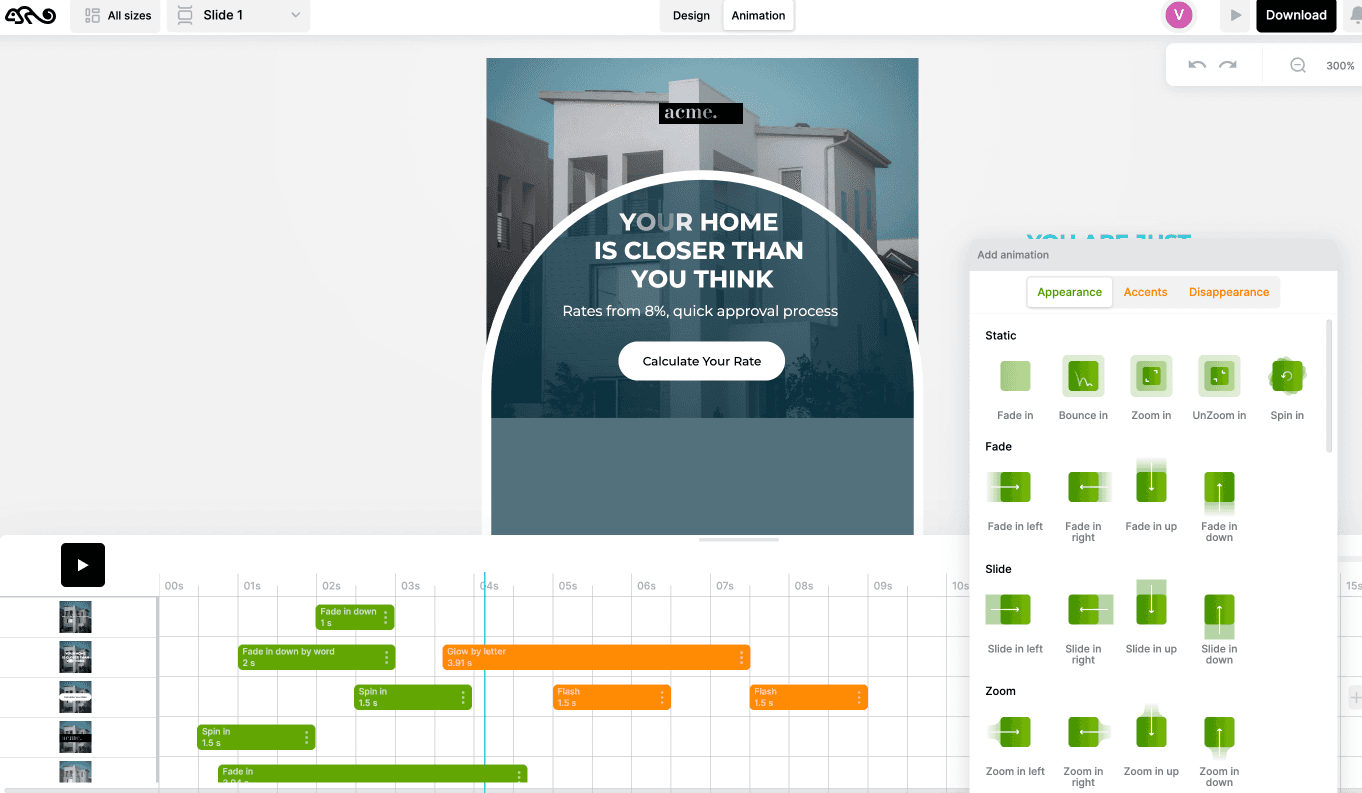
Viewst Animator
This matters operationally. The resulting HTML5 banners load fast, stay within ad-network file-size caps, and render consistently across browsers and devices. For teams that treat their HTML5 ad builder as a core production tool, not just a mockup generator, Viewst's architecture delivers cleaner, lighter output with fewer post-export fixes.
The Brief
Creatopy provides its own animation timeline with a three-phase structure: build-in, middle, and build-out, each offering 36+ presets. A "Magic Animator" feature applies pre-built animation sequences with one click, and a custom animation builder supports move, rotate, scale, opacity, and blur properties.
The system is capable and can produce attractive results, but because Creatopy's editor operates on a pixel-based paradigm, the exported HTML5 sometimes requires additional optimization to meet strict ad-network specs. Teams that frequently work under tight file-size budgets or need pixel-perfect cross-browser consistency may find themselves doing more QA on Creatopy exports. For general display campaigns with standard animation needs, however, Creatopy's presets are more than adequate.
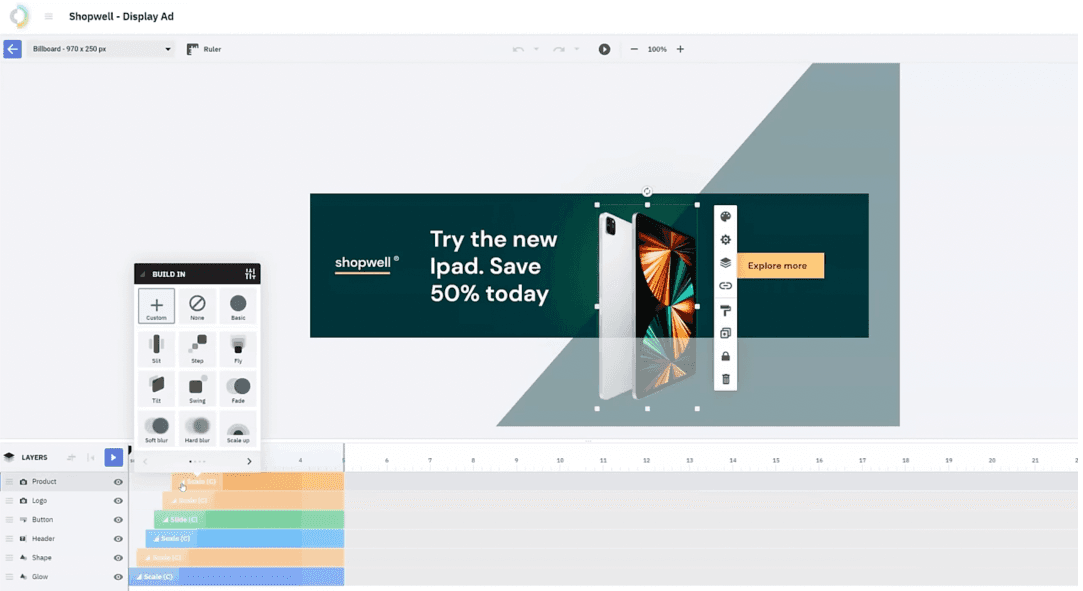
Creatopy Animator
Creative Scaling and Bulk Generation
The real test of any display ad builder is what happens after the first creative is approved. Can it generate the 50, 100, or 500 variations your media plan requires, without reopening the design file for each one?
Viewst
Viewst's scaling workflow is built around three pillars: one-click auto-resizing to all IAB standard sizes, CSV and feed-based bulk generation for producing entire HTML5 banner sets from a data source, and synced editing that propagates changes across every variation in real time.
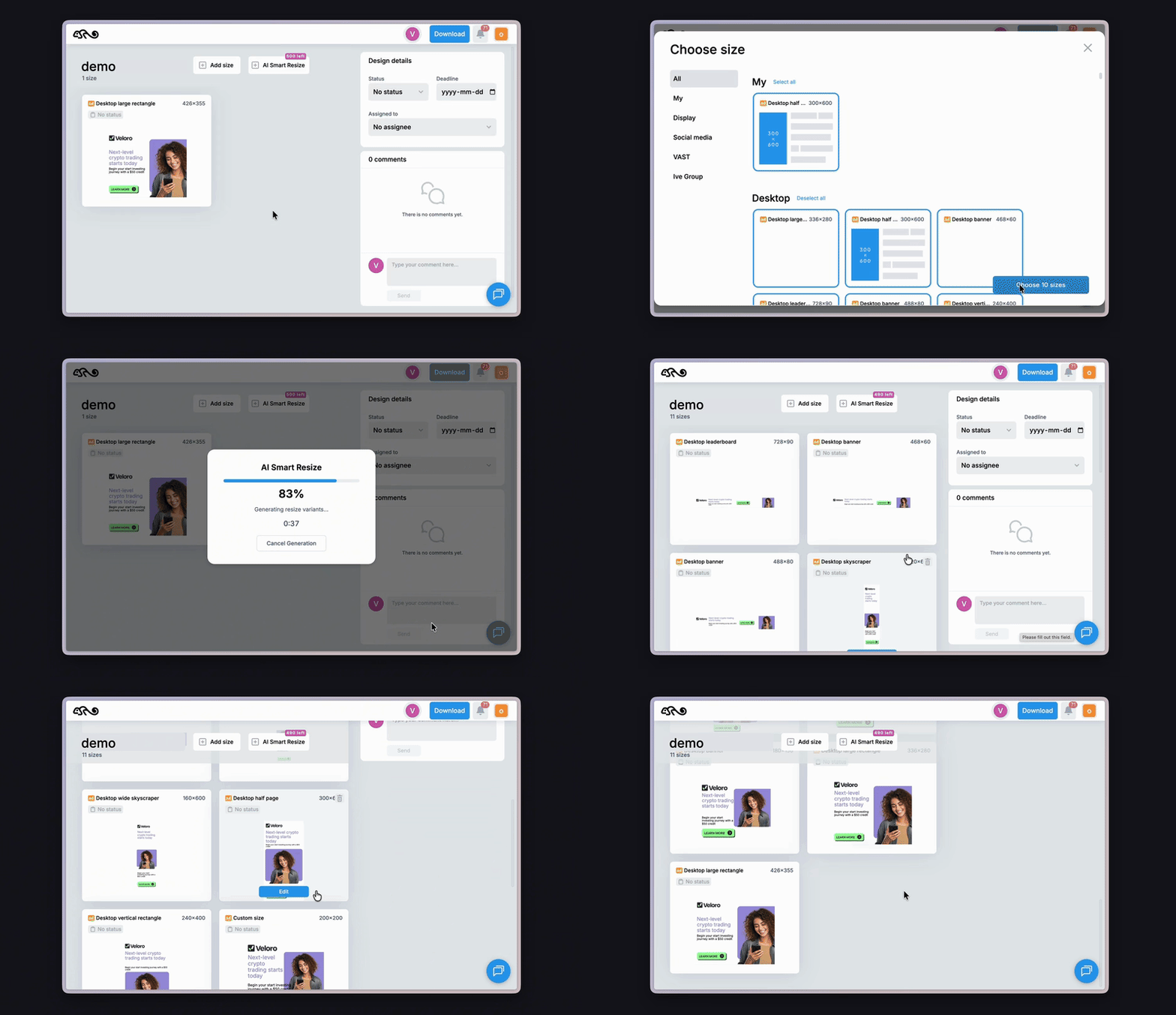
The synced-edit capability is particularly valuable for large campaigns. When a stakeholder requests a copy change or a new CTA color, you make the edit once, and it cascades across every size and language variant instantly. There is no need to open each variation individually, a workflow bottleneck that scales linearly with campaign complexity on most other platforms. This is what makes Viewst a genuine HTML5 banner creator built for volume.
Creatopy
Creatopy offers Smart Resize for adapting a master design to multiple dimensions and a Feed Ad Builder that connects to data feeds for automated variation generation. Both features work well for standard scaling tasks.
Where the experience diverges is in edit propagation. Creatopy's resize workflow creates independent copies of the design at each size. If you need to update copy, swap an image, or adjust timing on all variants, you are likely handling each one separately, manageable for a small campaign, but increasingly tedious as variation counts climb into the hundreds. Teams running high-volume programmatic campaigns should factor this operational overhead into their evaluation.
Collaboration and Brand Governance
Design tools do not exist in isolation. They sit inside a production workflow that involves creative directors, copywriters, compliance teams, and external stakeholders. Brand governance, the ability to enforce visual standards at scale, is just as important as the editor itself.
Viewst
Viewst offers Brandbooks with locked templates that enforce typography, color, and layout rules across every creative. A centralized asset library with version control ensures everyone works from the latest approved logos, images, and fonts. Collaboration features include in-context commenting, configurable roles and permissions, guest preview links for external stakeholders, approval workflows, and status and deadline tracking.
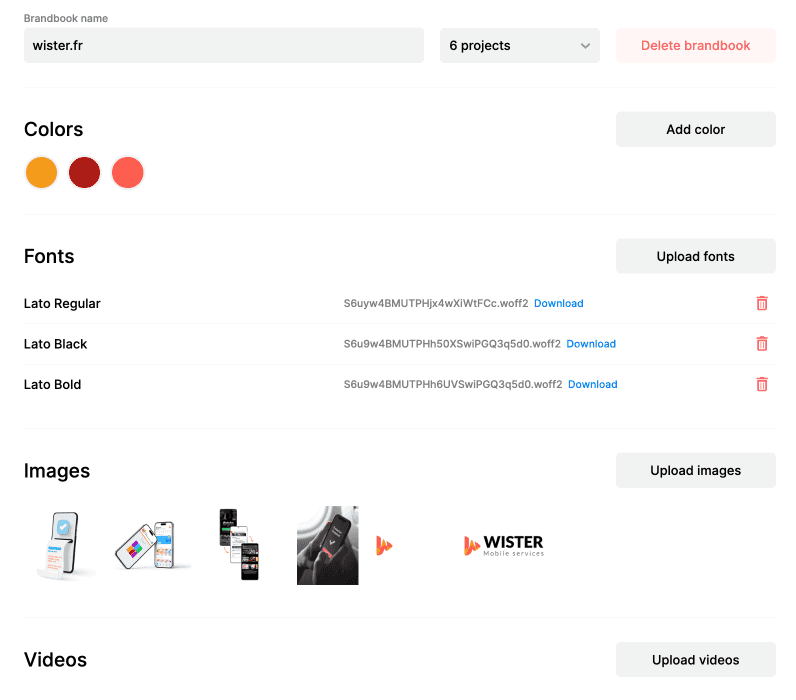
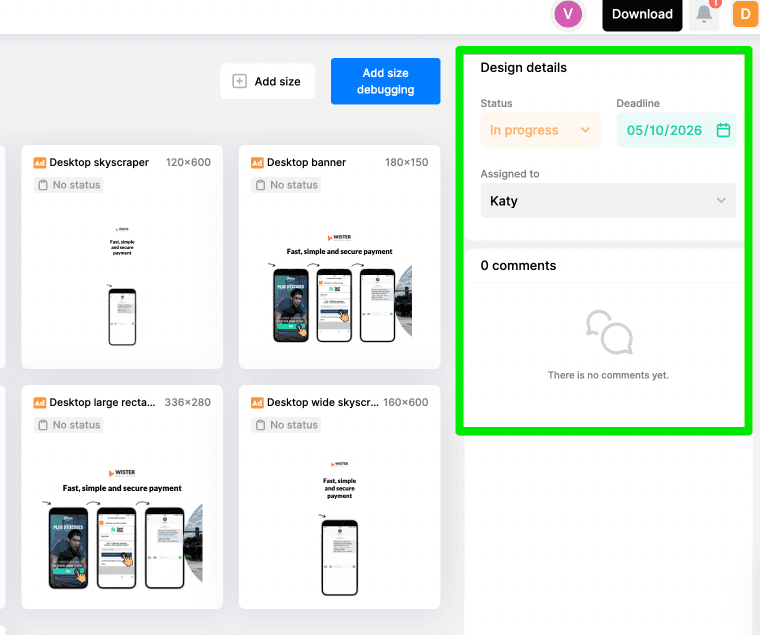
The platform also supports Figma and Photoshop import, so design teams can start in their preferred tool and transition to Viewst for production and scaling without rebuilding from scratch. One-day onboarding means new team members are productive almost immediately, a practical advantage that compounds as organizations grow.
Creatopy
Creatopy provides Brand Kits, three on the Pro plan, unlimited on Team and above, for storing logos, colors, and fonts. The platform also supports Photoshop and Figma import.
Collaboration is solid: team workspaces, shared folders, and commenting features are included in paid plans. However, advanced governance features—locked templates, granular role-based permissions, and formal approval workflows—are less mature compared to Viewst's implementation. Organizations with strict brand compliance requirements or multi-tier approval chains may find Creatopy's governance layer needs supplementing with external tools.
Viewst vs Creatopy: Ad Network Integration and Analytics
Getting creatives out of the design tool and into the ad network is where many platforms introduce friction. The last mile, export, upload, trafficking, should be seamless.
Viewst
Viewst offers direct export to Google DV360, Campaign Manager 360, and Meta Ads Manager. The HTML-first architecture means exported files need minimal or no post-processing before trafficking. All plans include unlimited HTML5 downloads, there is no paywall gating your production output.
Real-time creative analytics and A/B testing are available on every plan, not locked behind an enterprise tier. You can monitor impressions, clicks, and engagement metrics directly inside the platform, then iterate creatives based on performance data without switching tools. For teams that treat display ad design as an ongoing optimization cycle rather than a one-and-done deliverable, this tight feedback loop is a significant advantage.
Creatopy
Creatopy supports ad serving on 25+ ad networks, but this functionality is limited to the Pro plan and above. The platform provides HTML5 export compatible with major networks and includes reporting, analytics, and A/B testing again, on paid tiers.
Creatopy's Competitive Intelligence feature, available on Pro and above, lets you track competitor ad creatives across networks. This is a genuinely unique capability in the space—useful for media buyers and strategists who want to benchmark creative approaches. If competitor monitoring is part of your workflow, Creatopy offers something Viewst does not.
Pricing Comparison
Price is never just the number on the plan page. The real cost includes how many features are gated, whether downloads are metered, and how quickly your team can become productive.
Viewst
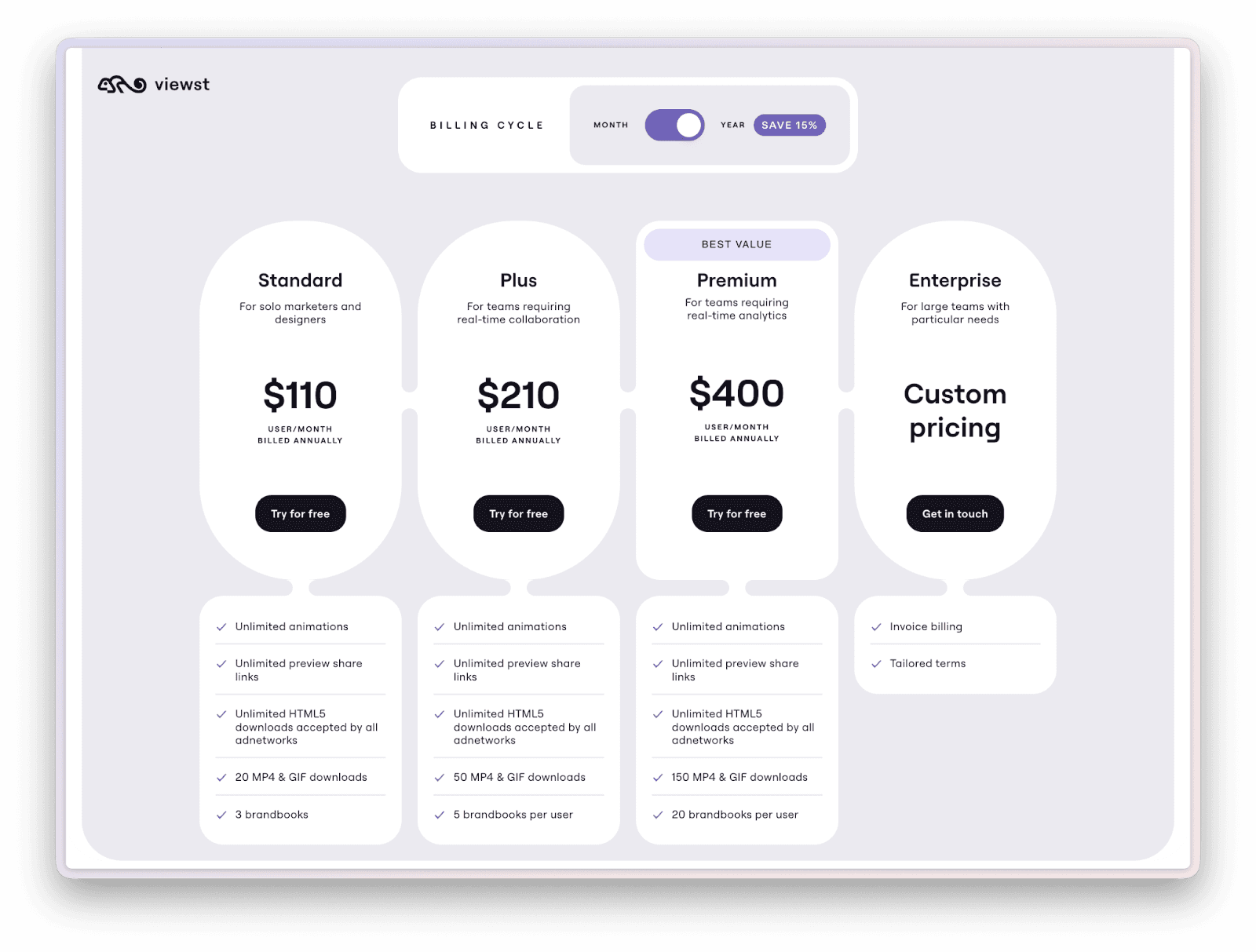
Viewst offers four tiers: Standard (for solo practitioners), Plus (for teams needing collaboration), Premium (adding analytics and advanced features), and Enterprise (custom). Every plan includes unlimited designs, unlimited auto-resizing, and unlimited HTML5 downloads, there is no per-export fee and no artificial cap on production volume.
Annual billing comes with a 15% discount, and the company advertises one-day onboarding, which reduces the ramp-up cost for new teams. For organizations focused on ad creative automation at scale, the all-inclusive plan structure means costs are predictable and do not escalate with output.
Creatopy
Creatopy's current pricing includes a Free plan (1 seat, 1 Brand Kit, 5 GB storage), Pro at $49 per user per month, Team at $79 per user per month, and Enterprise at custom pricing. The free tier is a genuine advantage for freelancers or very small teams testing the platform.
However, many of the features that matter most for production teams—ad serving, analytics, A/B testing, and Competitive Intelligence—are locked to Pro or above. At $49–$79 per seat, costs scale quickly for mid-size teams. The learning curve is also steeper than Viewst's, which can extend the time-to-value and increase implicit onboarding costs.
Viewst vs Creatopy: Feature Comparison at a Glance
Feature | Viewst | Creatopy |
Architecture | HTML-first (real HTML/CSS output) | Pixel-based editor with HTML5 export |
Animation Presets | 82+ with timeline editor | 36+ per phase with Magic Animator |
Bulk Generation | CSV/feed-based with synced edits | Feed Ad Builder (independent copies) |
Ad Network Export | DV360, CM360, Meta (direct) | 25+ networks (Pro plan and above) |
Analytics & A/B Testing | All plans | Pro plan and above |
Brand Governance | Brandbooks, locked templates, approval workflows | Brand Kits (3 on Pro, unlimited on Team+) |
AI Features | Background removal, copy gen, localization, image gen | Image gen, copy gen, video gen, product photography, competitive intel |
HTML5 Downloads | Unlimited on all plans | Plan-dependent |
Onboarding | One-day onboarding | Steeper learning curve |
Pricing | Standard / Plus / Premium / Enterprise; 15% annual discount | Free / Pro $49/user/mo / Team $79/user/mo / Enterprise custom |
Conclusion: Which Platform Should You Choose?
Both Viewst and Creatopy are capable creative automation platforms, and both can produce professional display advertising. The right choice depends on your team's priorities.
Choose Creatopy if you need a free entry point, value a broad AI toolkit that extends into video generation and product photography, or want built-in competitive intelligence for benchmarking rival campaigns.
Choose Viewst if your primary workflow is high-volume HTML5 display ad production and you need production-ready output with minimal post-export work. Viewst's HTML-first architecture, deeper animation control, synced cross-variation editing, unlimited downloads on every plan, and real-time analytics on all tiers make it the stronger choice for dedicated display ad design teams that treat banner production as a core competency rather than a side task.
For teams that live and breathe display advertising—agencies running multi-market campaigns, in-house creative ops teams scaling across dozens of sizes and languages, and performance marketers iterating on creatives daily—Viewst is purpose-built for exactly that workflow.
Ready to see the difference for yourself? Start your free trial at viewst.com and experience HTML-first creative automation in action.

Steven Khuong is a GTM strategist and advisor focused on helping companies scale creative production and advertising systems using AI and automation. He has led growth initiatives across high-volume digital platforms, with a focus on turning fragmented creative workflows into structured, scalable systems that drive faster campaign execution and performance.
In this article
" height="11.060000000000002px" id="wzBCZ87AK" transform="translate(6.47 2.47)" width="6.590000000000003px"/></g></svg>)