
Summary
A creative automation platform turns one master creative into hundreds of on-brand display ad variations across every size, language, and platform. The best platforms in 2026 are Viewst, Bannerflow, Celtra, Smartly, Creatopy, and Storyteq, each suited to different team sizes and use cases. This guide explains what creative automation actually does, who each platform fits best, and how to choose without wasting six weeks of procurement.
What a creative automation platform actually is
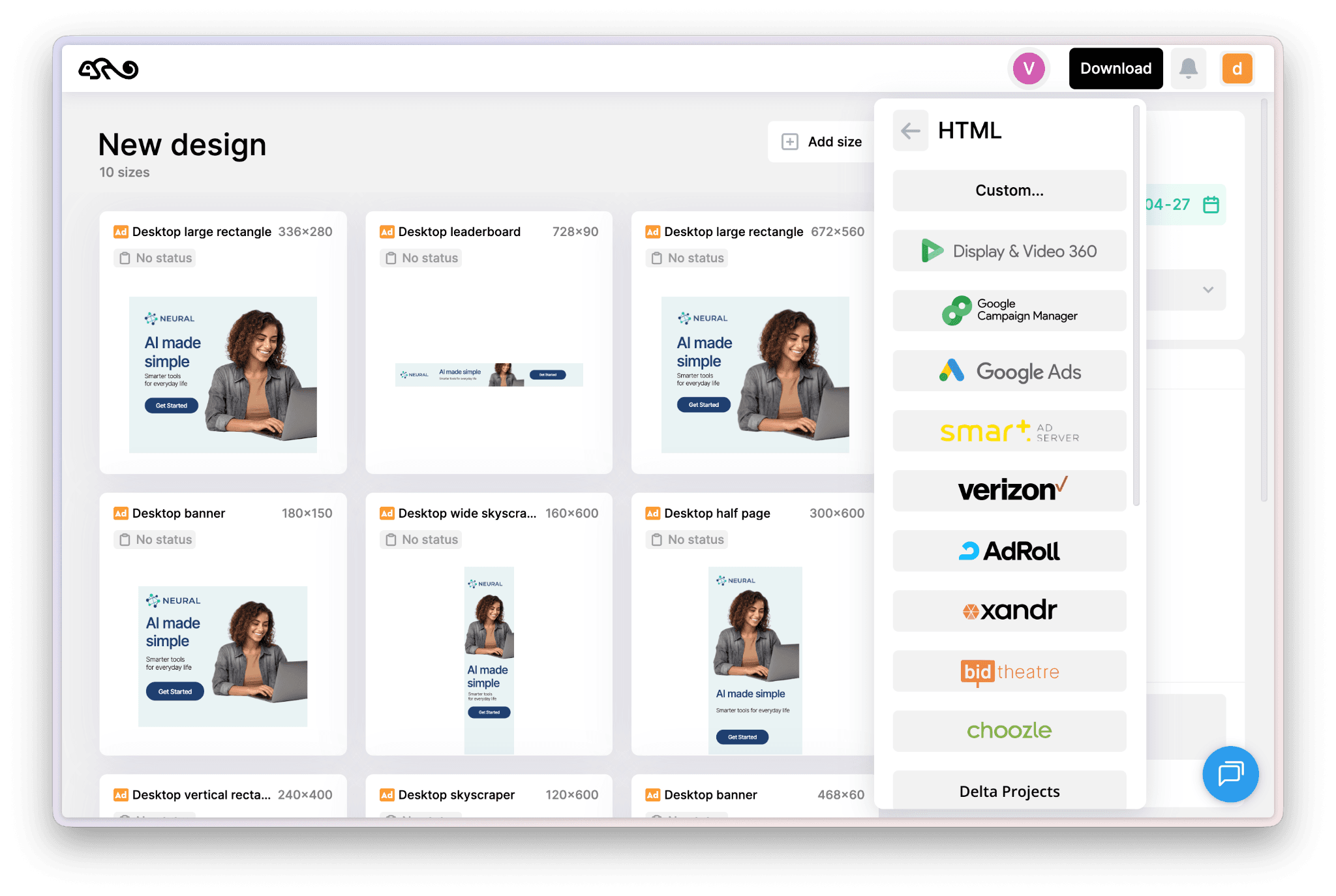
A creative automation platform is software that takes one master ad creative and produces every variation a campaign needs (sizes, languages, offers, audiences) as ready-to-serve HTML5 or video files. The category sits between design tools like Figma (where concepts are originated) and ad networks like Google Ads (where the creative is served). For a deeper look at the underlying production model, see our HTML5 ad automation guide.
The platforms exist because manual ad production stopped scaling. Modern campaigns need hundreds of variations per launch. Designers cannot build that volume by hand. Creative automation closes the gap between concept and production.
There are three things every serious platform in this category does:
Multi-size generation from a master. One canonical design, automatically resized into every required IAB and platform size, with layout adapting to each canvas.
Brand control at the workspace level. Logos, fonts, color palettes, and approved copy locked so variations cannot drift off-brand.
Native HTML5 (and video) export. Output that meets file size and format requirements for Google Ads, Meta, DV360, and the major DSPs.
The platforms differ in pricing model, target customer, animation capability, dynamic content support, and how cleanly they integrate with the rest of a modern marketing stack.
How to choose: the four questions that matter
Before evaluating platforms, answer four questions about your team.
1. What is your production volume? A team shipping 5 campaigns a year with 20 variations each has very different needs from a team shipping 50 campaigns a year with 200 variations each. High-volume teams need stronger dynamic content support and feed-based variation generation.
2. Where do your designs originate? If most creative starts in Figma, you need a platform with strong Figma import. See our breakdown of how Figma to HTML5 ad conversion actually works. If you have a hand-coded HTML5 workflow, the import requirements are different.
3. How regulated is your brand? Enterprise brands and regulated industries (finance, healthcare, pharma) need strict guardrails, audit trails, and SOC 2 documentation. Faster-moving DTC brands may be willing to trade some control for flexibility.
4. What is your team size and structure? Small in-house teams need different tooling from large agencies with multiple clients in the platform.
The answers narrow the shortlist faster than any feature comparison.
The platforms worth evaluating in 2026
Viewst
Best for: Performance marketing teams and creative agencies producing high-volume display campaigns with strict brand control needs.
What it does well: One master creative to native, editable, animated HTML5 ads across every size, audience, and platform. Brand guardrails locked at the workspace level. Clean HTML5 export. Free trial available.
Where it fits: Teams that have outgrown a manual workflow but want production automation without the enterprise-scale price tag and procurement cycle of Bannerflow or Celtra.
Learn more: Viewst homepage | Pricing | Viewst vs Bannerflow | Viewst vs Canva | Viewst vs Creatopy
Try it: Start a free Viewst trial
Bannerflow
Best for: Large enterprise brands with mature creative operations teams.
What it does well: Strong DCO (dynamic creative optimization) integration, mature workflow features, established enterprise customer base in finance and travel.
Trade-off: Enterprise pricing and procurement cycle. Smaller teams typically find the platform heavier than they need.
Abyssale
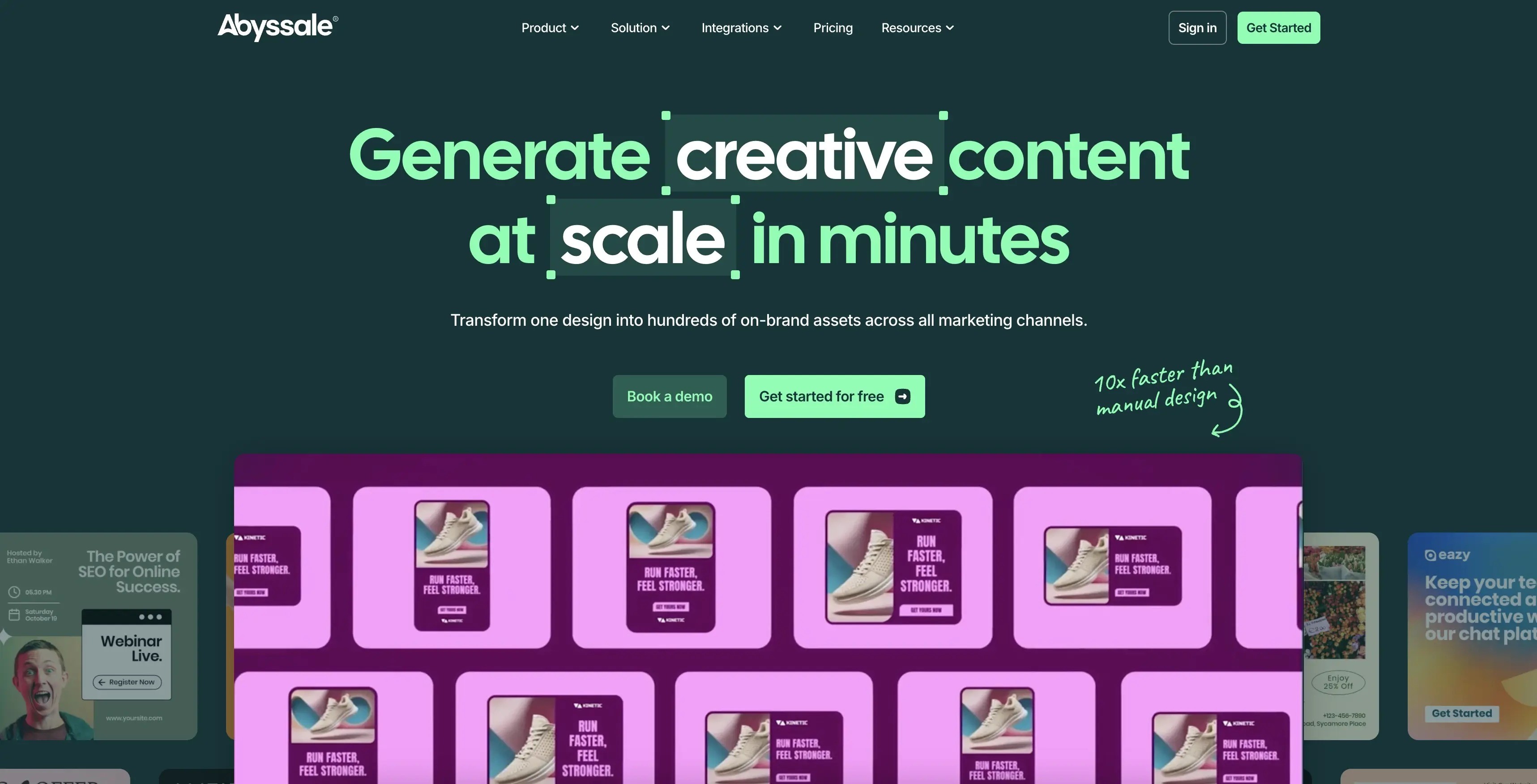
Best for: Marketing teams, creative teams, and agencies that need to produce large volumes of on-brand display ads and campaign variations across formats, markets, and audiences.
What it does well: Abyssale is a creative automation platform that turns one approved master design into hundreds of localized and personalized variations. Teams can generate creatives in bulk using spreadsheets, integrations, or the API while maintaining control over layouts and brand guidelines. The platform supports static images, video, GIF, HTML5 banners, and print-ready PDFs, and also provides access to multiple leading AI image-generation and editing models.
Trade-off: Abyssale focuses on structured creative production and variation rather than media buying or campaign distribution.
Celtra
Best for: Large brands and agencies with dedicated creative operations functions.
What it does well: Robust enterprise feature set, deep workflow customization, strong analytics layer.
Trade-off: Setup and onboarding are significant. The platform rewards teams that invest in it and frustrates teams that want a fast time to value.
Smartly
Best for: Performance marketing teams running paid social at high volume.
What it does well: Social-first creative automation, strong Meta and TikTok integration, programmatic creative production tied to media buying.
Trade-off: Display advertising is not the primary focus. Teams running heavy display alongside social may find the display feature set thinner than dedicated display tools.
Creatopy
Best for: Small-to-mid teams producing display creative without a heavy enterprise workflow.
What it does well: Accessible editor, broad template library, reasonable pricing for smaller teams.
Trade-off: Less depth on dynamic content and feed-based variation generation than the enterprise-grade tools.
Storyteq
Best for: Brands running both display and video at scale.
What it does well: Strong video automation alongside display, useful for teams unifying creative production across formats.
Trade-off: Enterprise pricing model. Smaller teams may find it more than they need.
What about Canva and Adobe?
These come up in every creative automation conversation, so let's be direct.
Canva is excellent for non-designers producing simple social posts and one-off creative. It is not a creative automation platform. There are no brand-locked variation workflows at scale, no clean HTML5 export for programmatic display, and no feed-based dynamic content. Use Canva for what it is good at and use a real automation platform for ad production.
Adobe (specifically Adobe Express and Animate) is a design tool, not a production automation platform. Animate produces HTML5 ads, but one at a time, by hand. Adobe is upstream of creative automation, not a replacement for it.
The category exists because design tools and production automation are different jobs.
What to test before you commit
Free trials and demos are how this category should be evaluated. Run a real campaign through the platform end-to-end. Specifically:
Import a real Figma file. Check how cleanly the import preserves layers, fonts, and structure.
Generate the full size set for one campaign. Look at every output, not just the 300x250 hero size. The 160x600 and 320x50 reveal whether the resize logic is real.
Run a dynamic content test. Upload a spreadsheet of headlines or offers and check the variant output.
Export and upload to your actual ad server. Validate file size, animation rendering, and click-through behavior on Google Ads or your DSP.
Test brand guardrails. Try to break them. If a junior team member can produce an off-brand variant in three clicks, the guardrails are not real.
This whole evaluation should take a week. Any vendor that resists letting you test the actual workflow before committing is selling marketing copy, not software.
The four traps in this category
1. Enterprise platforms sold to small teams. The biggest platforms have the most features. They also have the longest onboarding and the most rigid workflows. A 5-person team is better served by a platform built for their scale.
2. Pretty editors with broken exports. Some tools optimize for the demo. The editor looks great, the output is bloated and rejected by Google Ads. Always test the export.
3. Per-export pricing. Some vendors charge per variation exported. At scale this burns budget fast. Per-seat or campaign-based pricing is more predictable.
4. AI feature theater. Every platform claims AI now. Most of it is incremental. The AI that matters in this category is the resize intelligence and the brand guardrail enforcement, not the generative concept tools. Be skeptical of demos that lean heavily on AI-generated concepts.
Frequently asked questions
What is the difference between a creative automation platform and a DCO tool?
Creative automation produces the variation pool. DCO chooses which variation to serve in real time. You need a creative pool before DCO can do anything. Some platforms (Bannerflow, Smartly) handle both. Some specialize in production (Viewst, Creatopy) and integrate with DCO tools downstream.
How long does it take to migrate from manual production to a creative automation platform?
Most teams see productive use within 2 weeks and full workflow migration within 4 to 6 weeks. The first automated campaign typically ships at 5 to 10 times the speed of the manual equivalent.
Are these platforms worth it for in-house teams under 10 people?
Yes, if you are producing more than 20 variations per campaign or running more than 10 campaigns per year. Below that volume, manual production may still pencil out.
Can creative automation platforms produce video as well as display?
Most modern platforms support both. Storyteq and Smartly are particularly strong on video. Viewst and Bannerflow handle video as part of a broader display workflow.
Which platform should I shortlist if I want a fast time to value?
For teams that want production automation without an enterprise procurement cycle, Viewst and Creatopy are the fastest to evaluate. Both offer free trials and a workflow that a designer can be productive in within a few days.
Bottom line
Creative automation is no longer optional for any team running serious display advertising. The platforms differ in scale, price, and target customer, but the underlying job is the same: turn one master creative into every variation a campaign needs, without burning out the design team.
Pick a shortlist of two or three based on your team size and use case. Run real campaigns through each. Choose based on output quality and workflow fit, not feature lists.
Start a free Viewst trial if you want to evaluate the production-focused option in this list. One real campaign through the platform tells you more than any vendor demo.

Victoria is the CEO at Viewst. She is a serial entrepreneur and startup founder. She worked in Investment Banking for 9 years as international funds sales, trader, and portfolio manager. Then she decided to switch to her own startup. In 2017 Victoria founded Profit Button (a new kind of rich media banners), the project has grown to 8 countries on 3 continents in 2 years. In 2021 she founded Viewst startup. The company now has clients from 43 countries, including the USA, Canada, England, France, Brazil, Kenya, Indonesia, etc.
In this article
" height="11.060000000000002px" id="wzBCZ87AK" transform="translate(6.47 2.47)" width="6.590000000000003px"/></g></svg>)