If you're researching a creative automation platform for display advertising, Viewst and Abyssale are two names that come up early. Both let teams produce visual content faster, both support bulk variant generation, and both market themselves as alternatives to the slow, manual design workflows that hold campaigns back.
But they were built for different jobs. Abyssale is a broad content automation tool designed to generate social posts, display ads, email images, and marketing visuals all from one place. Viewst is a purpose-built HTML5 ad builder for advertising and creative teams who need professional-grade display ad production — animated, multi-size, and ad-network-ready — without involving a developer at any stage.
This comparison covers six areas where the two platforms genuinely differ: HTML5 capability, animation depth, brand governance, feed-based automation, analytics, and pricing. By the end, you should have a clear answer on which platform fits your team's actual workflow.
HTML5 Ad Building: Compliance vs. Coverage
The most important question for any display advertising team is whether your tool can produce output that actually runs on programmatic ad networks. Both Viewst and Abyssale export HTML5, but what that means in practice is different.
Viewst
Viewst was built from the ground up around HTML5 ad production. Every asset you create in the editor is rendered as real HTML and CSS in real time — not a flat image export with an HTML wrapper. When you export, you get network-specific packages with click-tag support, file-size compliance checks, and IAB spec alignment built into the workflow. That means the file your trafficking team receives is ready to upload to Google Ads, DV360, Campaign Manager, or Meta without needing a developer to repackage it.
For teams running programmatic display campaigns, this is not a small detail. A file that fails ad-network validation, has missing click tags, or exceeds file-size limits doesn't run — and fixing it after the fact is exactly the kind of manual work these platforms are supposed to eliminate.
Video with html5 export and validating: https://h5validator.appspot.com/dcm/asset
Abyssale
Abyssale supports HTML5 export and does it reasonably well. The platform's focus, however, is broader than display advertising. It was designed to generate visual content at scale across multiple channels: social media posts, email personalization, display ads, out-of-home formats, and blog imagery, all from one interface. HTML5 banner production is one use case among many rather than the core mandate.
The result is that Abyssale's HTML5 output is functional but lacks the ad-network-specific tooling that dedicated display ad builders provide. Teams producing high-volume programmatic display campaigns with strict network requirements will typically find they need to do more post-export work with Abyssale than with Viewst.
Try html5 export on a trial account and show either screenshots or short video (also validate)
Animation: Keyframe Control vs. Basic Motion
Animation is what separates a display ad that earns attention from one that gets scrolled past. The gap between the two platforms here is significant.
Viewst
Viewst's animation timeline gives designers keyframe-level control over every element in the design: entrance timing, exit timing, easing curves, delay, loop behavior, and per-layer sequencing. This is the same level of control that motion designers expect from dedicated animation tools, delivered inside the ad production environment without requiring a separate After Effects or Animate workflow. The output compiles to CSS and JavaScript keyframes, keeping file sizes small and load times within ad-network limits.
For teams producing animated HTML5 display campaigns across IAB standard sizes, this depth of control is how you get motion that feels intentional rather than templated. It also matters for performance: well-timed animation with a clear visual hierarchy consistently outperforms static ads and generic motion.
Abyssale
Abyssale supports animation in its design studio, including some preset motion options and basic timeline controls. For social content and simpler display formats, this is sufficient. For teams producing animated HTML5 banners intended for programmatic display campaigns — where animation complexity, sequencing, and file weight all affect delivery — Abyssale's animation tooling doesn't reach the same level of professional control.
Brand Governance: Per-Layer vs. Template-Level
For enterprise teams and agencies managing creative across multiple contributors, brand governance isn't a nice-to-have — it's the mechanism that prevents brand drift at scale.
Viewst
Viewst's brand governance operates at the element level. When a Creative Director builds a brand template in Viewst, they can lock individual layers: the logo stays in position and cannot be moved, the background color is fixed, the headline is editable, the product image can be swapped. Downstream users — regional marketers, local partners, junior designers — work within those constraints regardless of their intentions or experience level. The system enforces consistency rather than assuming it.
This is complemented by Brand Kits that store approved logos, colors, and fonts as a centralized source of truth, and SSO integration via Okta and SAML for enterprise identity management.
Abyssale
Abyssale supports brand templates with locked elements, which is a solid foundation for brand consistency. The platform's governance model, however, operates at the template level rather than the individual layer level. Teams can restrict which elements users can change, but the granularity doesn't reach the per-layer permission control that Viewst provides. For smaller teams or agencies where contributors are relatively controlled, this is unlikely to be a problem. For large enterprise organizations with many contributors working from shared templates across multiple markets, the difference matters.
Creative Scaling and Feed Automation
Both platforms support bulk variant generation — the ability to produce many ad variants from a single master template using data from an external source. This is where ad creative automation justifies the investment over manual design.
Viewst
Viewst connects to CSV files and URL feeds, binding data fields to design layers. Upload a product feed, map the columns to your text, image, and CTA layers, and Viewst generates every variant — animated, correctly sized, and ad-network-compliant — in a single batch. Every plan includes unlimited HTML5 downloads, so there are no per-export charges regardless of how many variants you produce.
Dynamic templates keep edits synchronized: change a headline in the master and the update propagates across every size and variant automatically. For teams running large-scale display campaigns with product catalogs, localization requirements, or A/B testing needs, this workflow is where Viewst saves the most time.
Abyssale
Abyssale's creative scaling is genuinely strong, and in some ways broader than Viewst's. The platform supports CSV-based bulk generation, a spreadsheet editor for managing variants, and a RESTful API with integrations into 1,000+ apps via Zapier and Make. For teams that want to embed creative generation into a larger marketing automation stack — triggering banner updates from a CMS, generating personalized email images automatically, or connecting to a live product database — Abyssale's API-first architecture is a real advantage.
The key difference is that Abyssale's scaling is optimized for content volume across channels, while Viewst's is optimized for display ad production specifically: animated HTML5, IAB sizes, and ad-network delivery.
Analytics and Performance Data
Knowing which creatives perform is the feedback loop that improves your output over time.
Viewst
Viewst's Premium plan includes creative-level analytics with ad-account sync, connecting individual banner performance to campaign data from Meta and Google. Teams can see which variants drive clicks, identify which sizes perform best, and make data-informed decisions about future creative direction. This feedback loop is built into the production environment — not a separate reporting tool.
Abyssale
Abyssale does not currently offer ad performance analytics. The platform tracks production workflows and asset status, but it doesn't connect creative output to campaign performance data. For teams that treat creative analytics as a core part of how they improve their display advertising over time, this is a gap worth factoring into the decision.
Pricing: Seat-Based vs. Credit-Based
The pricing models are structurally different, and the right one depends heavily on your team's production volume.
Viewst
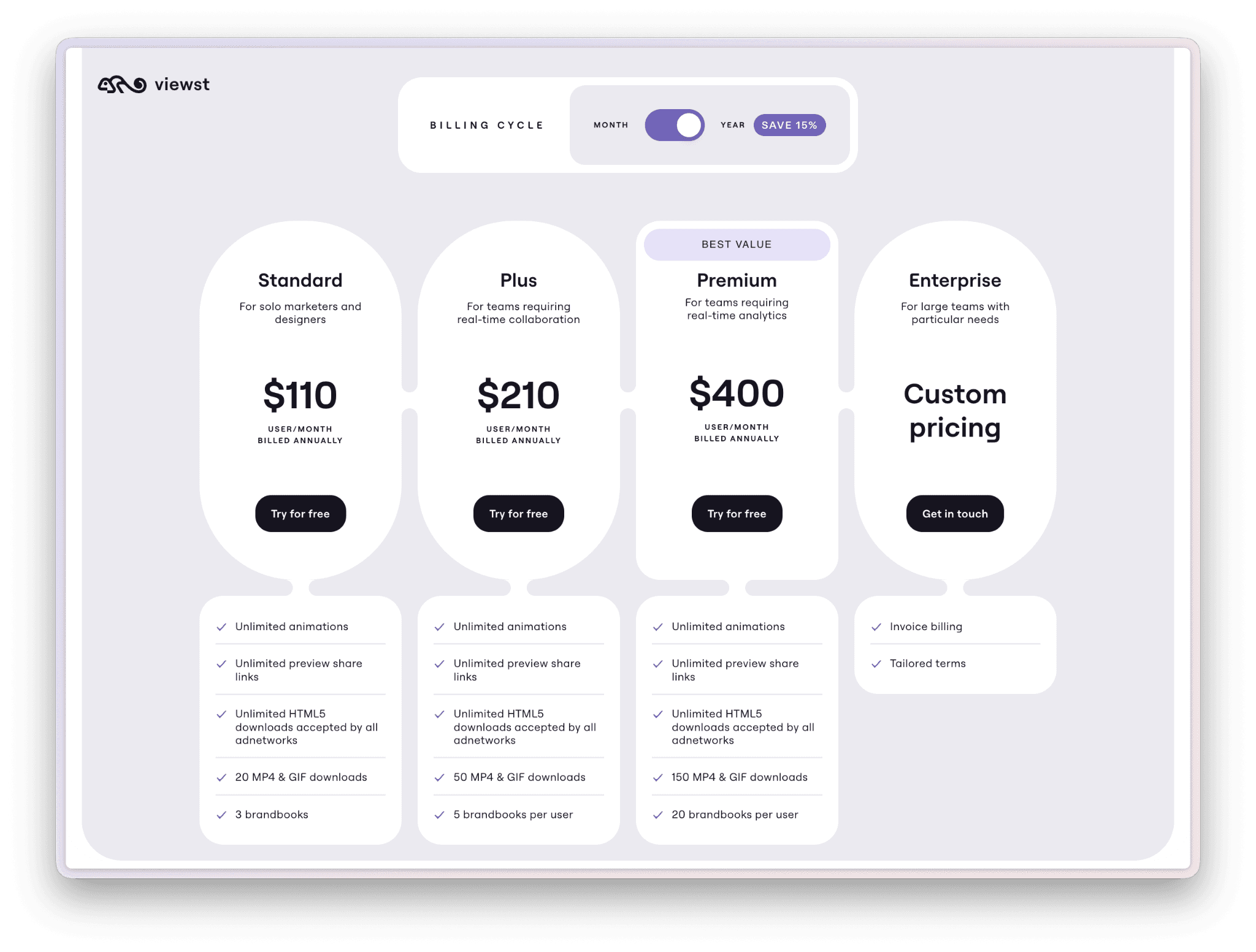
Viewst charges per seat with unlimited HTML5 and image exports on every plan. Standard starts at $110 per month, Plus at $210, and Premium at $400. Whether your team produces 50 creatives per month or 5,000, the cost stays the same. For high-volume display advertising teams, this unlimited model is meaningfully more cost-efficient at scale than credit-based pricing.
Abyssale
Abyssale operates on a credit-based model. Plans range from Starter ($25/month, 250 credits) to Business ($75/month, 2,000 credits) to Prime ($125/month, 10,000 credits), with Enterprise available at custom pricing. AI features consume additional credits. At low volumes and across multiple content types, Abyssale's pricing is significantly more accessible than Viewst's. At high HTML5 display ad volumes — particularly where animated banner generation is the primary use case — the credit model can become less predictable.
The right comparison isn't Abyssale Starter vs. Viewst Standard. It's: what is your actual monthly production volume, and what does each model cost at that volume?
Comparison Summary
Feature | Viewst | Abyssale |
|---|---|---|
HTML5 ad compliance | Network-specific packaging, click tags, IAB spec validation | HTML5 export available; no built-in network compliance tooling |
Animation | Full keyframe timeline — per-layer timing, sequencing, easing | Basic animation support |
Brand governance | Per-layer locks, Brand Kits, SSO (Okta/SAML) | Template-level locking; no per-layer permissions |
Bulk variant generation | CSV/URL feed automation; unlimited exports on all plans | CSV, spreadsheet editor, API; 1,000+ Zapier/Make integrations |
Content scope | Display ad production | Social, display, email, OOH, and more |
Ad performance analytics | Creative-level with ad-account sync (Premium) | Not available |
Pricing model | Per seat, unlimited exports — from $110/month | Credit-based — from $25/month |
API integrations | Webhooks and API on Plus plans | RESTful API, Zapier, Make |
Best for | Advertising teams producing HTML5 display at scale | Marketing teams automating content across multiple channels |
Which Platform Is Right for Your Team?
The answer comes down to what you're primarily producing and at what scale.
If your team's core output is HTML5 display advertising — animated banners, programmatic campaigns, multi-size IAB production, feed-driven product ad variants — Viewst is the purpose-built choice. The animation timeline, ad-network compliance tooling, per-layer brand governance, and unlimited exports are designed specifically for that workflow.
If your team needs to automate visual content across multiple channels — social media, email, display, and OOH — at modest volume, and wants a flexible API-first platform to integrate into a broader marketing stack, Abyssale is worth serious consideration. It covers more content types at a lower starting price, and its automation capabilities are genuinely strong for multi-channel content operations.
The price difference is real. So is the production depth difference. Evaluate both against your actual workflow, not the sticker price.
Start your free trial at viewst.com — 14-day trial, no credit card required, full platform access from day one.

Victoria is the CEO at Viewst. She is a serial entrepreneur and startup founder. She worked in Investment Banking for 9 years as international funds sales, trader, and portfolio manager. Then she decided to switch to her own startup. In 2017 Victoria founded Profit Button (a new kind of rich media banners), the project has grown to 8 countries on 3 continents in 2 years. In 2021 she founded Viewst startup. The company now has clients from 43 countries, including the USA, Canada, England, France, Brazil, Kenya, Indonesia, etc.
In this article
" height="11.060000000000002px" id="wzBCZ87AK" transform="translate(6.47 2.47)" width="6.590000000000003px"/></g></svg>)