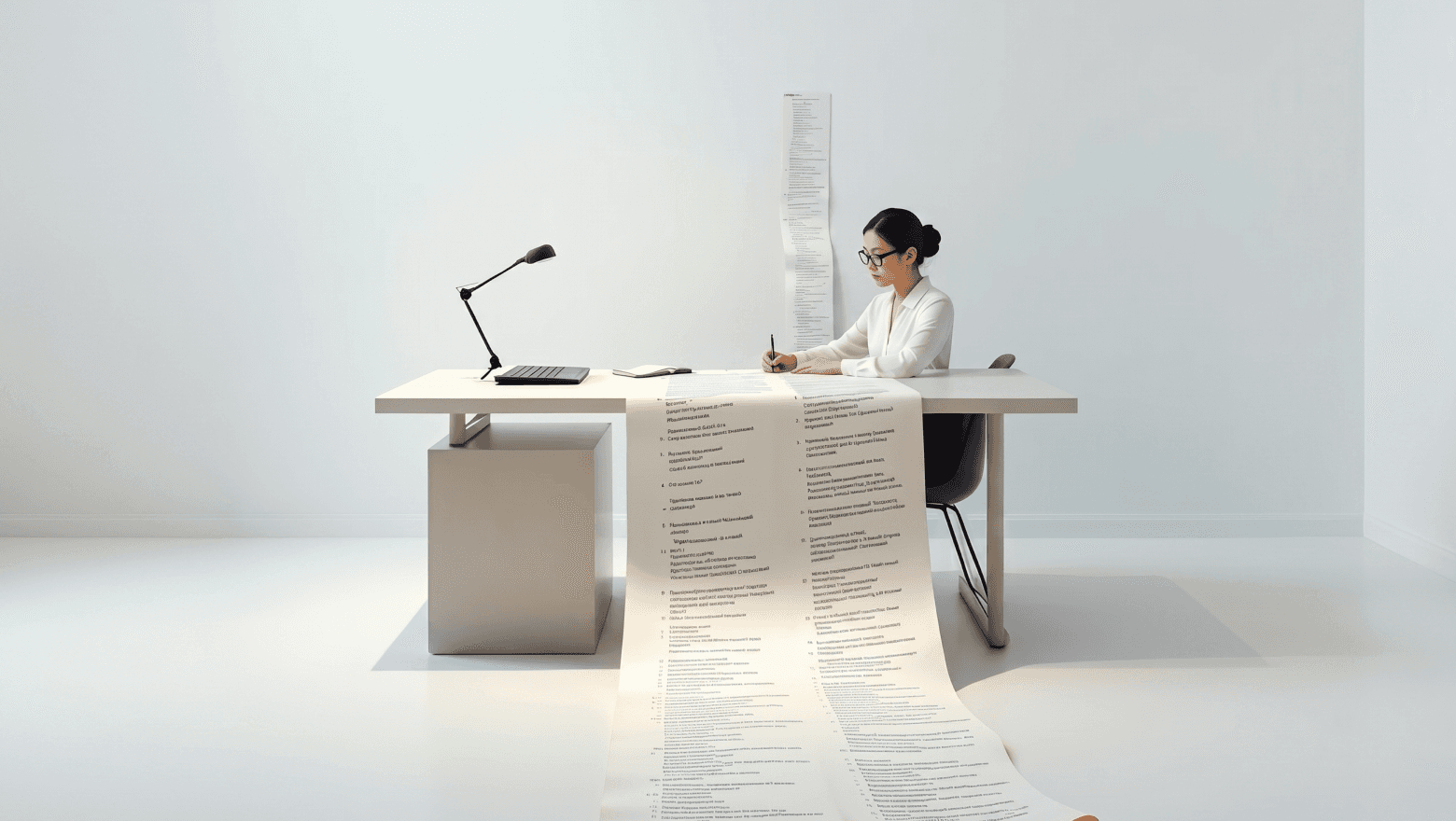
Most creative teams are still producing display ads the hard way: one size at a time, one variant at a time, with a developer on standby for the HTML5 export. AI tools have made that approach unnecessary. Here is what is actually possible now.
The conversation around AI in advertising tends to focus on the wrong things. Automated image generation gets the headlines. What actually matters for a working creative team is more practical: can AI eliminate the manual work that slows down ad production without sacrificing the brand control that makes the output usable?
Viewst's AI tools were built to answer that question with a yes. They are not a separate product or an add-on layer. They sit inside the same editor where designers produce HTML5 banners, animate creative, and sync ad sets. The result is a production workflow where AI handles the repetitive, time-consuming work — variant generation, resizing, feed-based bulk production — while designers retain full control over the output.
Here is how each capability works in practice.
THE PROBLEM AI SOLVES
Why ad production is still slow for most teams
A typical display campaign requires creative across 10 to 15 IAB sizes, multiple copy variants for A/B testing, and often several audience-specific versions of the same concept. In a traditional workflow, each of those outputs is a manual task: resize the layout, refit the text, check the file size, export to spec, repeat.
That is not a design problem. It is a production problem. And it is the reason creative teams spend the majority of their time on work that does not require creative judgment — leaving less time for the concept work that actually differentiates a campaign.
AI does not replace the creative judgment. It removes the production overhead that crowds it out.
The average creative team spends more time resizing ads than concepting them. AI doesn't fix that by being clever. It fixes it by making the repetitive work disappear.
FEATURE 1
Content variation: generate copy, image, and CTA alternatives in the editor
The first place AI saves time is at the variant level. Rather than manually duplicating a banner and rewriting the headline, designers can use Viewst's AI copy tool to generate multiple headline and CTA alternatives directly on the canvas — different tones, different lengths, different value propositions — without leaving the editor.
The same applies to images. AI image generation inside Viewst lets teams create background or product image alternatives from a text prompt, test them against the existing layout, and keep what works. No stock library hunting. No round-trip to a separate tool.
For A/B testing — where the value of testing depends on how many meaningful variants you can actually produce — this changes the math significantly. Instead of testing two or three variants because production time limits you, you can test ten.
▶ Watch: Watch: AI content variation in Viewst
FEATURE 2
Smart resize: one master creative, every IAB size, automatically
Resizing is the most time-consuming part of display ad production and the least creative. A 970x250 leaderboard does not automatically become a 300x250 medium rectangle — element positions break, text overflows, images lose their framing. In a manual workflow, each size is a separate rebuild.
Viewst's Smart Resize adapts the master creative to every required IAB format simultaneously. Element hierarchy, spacing, and text layout adjust to the new dimensions automatically. When you update the headline in the master, every size updates. When you swap the product image, every size updates.
For a campaign running across 12 standard sizes with three copy variants, that is 36 individual files generated from one design decision rather than 36 manual rebuilds. The time difference is measured in hours, not minutes.
▶ Watch: Watch: Smart Resize and ad set syncing in Viewst
FEATURE 3
Feeds integration: connect a product catalog, generate HTML5 banners in bulk
For teams running product catalog campaigns — retail, e-commerce, real estate, automotive — the variant problem scales differently. You are not producing 10 versions of one concept. You are producing one concept applied across hundreds or thousands of products, each with its own image, price, headline, and CTA.
Viewst's feeds integration connects your product feed — via CSV or URL — directly to a design template. Map the feed columns to the relevant design layers: product image to the image layer, product name to the headline, price to the CTA. Viewst generates every variant automatically, animated, correctly sized, and ad-network-compliant, without a designer touching each one individually.
Updates work the same way. When the product feed updates — a price change, a new product image, a seasonal promotion — the corresponding banner variants update automatically. The alternative is manually editing hundreds of individual files. The feeds integration makes that comparison irrelevant.
Every export is a production-ready HTML5 package with click-tag support and IAB spec compliance built in. No developer handoff required.
▶ Watch: Watch: Feeds integration and bulk HTML5 banner generation in Viewst
FEATURE 4
AI translation: one creative, every market
International campaigns multiply the production problem. Every variant needs to exist in every language, which in a manual workflow means a separate round of design work for each market. Viewst's AI translation feature handles this inside the editor: translate the copy layer across multiple languages in a single action, with the layout adjusting automatically to accommodate text length differences between languages.
The creative team reviews the output rather than producing it from scratch. Markets that previously required a two-week production lead time can receive localized creative in a fraction of that time.
PUTTING IT TOGETHER
What an AI-assisted ad production workflow actually looks like
The individual features matter, but their combined effect on a production workflow is where the real value shows up. Here is a realistic scenario for a mid-sized campaign:
Brief received Monday morning. Creative Director builds the master layout in Viewst. AI copy tool generates six headline and CTA variants for A/B testing.
Smart Resize runs automatically. All 12 required IAB sizes are generated from the master. One design decision, 12 outputs.
Feed connected for product variants. 150 product-specific banner versions generated in bulk from the CSV feed. Animated, sized, compliant.
Translation added for three markets. AI translates copy across English, French, and German with layout adjustment. 150 variants become 450.
Export and push. HTML5 packages with click-tag support pushed directly to Meta and exported for DV360. No developer involved at any stage.
That workflow — from brief to trafficking-ready creative across 450 variants — would take a traditional production team the better part of a week. With Viewst's AI tools working in the background, it is a day.
▶ Watch: Watch: Full AI-assisted production workflow in Viewst
The point is not the AI. The point is the time.
AI in ad design is not a trend worth chasing for its own sake. The reason it matters for advertising teams is simple: more time on creative judgment, less time on production overhead. Better campaigns, faster. More variants tested, more learning generated, more campaigns shipped without burning out the team that makes them.
Viewst's AI tools — content variation, Smart Resize, feeds integration, and translation — are each solving a specific production problem that every display advertising team faces. Together they change what a small creative team can realistically produce in a week.
If your team is still resizing banners one size at a time or waiting on a developer to package HTML5 files, the gap between your current workflow and what is possible now is larger than you might expect.
Start your free trial — see the AI tools in action on your own creative.
14-day free trial. No credit card required. Full platform access from day one.

Steven Khuong is a GTM strategist and advisor focused on helping companies scale creative production and advertising systems using AI and automation. He has led growth initiatives across high-volume digital platforms, with a focus on turning fragmented creative workflows into structured, scalable systems that drive faster campaign execution and performance.
In this article
" height="11.060000000000002px" id="wzBCZ87AK" transform="translate(6.47 2.47)" width="6.590000000000003px"/></g></svg>)