
We're moving again.
A new AI tool. Another interface. Another workflow rebuild. By the time you've memorized the keyboard shortcuts, the roadmap shifts, the pricing changes, or a competitor drops something shinier and your team's Slack lights up with "we should try this."
Creative professionals no longer occasionally adapt. They constantly migrate. And every migration, however small, quietly consumes attention, memory, and nervous system capacity. Designers don't just learn tools anymore. They rebuild parts of how they think, over and over, until the rebuilding itself becomes the job.
Nobody talks about this cost. So let's talk about it.
Interfaces Become Part of the Nervous System
A professional interface, used for long enough, stops being software. It becomes an extension of cognition. You don't think about Cmd+Z. You don't think about where the layers panel lives. Your hand moves before your brain finishes the sentence.
That's not a quirk. That's how expertise works. Familiar workflows reduce cognitive load because the brain stops consciously processing repetitive actions. Muscle memory creates a kind of quiet emotional stability. You can focus on the actual decisions because the mechanics have gone invisible.
Which is why losing a familiar workflow feels bigger than software frustration. It feels like losing operational continuity. The nervous system depends on predictability more than most of us realize, and design work depends on the nervous system more than most leadership decks acknowledge.
We Live Inside Perpetual Workflow Migration
Here's the uncomfortable truth about 2026: tools mutate faster than habits stabilize.
AI acceleration created permanent adaptation pressure. Designers no longer work inside one system. They exist inside fragmented ecosystems. Endless updates, unstable pipelines, multitool workflows, constant optimization. The modern creative environment is structurally unstable, and we've quietly accepted that as the price of working in this industry.
The problem isn't any single tool. It's that the ground keeps moving while you're trying to do the work.
Adaptation Became Infrastructure for Survival
Curiosity used to be a personality trait. The "always learning" type. Now it's professional infrastructure. Staying relevant means staying adaptable, and staying adaptable means rebuilding workflows, habits, and operational logic on a rolling basis.
The real problem isn't learning itself. Designers love learning. The problem is continuous cognitive rebuilding, where you never get to the part where the new system becomes invisible and your brain can stop watching itself work.
Why Changing Tools Feels Emotional
If you've ever watched a senior designer get genuinely upset about a UI redesign, you've seen this. They're not being precious. Software stores rituals, habits, shortcuts, and years of accumulated competence. Interfaces become part of identity continuity. The familiar system holds a version of your professional self.
Losing it feels strangely personal because, in a small way, it is. A workflow can feel like a place you lived inside for years. The fact that we don't have good language for that loss doesn't mean it isn't happening.
The Nervous System Cannot Endlessly Rebuild Itself
This is where the math stops working.
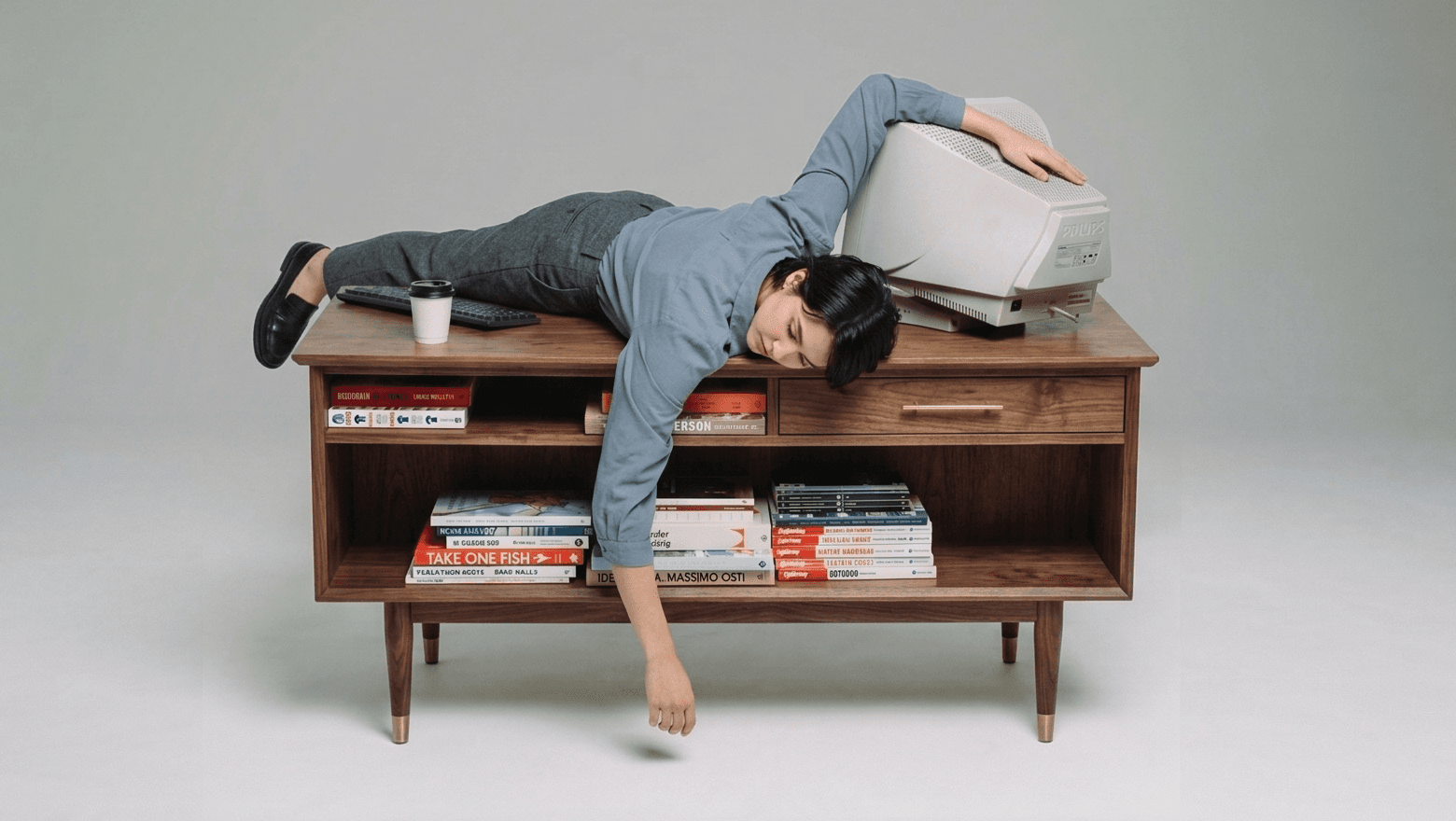
Simultaneous adaptation creates fragmentation. Production pressure consumes the cognitive flexibility you were supposed to be using for ideas. Repetitive production work, the resizing, the reformatting, the version-stamping, occupies the energy that should belong to thinking. The danger isn't difficulty. The danger is exhaustion through repetition while the ground underneath you keeps shifting.
At some point production stops supporting creativity and starts eroding it. Most teams hit that point and assume they need more discipline, more focus, more hustle. They don't. They need fewer simultaneous migrations.
Stable Production Infrastructure Becomes Strategic
Here's the part most leadership teams miss. In unstable ecosystems, stability is a competitive advantage. Not stagnation. Stability.
Teams don't necessarily need more tools. They need more stable operational layers underneath the tools. Production systems should reduce adaptation cost, not add to it. When the AI image generator changes, when the social platform adds a new aspect ratio, when the brand refresh hits mid-quarter, something in the stack has to hold still.
This is where Viewst fits. The repetitive mechanics of ad production, resizing across formats, adapting one concept into a hundred on-brand variations, scaling output without scaling chaos, sit in a stable layer. The designer stays at the level of decisions. The system carries the mechanics. If you're rebuilding the creative engine right now, our piece on design automation goes deeper on what that operational layer actually looks like in practice, and our Viewst vs Canva comparison breaks down where template tools stop being enough for serious production teams
How to Survive Perpetual Migration More Softly
A few things actually help. Not because they're clever, but because they respect how the brain works.
Don't rebuild entire workflows at once. Migrate one layer at a time and let it settle before you touch the next one. Preserve familiar anchors wherever you can, the file structures, the naming conventions, the review rituals that don't need to change just because the tool did. Reduce the number of simultaneous migrations on the team's plate at any given moment, even if the roadmap says otherwise.
Most importantly, separate creative thinking from repetitive mechanics. The thinking should sit with people. The mechanics should sit with systems. When those two get tangled, you get the burnout that nobody can quite explain on a Monday morning. Automate the banner resizing, automate the format adaptation, automate the on-brand version generation, and let the team spend its scarce cognitive flexibility on the work that actually requires a human.
The nervous system needs continuity inside movement. That's the whole game.
Final Thought
Stable digital environments may no longer exist, at least not in the way they did ten years ago. That's probably not coming back. The future belongs to people and teams who can remain cognitively whole inside changing systems.
The goal is no longer permanent stability. The goal is sustainable adaptability without fragmentation. Build the stable layers where you can. Protect the human ones. And stop apologizing for the fact that constant rebuilding is, in fact, expensive.

Steven Khuong is a GTM strategist and advisor focused on helping companies scale creative production and advertising systems using AI and automation. He has led growth initiatives across high-volume digital platforms, with a focus on turning fragmented creative workflows into structured, scalable systems that drive faster campaign execution and performance.
In this article
" height="11.060000000000002px" id="wzBCZ87AK" transform="translate(6.47 2.47)" width="6.590000000000003px"/></g></svg>)