Viewst is an ad production tool. Unlike traditional graphic editors with fully independent artboards, all ad sizes in a Viewst design are synced:
If you add an element to one size, it will be added to all other sizes in the set.
If you edit an element (e.g., replace an image, change a style, or edit text), it will change on all other sizes in the set.
If you delete an element from one size, it will be deleted everywhere.
Ad sets are similar to components in Figma: every size (instance) has unique properties, but they share common elements across the set. This allows you to create entire ad sets highly efficiently and apply changes to the whole set of banners in literally seconds. However, it requires a slightly different approach to working with banner sizes.
Here is a quick guide on how to make individual changes to specific sizes while set synchronization is active.
How to delete an element from a specific size
❌ Incorrect:
If you simply delete an unwanted element from the canvas, it will be deleted across all other sizes in the set.
✅ Correct:
To remove an element from just one banner, simply drag it outside the canvas borders. All elements located outside the canvas will be excluded from the export and will not appear on the final banner, but they will safely remain on your other creatives.
How to edit or replace an element on a specific size
❌ Incorrect:
If you edit an element directly (e.g., rewrite text, replace a photo, or change a button color), it will simultaneously change on all sizes in the set.
✅ Correct:
To edit an element on just one size, follow these steps:
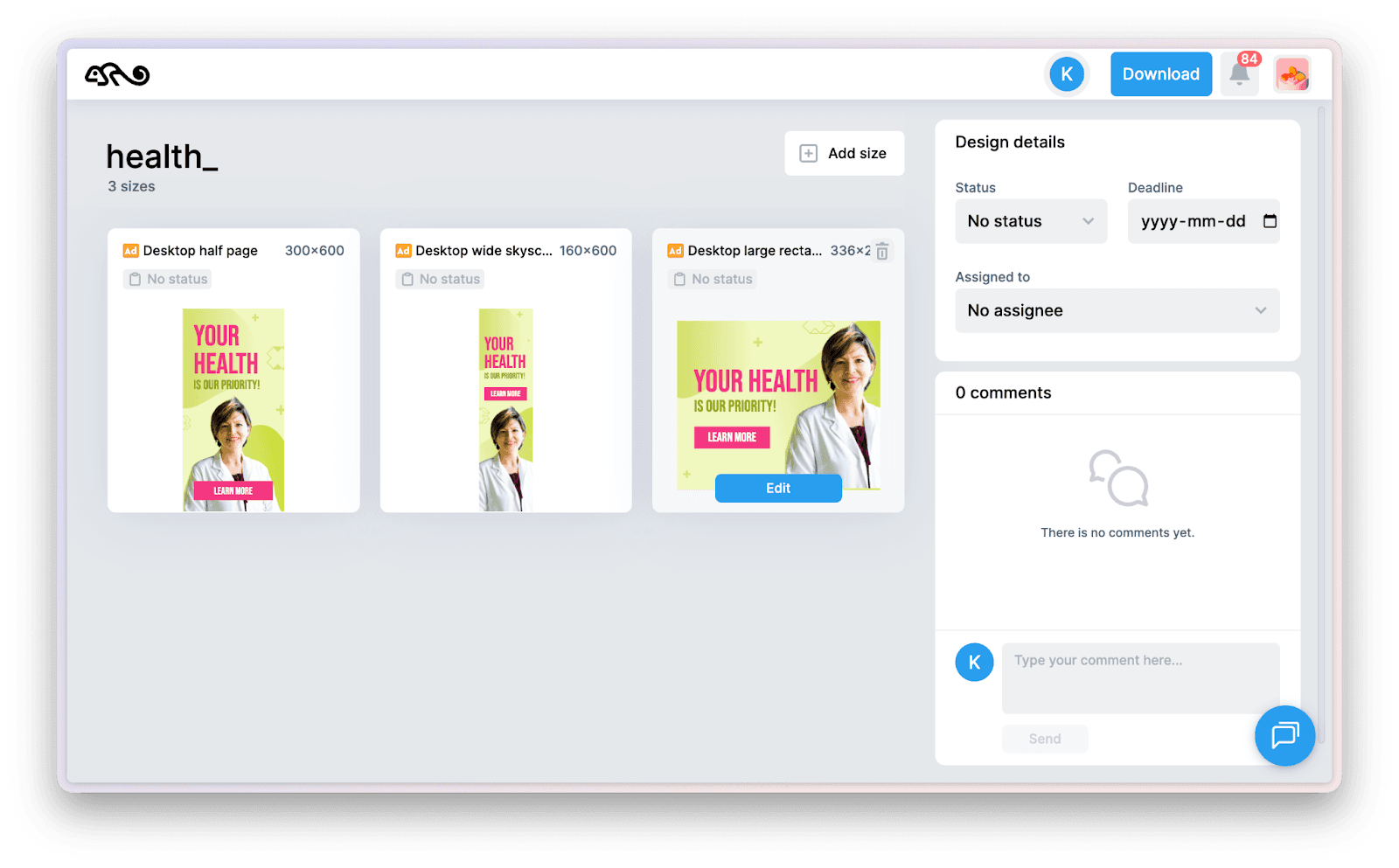
Open the specific size by clicking Edit.
Duplicate the element that needs to be different and make changes to the copy (e.g., replace image or text content, change color, etc.) or just add a new element. Do not edit the original element to prevent changes distribution to other sizes!
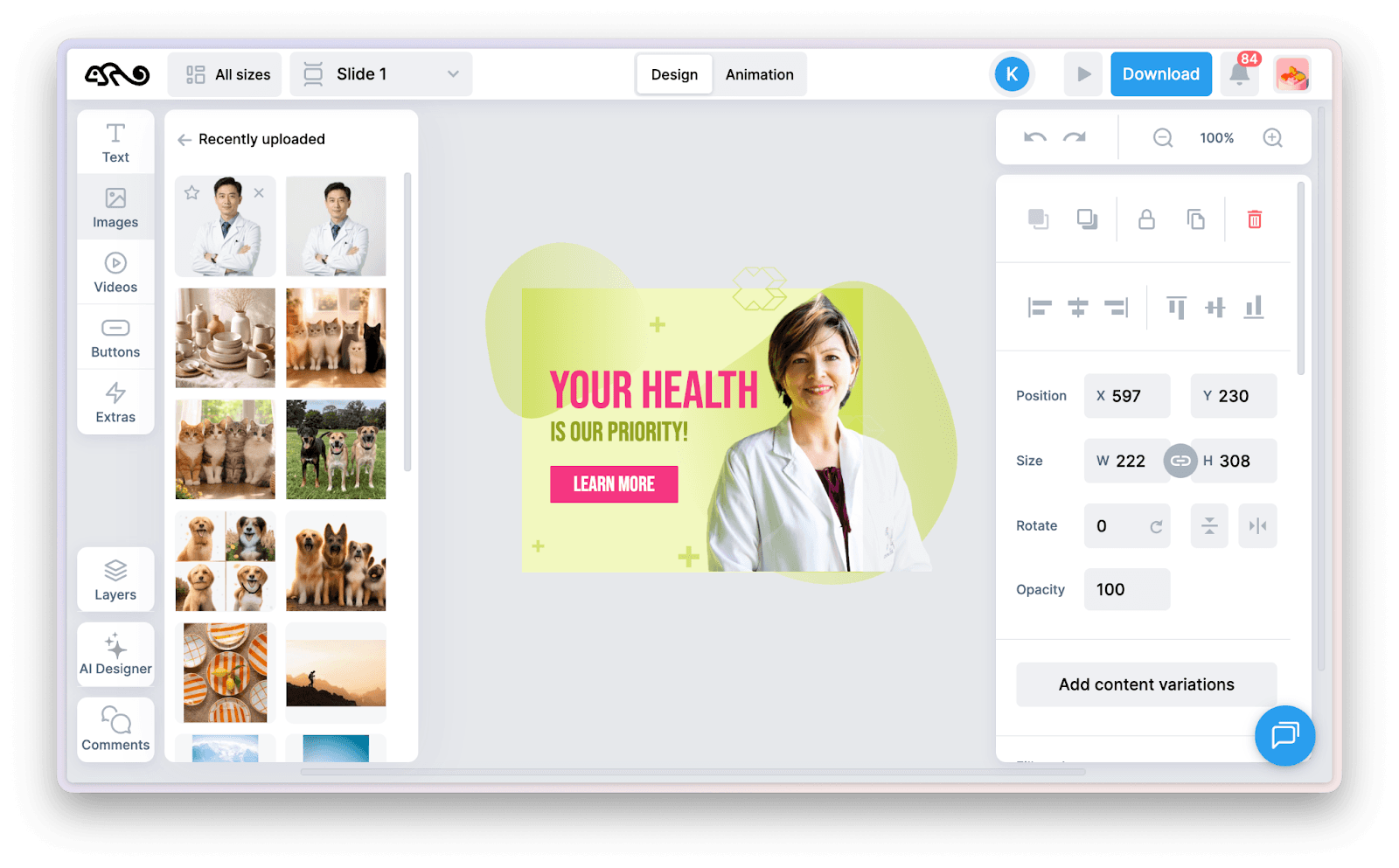
Drag the original element outside the canvas to hide it and exclude it from the export (just like the deletion case above).
Following the sync logic, the new element you added has now automatically appeared on all other sizes in the set. Review your other sizes and drag this new element outside the canvas wherever it is not needed.
How to add an element to a specific size
✅ Correct:
Open the size where you want the additional element to appear.
Add the element to the canvas.
Following the sync logic, this element is now added to all other sizes. Review the set and simply drag the new element outside the canvas on any sizes where it shouldn't appear.
Which style parameters sync and do not sync
Synced Parameters:
Element fill modes
Fill, shadow, border, and text colors
Opacity
Adding/deleting shadows (the presence of the shadow and its initial distribution upon adding)
Adding/deleting borders (the presence of the border and its initial distribution upon adding)
Adding/deleting corner rounding (the presence of the rounding and its initial distribution upon adding)
Image replacement
Content of text elements and CTAs
Font family and font style (+ initial distribution of all other parameters)
Constraint proportions toggle
Non-Synced Parameters:
Element position, size, rotation, and flip
Exact shadow size and offset
Exact border width
Exact corner rounding radius
Exact blur size
Text alignment
Font size
Line height
Letter spacing
Frequently asked questions
How does Viewst’s platform facilitate real-time collaboration between creative and media teams?
Viewst’s platform facilitates real-time collaboration between creative and media teams by providing a mutual workspace where they can seamlessly collaborate at the design step and are able to share comments and stay on the same page with all their mutual projects. The platform allows for quick and efficient collaboration, enabling teams to receive prompt data on each creative performance. This ongoing conversation and continuous flow of ideas and insights between designers and media buyers enhance understanding and collaboration between the two teams.
Can Viewst provide more details on how they establish attribution connections between Google Campaign Manager and various Demand-Side Platforms?
Viewst has achieved a significant breakthrough by successfully establishing attribution connections between Google Campaign Manager (CM) and various Demand-Side Platforms (DSPs). Through this integration, Viewst provides advertisers with immediate feedback on the effectiveness of their display ads. The platform’s proprietary algorithms correlate user interactions with creative variations across multiple channels, attributing conversions and engagement metrics directly to specific creative elements. This granular level of insight allows for rapid iteration and refinement of ad creatives, leading to improved campaign performance.
What specific features does Viewst offer to bridge the gap between creative and media teams and foster understanding and collaboration?
Viewst offers features, such as statuses for each creative and each ratio inside it, assignee, who is in charge of the project, deadline settings, preview sharing link to speed up and simplify approval process, data analytics of each creative performance, etc.The platform provides a home field for both creative and media teams, creating a space where everyone feels valued and can contribute their unique perspectives. It enables teams to iterate quickly, improve creatives, and speed up go-to-market. With Viewst, collaboration is not a one-off handoff but an ongoing conversation, allowing for a continuous flow of ideas and insights. This fosters a comprehensive understanding of consumer behavior and facilitates data-driven design decisions, resulting in exceptional user experiences.